
要点
- IBM Research / HF (2026-11-03): Palette—~20B + LoRA with designer/coder roles for IBM Design Language decks; per-slide coding ~6–7× parallel.
- Data: ~1000 decks / 10k slides teacher-synthesized; counterfactual rationales; checker repairs; reference decks beat rule-stacking for faithfulness; 12 [[directive]] categories.
- PresentBench: first on Economics/Education, third on Talk, second on three-domain mean (59.7 vs NotebookLM 60.8); harness +3.5 avg on 131 decks.
- Authors note no benchmark yet for design-language fidelity; next: RL on checker signals, figure placement, few-shot re-skin.
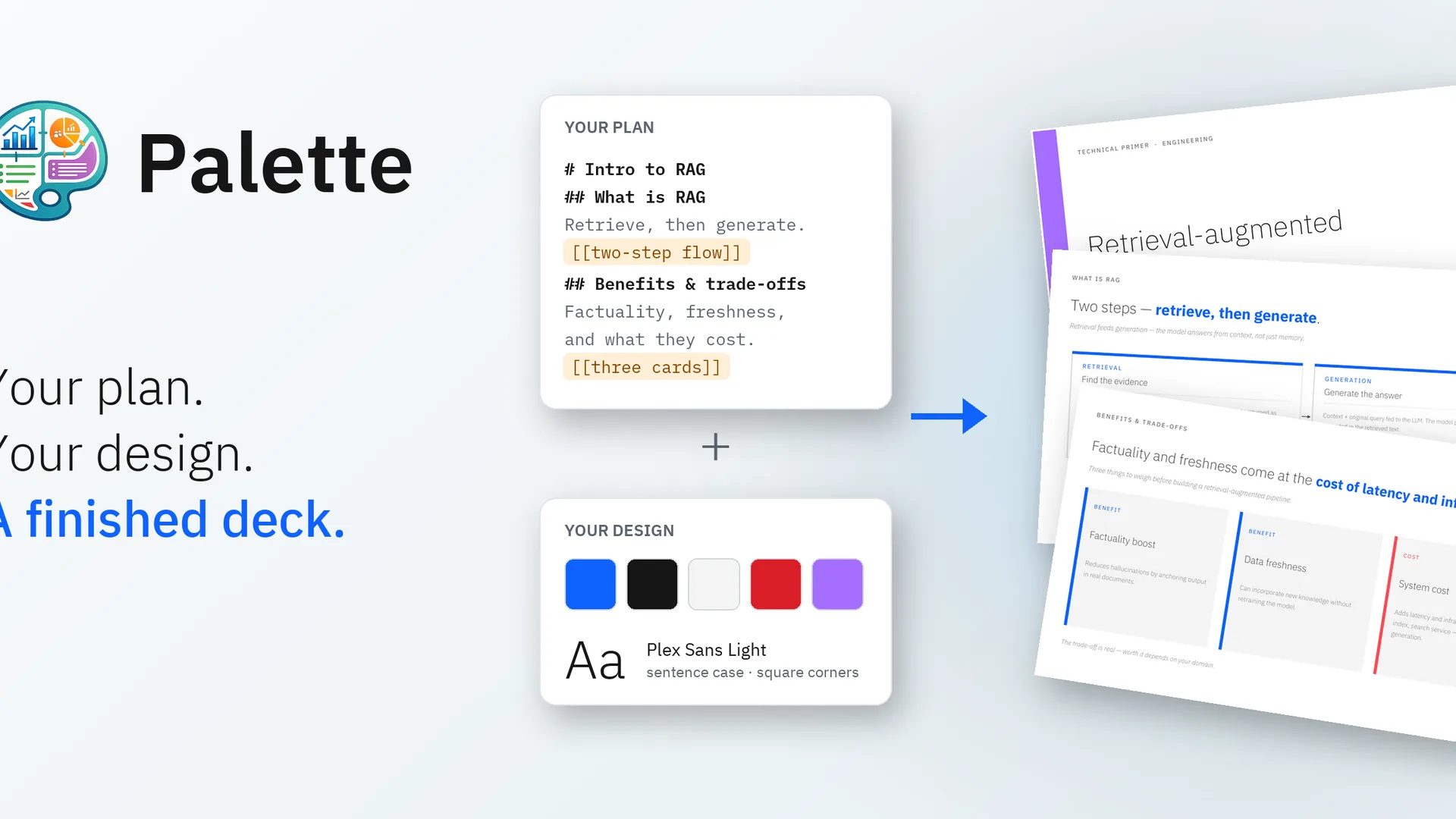
IBM Research’s 3 November 2026 Hugging Face post introduces Palette: a ~20B open-weight LoRA stack that builds slide decks in a owned design language and is scored on PresentBench against frontier systems.
Thesis: “make it look like our template” is not a prompting problem; after a designer/coder split, counterfactual synthetic data, and a check-and-repair harness that keeps edits only when they help, a small owned model can lead structured PresentBench domains—while weights stay in-house.
[1]What shipped
Small models routinely emit overlaps, overflow, and vanishing titles. Palette mirrors human workflow with two roles on one LoRA: a designer emits a JSON brief (palette, type, per-slide layout + rationale); a coder writes pptxgenjs per slide, parallelizable ~6–7×. Roughly 1000 decks / 10,000 slides are teacher-synthesized; traces are counterfactual (why not a table). The same geometry checker used at inference repairs broken slides and rewrites rationales. Faithfulness improved more from reference decks than from stacked prompt rules. [[directives]] span 12 control categories.
How hard is the evidence
PresentBench scores fundamentals, visual design, completeness, correctness, fidelity. Palette ranks first on Economics and Education, third on Talk, and second on the three-domain mean (59.7 vs NotebookLM 60.8), ahead of the rest of the reported field. On 131 decks, the harness adds +3.5 points on average; rewrites keep only when the checker confirms improvement.
The authors note PresentBench does not measure obedience to a specific design language—the product claim still lacks a dedicated benchmark.
[1]Steelman and gaps
Steelman: frontier house style drifts; confidential decks cannot leave the perimeter; packaging checkable geometry into data and a harness is a method that transfers to charts/UI, not only a demo.
Gaps: plans are drafted by a separate frontier model from source docs, so Palette consumes plans not raw documents; training is on IBM Design Language; Talk lag shows narrative decks remain harder; teacher synthesis can imprint style bias.
[1]Who pays, what to watch
Enterprise design systems and internal tooling pay first: rather than coaxing API models to “look like us,” own a small adapter plus a falsifiable checker. Next steps the authors flag: GRPO-style RL on the same signals, Docling figure placement, and few-shot re-skinning without full retrain.
[1]Close
The defensible sentence: on program-checkable layout tasks, a small open model + counterfactual synthetic data + safe repair can lead structured PresentBench domains without leaving design language to prompt luck. It does not yet prove zero-shot brand transfer or parity on speech-driven Talk decks.
[1]