
要点
- On 5 Nov 2026 PFN open-weighted PLaMo 3 Translate on Hugging Face in four sizes — 0.8B, 2B, 8B, 31B — covering 53 languages including Japanese and English.
- Under the PLaMo Community License, individuals and firms with revenue at or below ¥1 billion in the latest fiscal year may use the models free on edge devices for commercial and non-commercial work (same-day correction).
- Quality comparisons are PFN’s own and claim even the smallest size beats Google’s TranslateGemma and Tencent’s Hy-MT2. The falsifiable claim is open-weight edge deployment plus independent reruns, not “world-class” wording.
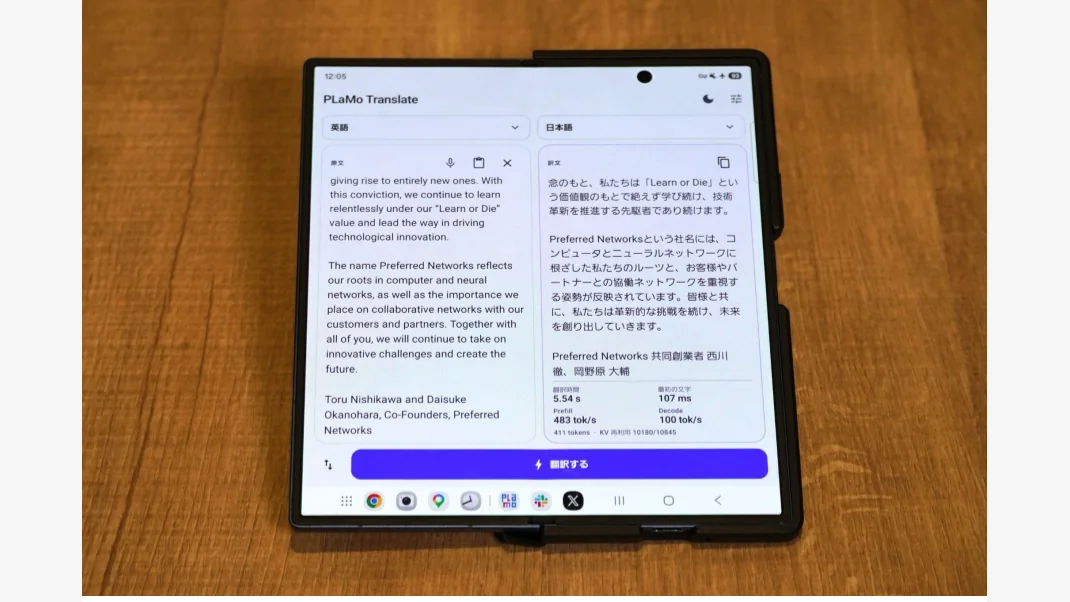
Preferred Networks (PFN) said on 5 Nov 2026 that PLaMo 3 Translate — the translation-specialized models behind its PLaMo Translate service — is now open-weight on Hugging Face. Four sizes run from 0.8B to 31B. The pitch is offline inference on phones, laptops, or internal servers, so source and target text need not leave for an external cloud.
The falsifiable reading should strip “world-class” from the headline. If the Community License revenue gate cannot be checked in practice, or independent evals cannot reproduce the self-reported ranking that the smallest size beats TranslateGemma and Hy-MT2, discount the quality extrapolation and keep only the product fact: open weights that can run on the edge.
[1]Hard facts (PFN Japanese/English release, 5 Nov 2026, including the 11:45 same-day correction):
- Model: PLaMo 3 Translate, translation-specialized; built by PFN on PLaMo 3 NICT, a pretrained base from joint work with Japan’s NICT.
- Sizes: 0.8B, 2B, 8B, 31B; said to cover 53 languages including Japanese and English.
- License: under the PLaMo Community License, individuals and enterprises with revenue of ¥1 billion or less in the latest fiscal year may download and use the models free on edge devices for commercial and non-commercial use; larger commercial use needs a separate PFN license.
- Controls: surrounding context and glossaries for proper nouns and terms; when translating into Japanese, formal (desu/masu) or plain (da/dearu) style can be specified.
- Self-eval: PFN says even the smallest model scores above Google’s TranslateGemma and Tencent’s Hy-MT2 on its comparisons (including proprietary benchmarks); charts plot size on a log x-axis against a quality score.
- Access: Hugging Face repos such as pfnet/plamo-3-translate-0.8b returned HTTP 200 in this round’s check.
Evidence strength: first-party corporate release plus a public weights entry point. The quality curves and “beats TranslateGemma / Hy-MT2” claim are PFN’s own, explicitly including proprietary benchmarks — not a third-party blind study. The edge demo is an official airplane-mode phone run of the 0.8B model at stated demo settings.
Mechanically, open translation weights turn “data stays in-house” from a policy line into an installable artifact: contracts, R&D notes, and support logs can stay on machines the buyer controls. Four sizes let buyers choose physically between phone latency and server quality instead of only picking a cloud API.
Steelman: if 0.8B stays usable on public Japanese–English and multilingual protocols, and the Community License is workable for smaller organizations, that matters more for regulated local deployment than another cloud MT endpoint.
[1][2]Strongest steelman: tying translation specialization to edge sizes targets confidentiality constraints common in Japanese enterprise work; glossary and sentence-ending controls aim at real documents, not chat demos.
Steelman risks: “world-class” is marketing comparative; the test objects are public tables and third-party reruns. How the ¥1B revenue gate is verified, and how group consolidation counts, is not operationalized in the release. Open weights are not unlimited commercial rights above the threshold. Self-evals may skew Japanese-centric or toward PFN’s internal mix. This round could not open the linked Tech Blog deep-dive (lookup path 404); development detail rests on the release and HF pages.
[1]For privacy and legal teams, the six-month checks are whether on-prem installs truly cut egress, and whether Community License audit terms clear procurement. For engineers, watch token throughput of 0.8B/2B on target phone silicon and glossary adherence. For eval readers, wait for independent Japanese–English and multilingual reruns before accepting the “smallest size already beats TranslateGemma / Hy-MT2” ranking.
[1]The news core of PLaMo 3 Translate is open downloadable translation weights, edge-runnable sizes, and free commercial use inside the Community License for smaller organizations. The falsifiable focus should be whether the license gate is operable and whether PFN’s self-ranked ordering survives independent reruns. Park “world-class” in the headline; what matters is whether open-weight edge MT shows up in real workflows.
【No.2】
[1]