
要点
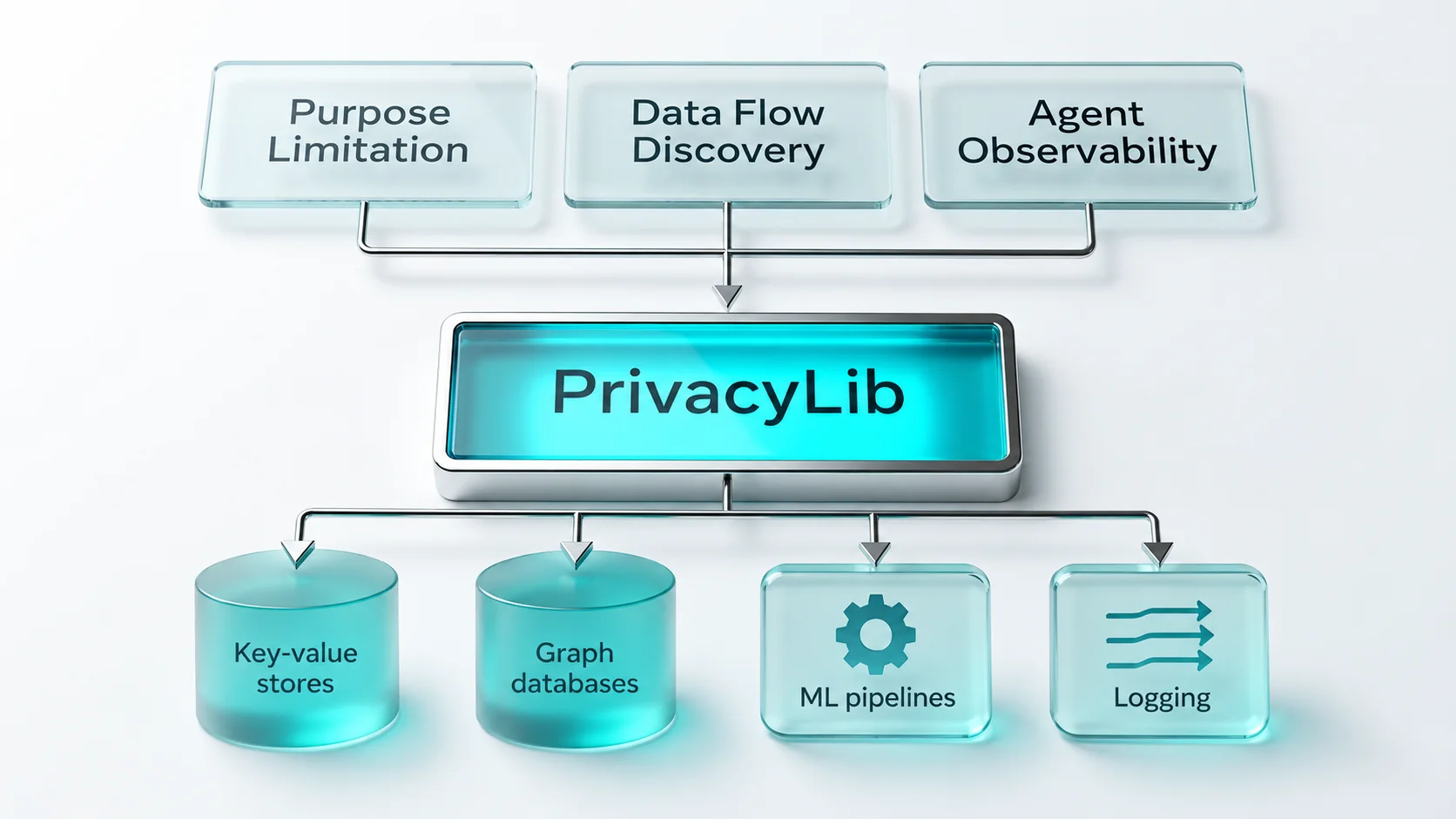
- PrivacyLib sits inside clients of hundreds of data/processing systems: integrate once, plug privacy capabilities in as modules; billions of checks per second claimed.
- For internal AI agents, tool-call paths may be unknown at build time; AgentLib attaches session context and propagates it to PrivacyLib, where modules such as Policy Zones observe and block.
- Lessons from live incidents: bad configs crashed processes; annotation changes rewrote access decisions—reliability and per-service rollback are the price of hot-path trust.
On 27 October 2026 Meta Engineering published a deep dive on PrivacyLib, part of its Privacy Aware Infrastructure (PAI) series. The governing question is blunt: can you prove data goes only where it is allowed?
For internal AI agents, the answer is no longer a per-agent allowlist of systems. The post states that tool-call paths may not be known in advance; so agent context is carried to a shared data-access boundary, where PrivacyLib modules observe and block disallowed operations. That is a bet that agent safety must be infrastructure enforcement, not application-layer intent.
[1]Historically each privacy requirement was re-implemented in each system’s clients—new requirements could take months across the fleet. PrivacyLib splits system integration from requirement implementation: integrate each system once; ship requirements that can be met at access time as shared modules. Enforcing modules can block (e.g. Policy Zones for purpose limitation); observing modules only record (e.g. Privacy Probes for data-flow discovery). When internal AI agents became a new access mode, an Agent Observability module landed on already-integrated systems without another integration project.
Scale claims: 100+ libraries for data-service access, thousands of production service versions, millions of assets accessed daily, billions of checks per second. Engineering answers coverage (typed clients plus remaining RPC network boundaries), scale (compile requirements at build time; in-process caches avoid network on the common path), and reliability (roll with each owning service’s pipeline, not a fleet-wide config push). A Messenger backend walkthrough shows Logger invoking Policy Zones before writing messaging metadata to warehouse tables.
[1]The agent section is the piece with the most external spillover. AgentLib is a common runtime on PrivacyLib’s design principles: on supported paths it associates each tool call with an agent session; downstream clients and services propagate that context until a PrivacyLib-integrated system is reached. At the boundary the library combines context, operation and destination annotations for module decisions. Agent Observability records session and tool-call IDs with destination, client API, integration point and errors. Policy Zones is reused without modification on enabled paths: even when an agent picks a tool its developer did not anticipate, the access decision does not depend on the agent behaving as intended.
Looking forward, Meta names harder problems next: evaluating internal agent behavior while it happens, and multi-agent communication where a single access may be several agents removed from the human who asked. PrivacyLib-style controls are also being extended toward AI training-data paths.
[1]Steelman: this is a company engineering blog—architecture intent plus selected incident lessons, not an independent audit; “supported paths” implies unsupported tool chains may still bypass; Policy Zones + annotations inherit annotation correctness, and the post itself admits annotation changes once caused product failures, so boundary enforcement can amplify bad policy.
Still thin: share of tools/services under AgentLib; block vs false-positive rates; quantitative comparison versus per-agent allowlists; whether any of this ships outside Meta or is narrative-only. Confidence in the mechanism description is medium-high (concrete, includes failures); confidence that every large lab should adopt the same boundary pattern is medium.
[1]For enterprises wiring coding/ops agents into production data planes, the debate shifts from “prompt the model not to touch sensitive tables” to “when tool paths are unknown, policy must live in the data client.” For privacy and security teams, modularity means new requirements should prefer reusable enforce/observe modules over a hundred system projects. For regulators, PAI offers a template for “proof embedded in infrastructure”—while pushing accountability onto annotation quality and coverage that can still drift.
[1]Watch three things over six months: whether AgentLib coverage expands from “supported paths” to a measurable default; how multi-agent chained access is attributed in policy; and whether peers keep shipping application-layer allowlists—or start reporting the same class of modules at shared data clients.
[1]