
Alibaba did not lead with a flagship name. It opened the next-generation skeleton.
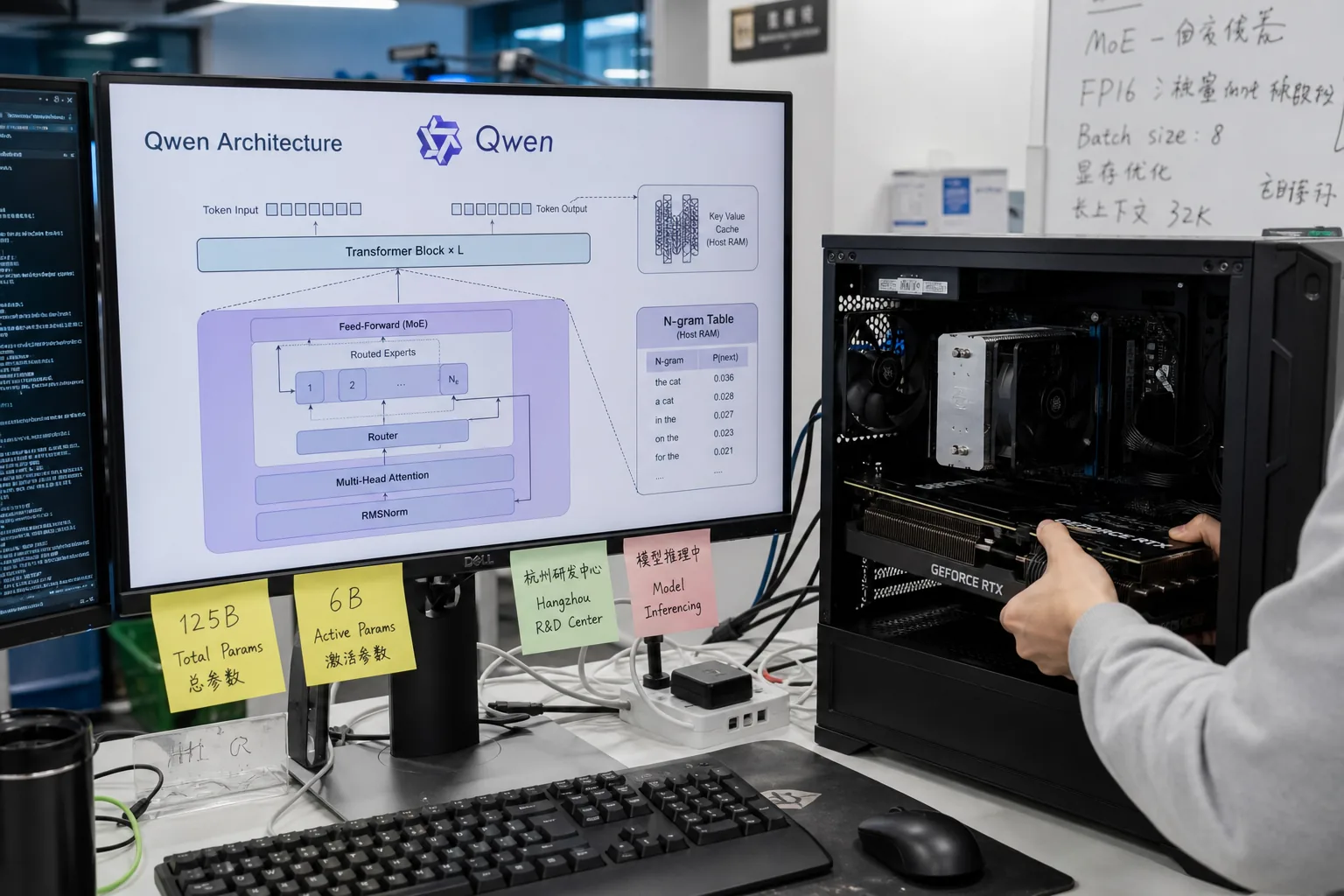
Qwen3.8-Flash-Next is an open-weight multimodal MoE: about 125B total parameters, roughly 6B active per token, plus a 51B N-gram embedding table. The team calls it an early preview of the architecture destined for Qwen4—the same role Qwen3-Next played for the 3.5 line. Four moves: Gated DeltaNet to compress history plus Qwen Sparse Attention over micro-blocks; gated residuals that widen the residual stream into four branches; N-gram embeddings that can sit in host memory and prefetch asynchronously; and a Muon-centered optimizer with a refit scaling law that drops batch-size warmup (claimed ~18.8% fewer optimizer steps). Versus Qwen3.7-Plus (~397B / 17B active), active compute is roughly a third; training cost is claimed near 1/9. Native context is 262K, extensible to 1M with YaRN.
TNW’s sharper read: designing for memory-short accelerators sounds like export-control realism. The qwen-community licence may not earn the EU AI Act’s open-source exemption—European buyers inherit that ambiguity.
Take: The real product is an early architecture contract—months for inference stacks to adapt, months for the community to stress-test. Treat self-reported harness numbers as marketing, not gospel. If parking capacity in host RAM holds up under real agent workloads, that changes who can run long-context agents locally more than another 400B fully-active poster does.
[1][2]