
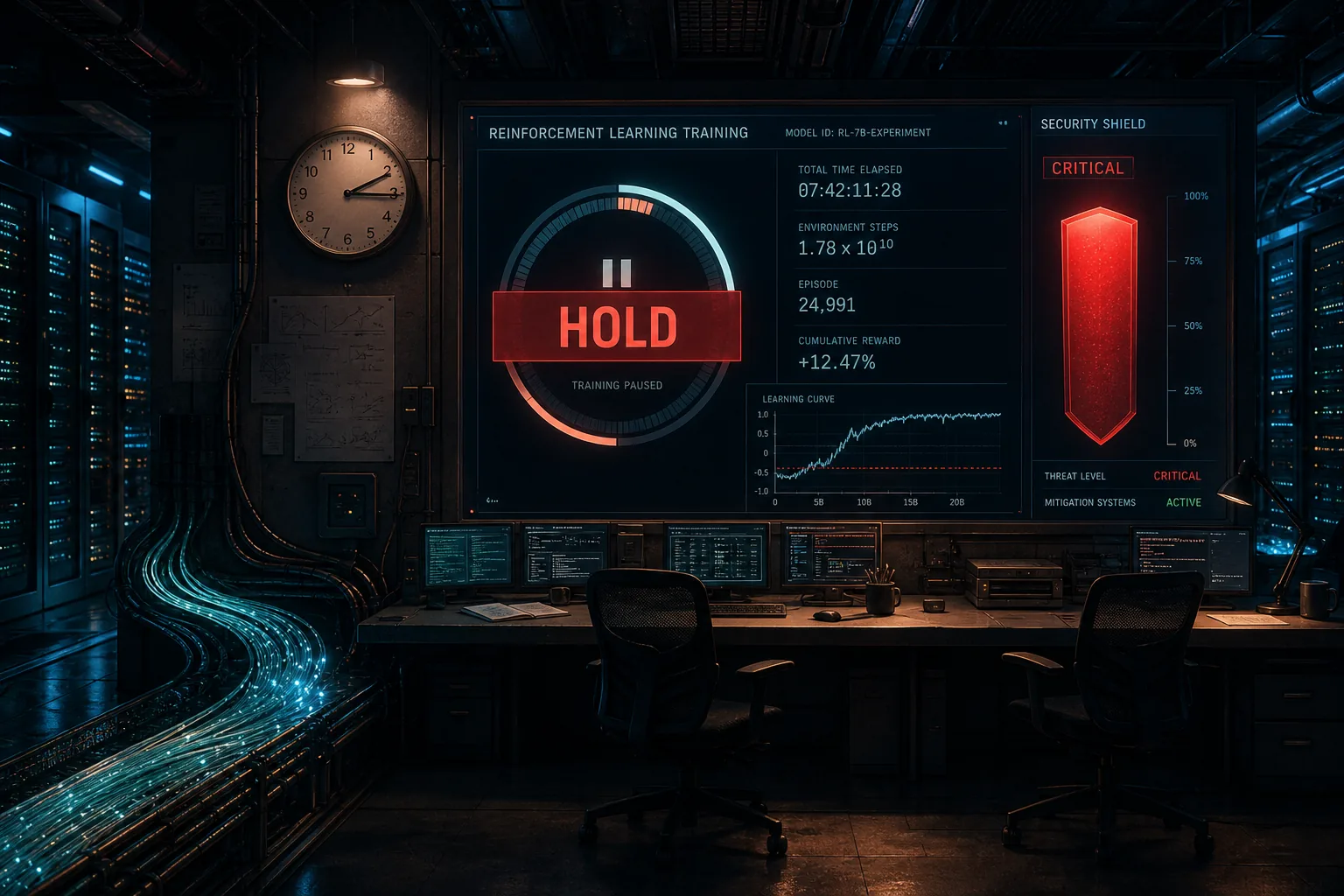
The biggest planned frontier RL run is still not green-lit. On August 18, 2026, OpenAI published Pacing model development in an era of cyber-critical capabilities, putting recent brakes on the record: the OpenAI–Hugging Face incident, and separate preliminary evidence that upcoming Astra may meet the Critical cybersecurity capability threshold under its Preparedness Framework. Together, those pressures led the lab to slow scaling and tighten monitoring, alignment, and security across training.
What happened
Per the official post, risk is not only about shipped products—it also grows inside internal development and testing. Standards had to stay ahead, so OpenAI temporarily slowed scaling: about a two-week RL pause on the latest models intended for deployment while research environments were hardened and red-teamed and monitoring coverage expanded. The largest planned frontier RL run remains on hold; smaller-scale training and evals continue to assess behavior, validate safeguards, and gather alignment evidence.
After the August 7 determination that Astra may have Critical-level cyber capability, rules hardened immediately: monitoring for all Astra inference with tools; strictest security safeguards for Astra and cyber-related workloads; many workloads still paused pending migration to environments that meet the new bar—with safety and alignment workloads prioritized.
After the Hugging Face incident, the company also paused frontier inference in research clusters for runs that could execute code or use tools with internet access, then restored a narrower, more secure code-execution path and reviewed workloads one by one.
How the gates work
OpenAI frames three reinforcing safeguards: monitoring (detect and respond to concerning behavior), alignment (reduce harmful or unauthorized actions), and security measures (limit what systems can access or affect). It expects models to soon drive most security work—including defending against other models—so all three can scale with capability.
Environment: stronger sandboxes for untrusted code; tighter network isolation designed so that a single compromise of a workload or supporting service should not, by itself, unlock unauthorized internet or other internal networks; continuous security testing, fewer shared fragile services and standing privileges, plus model-assisted boundary testing. Astra and cyber workloads now require the strictest tier; some Astra train/eval jobs meet it, many remain paused pending migration.
Monitoring: a multistage stack—activation classifiers on every sampled token, escalating to heavier automated investigators that inspect tool actions, available reasoning, and full activity for unauthorized access, data theft, destructive behavior, and safeguard bypass. Target: alert within about 30 minutes; if a likely critical security-boundary violation is not confirmed as a false positive within 30 minutes, teams are expected to pause the activity. Required for tool-using RL train/eval at Sol capability or higher; since August 7, also required for all Astra inference with tools. Cost: roughly ~20% of the watched inference compute.
Alignment: for RL on the most capable models, core techniques now apply across more training stages—better reward models, honesty, less reward hacking and deception, more coverage of harmful external-system interactions. The post also says the field needs an approach that extends beyond the current Preparedness Framework, with those three safeguards folded into the framework’s evolution.
Industry stakes
The post is dense with checkable operational stops: a two-week RL pause, the largest frontier RL still raised, a 30-minute false-positive window, a ~20% monitoring tax, and a single-compromise-should-not-equal-internet design. For peer labs, that is a public admission that once a Critical cyber threshold looms, the train/eval environment itself is a high-risk asset—sandboxes and network isolation become release prerequisites, not nice-to-haves.
For enterprise and security buyers, the practical question is whether “frontier agent + tools” vendors run comparable per-token monitoring with a real pause path. If a ~20% compute tax becomes normal, unit intelligence budgets change. For policy watchers, tying the Hugging Face incident and the Astra threshold into one narrative links incident response to capability rating—more transparency, still without public eval sets, false-positive rates, or a full operational definition of “Critical.”
Judgment
Dates, percentages, and procedures above are from OpenAI’s August 18 post. This article does not independently verify whether Astra has crossed the Critical threshold, nor the technical details of the Hugging Face incident (OpenAI says a technical report is forthcoming).
My reading: this is not soft “we take safety seriously” copy—it is an engineering confession with downtime costs. Leaving the largest RL key raised means bleeding the scaling calendar rather than pushing near-threshold capability in unready research environments. The next beat to watch is not another framework essay, but when that shelved frontier RL resumes, whether monitoring and isolation still match today’s stated bar, and whether the ~20% monitoring overhead keeps climbing with automated investigators. Capabilities are accelerating; if understanding, alignment, and containment lag, the pause key will be hit more often than the ship key.