
要点
- FoundationWorlds pair a controlled simulated environment with automatic task and demo generation and with metrics over time. ToyBlocks is the first: an arm and blocks on a table, building on MolmoAct 2, MolmoBot, and MolmoSpaces.
- Demonstrations are generated without a person remotely driving the robot. Skills are trained with reinforcement learning and motion planning in Nvidia Isaac Lab, then sequenced by a task-and-motion planner. Hundreds of plans run in parallel on one GPU, up to 24 times real time.
- Initial public release: 85,336 long-horizon demonstrations, about 6 to 12 skills each, nearly 1,600 hours of execution, 144 million frames, plus training and evaluation code.
- Vision-language-action models (ManiFlow, π0.5, MolmoAct 2) generalized poorly on spatial interpolation and extrapolation in the authors' initial results, despite large-scale pretraining.
- ManiFlow atomic skills succeeded in 80.0% of simulation trials and 81.1% on a Franka FR3 with a Robotiq gripper. Hierarchical Molmo 2 plus ManiFlow three-block spelling succeeded in 55.5% of simulation episodes (111/200) and 50.0% of real episodes (15/30), on the easiest scene setup. A Claude Opus 5.5 agent solved or correctly called infeasible 63% of search-and-spell tasks.
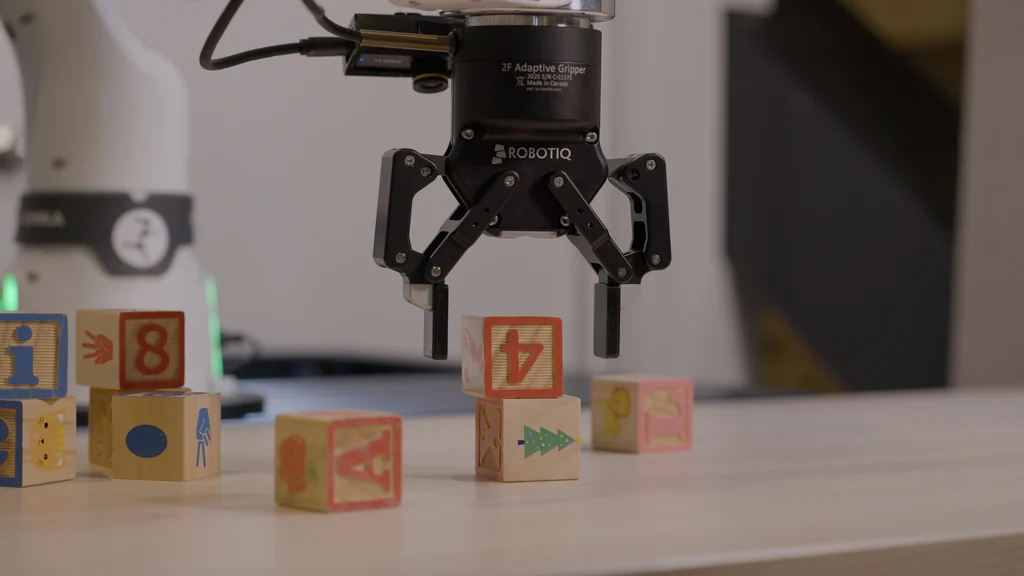
On 6 November 2026 the Allen Institute for AI introduced ToyBlocks, an open simulation built around a robot arm and wooden blocks on a table. The post is not selling another laundry-folding clip. It argues that robot learning still lacks the kind of small, repeatable world that a biologist would call a petri dish: a place where you can change the training data or the model, rerun the test, and say why the robot failed.
[1]What shipped
Ai2 calls that class of environments FoundationWorlds. Each one pairs a controlled simulated setting with tools that automatically generate tasks and training demonstrations, and with metrics that track behavior over time. ToyBlocks is the first. The tabletop looks simple, but the robot must push, flip, and stack while reading pictures and letters on the faces of the blocks. A block may need to be turned before the robot knows where it belongs. Scene properties such as block size and table height can be varied so that tests measure more than memorized layouts.
The data pipeline is the practical claim. Short skills, including pushing a block or flipping it onto another face without picking it up, are trained in Isaac Lab. The simulator can supply privileged facts a real robot would not have, such as a block's exact pose, which makes skills that would otherwise need teleoperation cheaper to generate. A task-and-motion planner then selects and sequences those skills. Running the plans in simulation produces labeled demonstrations. Ai2 says this scales to hundreds of plans in parallel on a single GPU, at up to 24 times real time.
High-level models decide what to do. Low-level action models move the arm. Evaluation reports more than success or failure. The same specifications used by the planner also report execution speed, forces on objects, and task progress. A web interface can connect Claude or another frontier model so that people without a robotics background can give natural-language instructions and watch the plan.
The first data drop is sized as a proof point: 85,336 long-horizon demonstrations, each about 6 to 12 skills, nearly 1,600 hours, and 144 million frames. Simulation assets, generators, two trained models based on Molmo 2 and ManiFlow, training code, and evaluation sets are being released. A larger dataset, more skills, fuller benchmarks, and integrated reinforcement-learning training are promised in a few weeks.
[1]Evidence on the table
The authors use the world to ask several separate questions.
On low-level action models, they test how vision-language-action systems map instructions and camera images to motion. They cite conflicting prior claims: some studies find these models brittle to layout and lighting changes, others find broad generalization, often from real-world datasets that cannot vary space cleanly. In ToyBlocks they vary skill sequences, letters and colors, and the number of blocks. They distinguish interpolation, meaning new layouts inside the training range, from extrapolation, meaning layouts beyond it, such as training stacks of height 2 and 5 and testing heights 3 and 4, or training objects on the left of the table and testing the right. Using ManiFlow, π0.5, and MolmoAct 2, they report that these popular action models generalize poorly in the initial results, then improve after extra adaptation, including low-rank updates. They conclude that action-model generalization is far from solved.
On long-horizon planning they pair Molmo 2 as a high-level planner with ManiFlow or a motion planner underneath. An example task is stacking blocks to spell "Ai2". Difficulty rises from characters that start upright and facing the camera, to characters that may not be upright, to characters that are hidden at the start.
On frontier agents they study three settings with Claude Opus 5.5, exposing ToyBlocks skills through the Model Context Protocol. For classical block-stacking the agent solved all 30 tasks from text descriptions, and all 30 again when it watched camera images and chose actions in a closed loop. In search-and-spell it had to build three-letter words from up to eight blocks, and in half the scenes a required letter was missing, so the correct act was to say the task was impossible. The agent solved the task or correctly declared it infeasible 63% of the time. Errors were mostly look-alike letters (13%) or a wrong letter orientation in the stack (15%). Patterned blocks, whose hidden faces can be inferred, let the agent inspect fewer faces before deciding. In a third setting the agent wrote its own skill descriptions after running tests. Those learned descriptions raised success from 24% with the default text to 63%, above the 36% reached with descriptions written by a human expert.
They also probe action-conditioned world models as stand-ins for a physics simulator: Wan 2.2, a 5-billion-parameter video model; Astra, an agent that built its own physics simulator to match demonstrations; and LeWM, a latent world model. Each skill (pick-and-place, flip, rotate, and a mixed task) had 900 trajectories, half successful and half unsuccessful, so a model that always predicted success would be right only half the time. Wan 2.2 predicted block motion and task outcomes most accurately. Astra tracked the gripper well but struggled with contact. LeWM was stronger on short segments and drifted over full trajectories. Adding 100 rollouts from the best video model raised a policy's success in an unseen region from 19% to 78%.
The transfer numbers are the ones a skeptical reader will remember. Models trained only in ToyBlocks were run zero-shot on a Franka FR3 with a Robotiq gripper across thirty scenes of 4 to 10 familiar blocks. Success required moving the relevant blocks to target poses without collisions. An operator stop for an unsafe motion counted as failure. ManiFlow's atomic skills (pick, place, flip, rotate) succeeded in 80.0% of simulation trials and 81.1% of real ones. The hierarchical Molmo 2 plus ManiFlow system succeeded in 55.5% of simulated spelling episodes (111 of 200) and 50.0% of real episodes (15 of 30). The real hierarchical tests used the easiest simulation configuration, with characters visible and upright. The authors say more trials are needed for statistical confidence.
[1]Steelman and gaps
Steelman. Laundry-folding videos show that a robot can look capable without telling you what it learned. If you cannot vary the training mix, hold out tasks, and separate a bad plan from a bad grasp, you are collecting anecdotes. A narrow world that still demands reasoning plus dexterity is a fair scientific bet, the same way Hodgkin-Huxley started with one axon. Automatic demonstration generation removes the bottleneck of scarce human teleoperation. Close sim-to-real rates on atomic skills suggest the petri dish is not a fantasy, at least for this tabletop.
Gaps. The VLA spatial result is described as poor initial generalization, but the prose does not publish a full numeric table for every model and split in the blog text. Hierarchical real-world spelling is 15 of 30 trials on the easiest setup; the authors themselves ask for more trials. Claude Opus 5.5's 63% search-and-spell score includes "correctly infeasible" as success, which is the right scoring rule and also makes the headline gentler than a solve-only rate. World-model comparisons use one fine-tuning diet of 900 trajectories per skill. A later release is still to come with more data, more skills, two-arm work, dexterous hands, and pile play. ToyBlocks cannot, by design, settle questions about laundry, kitchens, or streets.
[1]Who should care, and what to watch
Labs training vision-language-action models, teams that sell "generalist" robot policies, and anyone funding embodied AI as if more unscripted demos were the same thing as a learning curve. Watch over six months: whether other groups reproduce the spatial interpolation and extrapolation splits; whether the promised larger dataset and integrated RL training arrive; whether hierarchical spelling success on harder hidden-letter scenes closes the gap with atomic skills; and whether outside labs treat FoundationWorlds as a pattern, not a single Ai2 repo.
[1]Close
The durable claim is not that wooden blocks are the future of housework. It is that robot learning stays a demo reel until failure can be traced to the training mix, the planner, or the motor skill, and until those traces survive contact with a real arm. Six months on, either controlled worlds like ToyBlocks become a normal way to argue about generalization, or the field will still be comparing highlight videos that cannot say why the next layout failed.
[1]