
Frontier models are too expensive; small models too weak. This is the practical dilemma of enterprise AI agents — and a Salesforce AI paper submitted on September 8 offers a counterintuitive but highly actionable answer: pair a weak model with an automatically evolved "harness" and it closes much of the gap to frontier models; but if you then have it directly imitate an expert model's complete trajectories, scores regress on all seven tasks by 4 to 30 points. The real fix is not "copying the homework" but "asking the expert to rewrite only the single step where the student went wrong."
The title says it plainly: "Co-Evolving Harnesses and Models: On-Policy Correction Helps Weaker Models Catch Up Where Imitation Fails."
[1]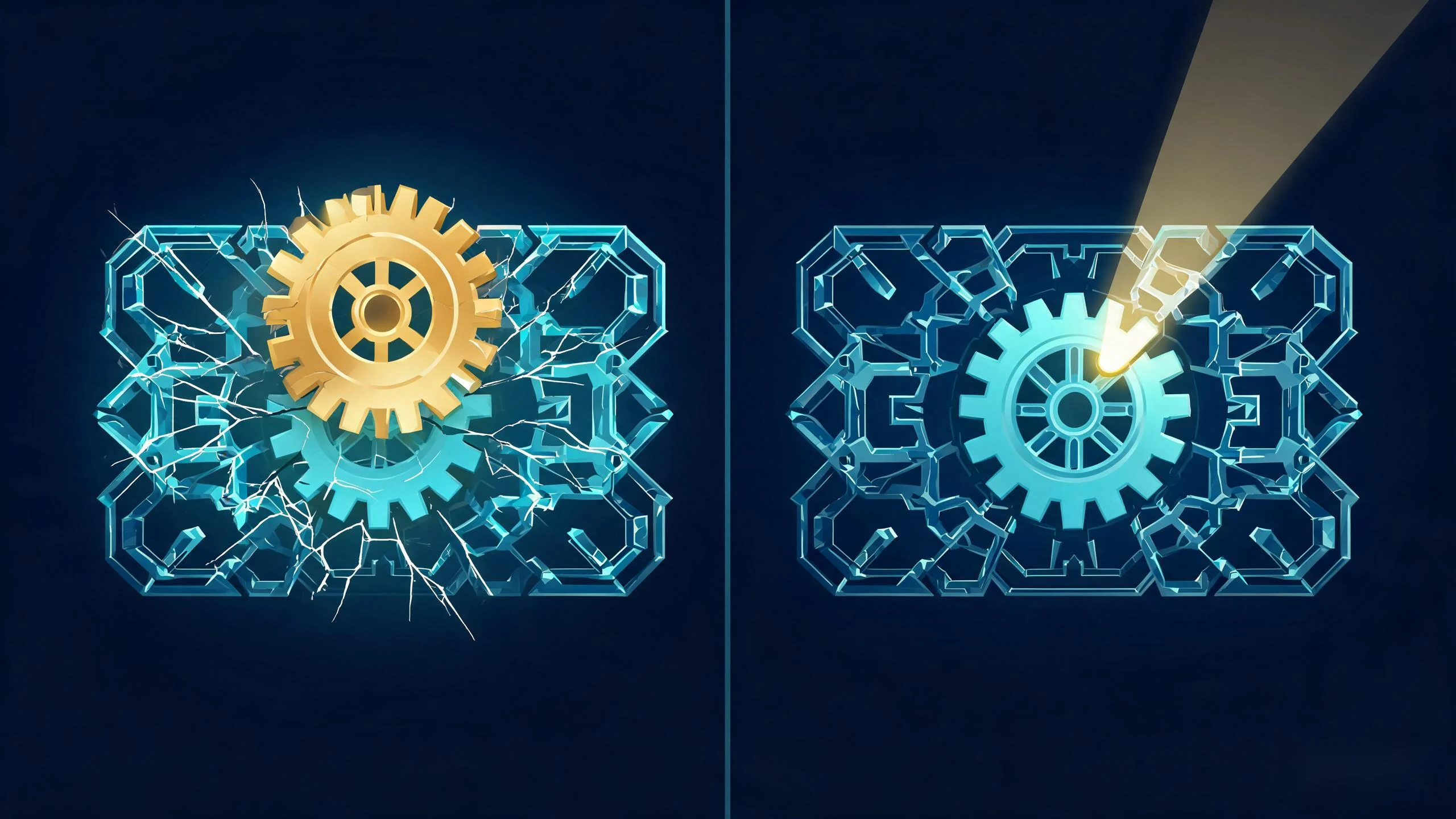
Setup: seven enterprise tasks, two model families
The study adopts the seven objectively verifiable enterprise agent tasks from Yang et al. (2026): payroll auditing, budget approval, stock alerting, IoT anomaly detection, browser automation, website management, and code refactoring. Harness optimization uses a GEPA-style search (a gemini-3.1-pro-preview meta-agent proposes failure-driven edits kept only when validation improves); the model side applies LoRA-SFT on H100/H200 GPUs. The weak models are reproduced across two families: Qwen3-Coder (30B total / 3B active) and Gemma 4 (26B / 4B).
[1]Finding one: harness evolution is the cost-performance king
Evolving a harness around the weak model itself lifts the average from 29.2% to 78.0% (+48.8) — nearly fifty points gained entirely from external scaffolding (system prompts, tool sets, execution hooks, context management) without touching a single weight.
Better still is the upward transfer: the same harness evolved for the weak model, when fitted to the stronger gemini-3.1-pro-preview, goes from 84.4% to 93.6% (+15.6). The expert triggers the evolved components in 93.6–100% of its rollouts — including a "domain-computation recipe" the base model uses only 30.8% of the time but the expert uses 94.2%. The harness is general; the weak model simply hasn't squeezed it dry.
[1]Finding two: full-trajectory imitation collapses across the board
The natural next step — have the weak model imitate the expert's complete trajectories under this harness — unexpectedly backfires: after LoRA-SFT on expert trajectories, the weak model regresses on all seven tasks by 4 to 30 points (Qwen3-Coder average 78.0 → 63.1, -14.9), with Gemma 4 reproducing the same result. Yet the identical imitation procedure helps under the unevolved baseline harness (+6.3) — the problem is not imitation itself but its interaction with harness evolution.
Mechanistic analysis rules out two common explanations: after imitation, scaffold usage goes up and knowledge increases. What actually degrades is the model–harness fit — the weak model adopts the expert's planning strategy without the competence to execute it, while the harness was evolved around its native planning style.
[1]Finding three: on-policy correction — teach only the failing step
The fix is the paper's core contribution: an on-policy expert-correction pipeline, automated end-to-end by a meta-level MLE agent — localize the failing turn in the weak model's own rollout and have the expert rewrite only that turn, leaving the rest of the trajectory in the weak model's own style.
Result: Qwen3-Coder under the evolved harness goes from 78.0 to 81.3 (18.2 points above imitation), improving on five of seven tasks. The knowledge is absorbed, the planning style preserved, the harness fit intact.
[1]Analysis: three judgments
First, this paper turns "harness and model" from two independent tuning knobs into a coupled system. Once a harness has evolved around a particular model, it ceases to be a neutral tool and becomes a symbiont "locked" to that model's behavioral distribution. Any subsequent weight update must be predicated on not breaking that fit. For every team doing "small model + prompt engineering + tool orchestration," this is a direct warning: the scaffold you carefully tuned may be silently failing with your next fine-tune.
Second, "expert-trajectory distillation" — the industry's default move — is half-falsified in the enterprise agent setting. Imitation's implicit assumption is "expert trajectories = better trajectories," but the paper shows this holds only while the harness is neutral. Once the harness specializes, expert trajectories become samples from a different distribution — the weak model learns the form, not the substance, and loses its own. The more economical inference: enterprises should stop anxiously asking "why can't the small model do the expert's task" and start redesigning the teaching signal around "expert trajectories don't fit the small model."
Third, "on-policy correction" may be the most practical training paradigm of the agent era. It satisfies three demanding conditions at once: preserving the student's own distribution (harness fit intact), injecting expert knowledge precisely (only at failure points), and full automation by a meta-agent (embeddable in a co-evolution loop). Unlike RLHF's global preference scoring or distillation's global trajectory copying, it compresses the teaching granularity to a single turn. As agent tasks grow longer and more domain-specific, "where to teach" will decide outcomes more than "what to teach."
[1]Appendix: short-form post (Weibo / X ready)
New Salesforce paper: small model + auto-evolved harness jumps from 29.2% to 78.0% on seven enterprise tasks — no weight updates. But having the weak model imitate the expert's full trajectories regresses everything by 4–30 points: the harness is "locked" to the weak model, and forcing the expert's strategy breaks the fit. The fix: a meta-level MLE agent rewrites only the turn where the student fails — back to 81.3%. Lesson: teaching granularity beats teaching content. #Salesforce #AIAgents #SmallModels
[1]