
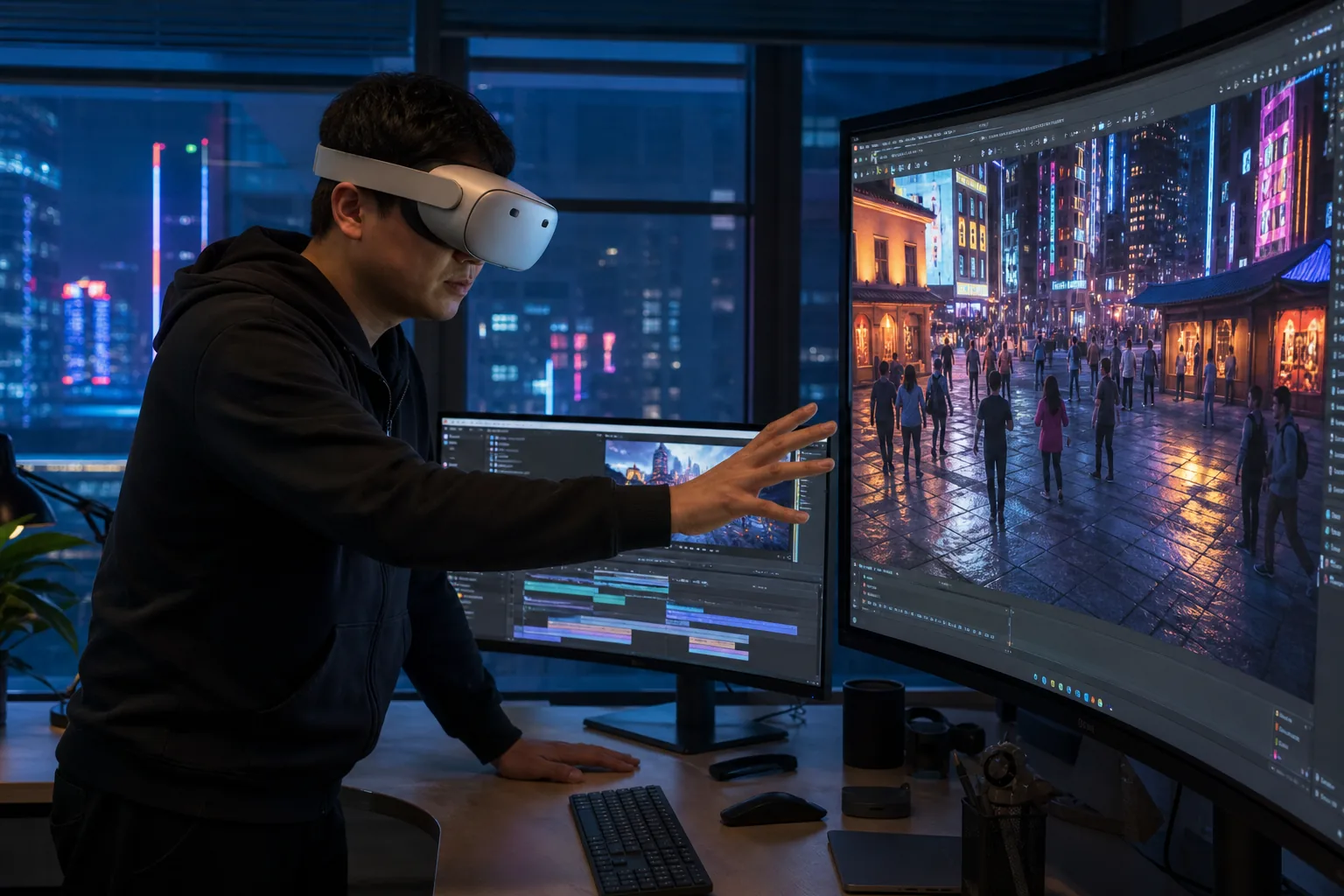
On September 7, The Edge Malaysia and Crypto Briefing carried the same thread: ByteDance is preparing a “world model” for real-time spatial video, with founder Zhang Yiming personally overseeing it, and external timing talk of a launch “as soon as next month”—still uncertain.
This is not another chatbot layer. Reports place the stack on Seedance, ByteDance’s cinematic video model, aiming at interactive virtual worlds for livestreams, short-form dramas, and games, with a robotics and autonomous-systems spillover. The sharp number is latency: roughly 0.05 seconds at 20 fps, responding to Pico headset voice and movement.
[1][2]Selling “follow-the-hand,” not filters
World models have been a buzzword since Google Genie–style interactive worlds; ByteDance is now being slotted onto the same comparison sheet, with Meta Quest and Apple Vision Pro named as the hardware rivalry. The difference is distribution: content platforms, cloud, and Pico. The reported strategy is explicit—move heavy generation to the cloud so headsets can be cheaper and lighter.
The Edge, citing Bloomberg, also notes ByteDance secured about $30 billion in loans for AI and data centers. That is not garnish. Without a cloud compute pool, “0.05 seconds” is a slide deck; with it, cloud rendering can be welded into the hardware roadmap.
[1][2]The Seedance → cloud → Pico flywheel
The chain is straight: Seedance supplies cinematic video generation; a world model turns it into interactive spatial video; the cloud carries heavy inference; Pico takes user voice and motion and plays the result back. Livestreams, short dramas, and games are the content on-ramps; robotics and autonomy are the same spatial understanding exported.
That is why “another chat model” is the wrong headline. Chat sells tokens; this sells a platform–cloud–headset loop. Whoever owns where rendering lives owns the BOM and the distribution rights.
[2][1]What it means for the field
If latency really lands near 0.05s at 20 fps, interactive worlds slide from demo reel toward shippable product—especially for short drama and livestream formats ByteDance already distributes. On hardware, the cloud-render story challenges the assumption that headsets must carry heavy local GPUs, and puts Meta’s and Apple’s on-device compute bets in the contrast column.
The risks are equally clear: launch timing is still press speculation; whether a world model holds up under multiplayer interaction and long sessions is unanswered in public. Loan size shows capital is already leaning in; product still has to turn “next month” from rumor into something you can put on.
[1][2]Commentary
I read this as ByteDance playing the table it knows: content platforms feed scenes, cloud feeds latency, Pico feeds the entry point, Seedance feeds the image. Zhang’s personal oversight is not because world models sound more sci-fi—it is because if this line works, models, cloud, hardware, and content can feed each other data, which looks more like a home-field fight than another benchmark sprint.
Watch two things, not the “next month” headline: whether interactive latency reproduces on a real headset, and whether cloud rendering actually bends Pico’s hardware cost curve. The first decides if the world model is a toy; the second decides if the flywheel is spinning or idling.
[1][2]