
要点
- On 9 November 2026, ByteDance Seed introduced Seedream 5.5, its next image model, with three advertised upgrades: more stable multi-turn editing, native RGBA images with transparent backgrounds, and more realistic images and clearer text.
- The editing claim is that unedited regions are preserved at the pixel level, including color, so the same image can be revised across 100 rounds without those areas drifting. The post demonstrates this with demos, including 100 successive edits of one person.
- On MagicArena, covering e-commerce, marketing, film and television, gaming, office work, and fashion design, vendor evaluators gave Seedream 5.5 higher quality scores and usability rates than Seedream 5.0 Pro in all six cases, with more than twice the usability rate in film and television and in office work.
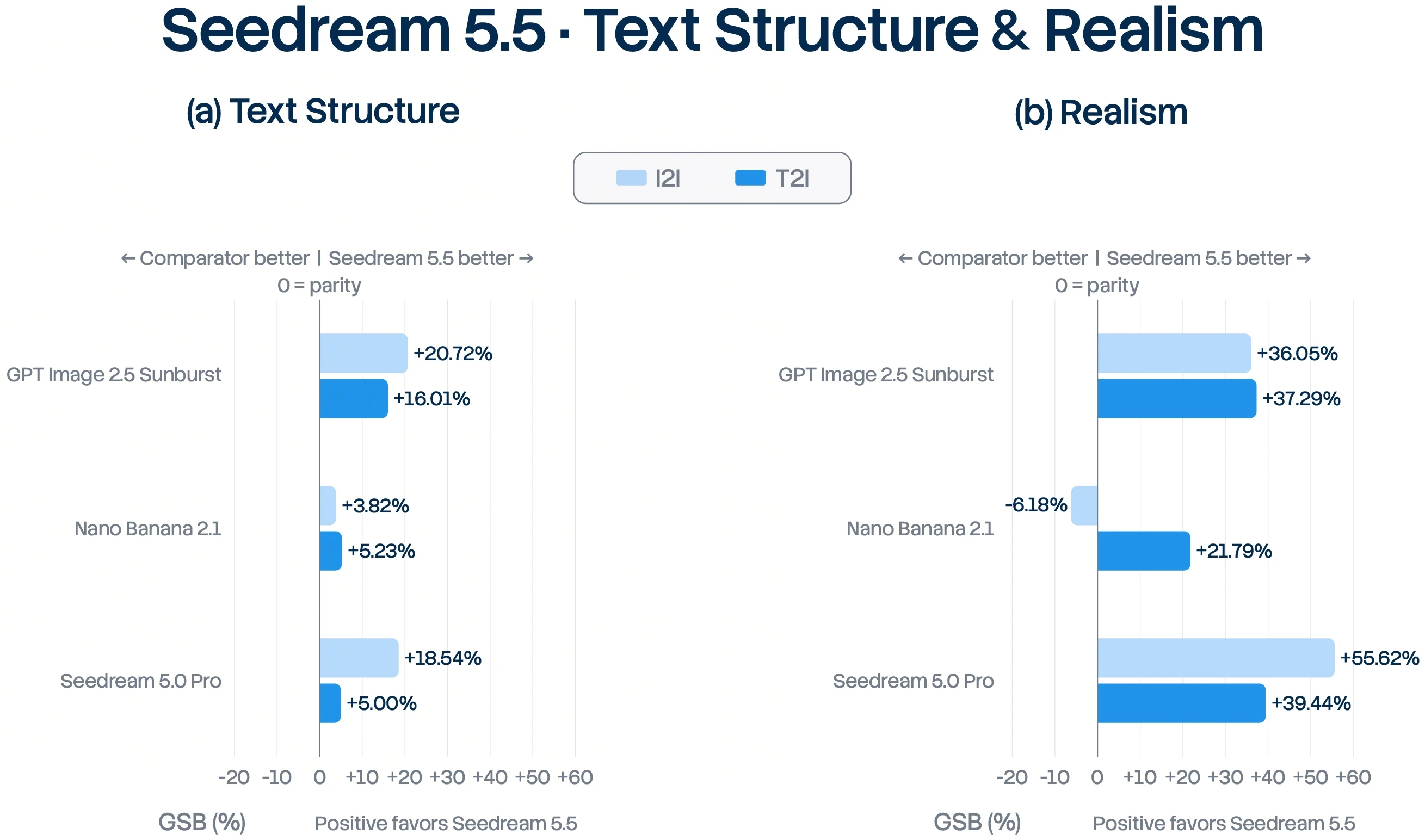
- In first-party Good/Same/Bad tests, Seedream 5.5 scored +55.62% for image-to-image realism against Seedream 5.0 Pro, and led GPT Image 2.5 Sunburst and Nano Banana 2.1 on text structure. On image-to-image realism against Nano Banana 2.1, the same chart shows -6.18%.
- Severe text corruption fell to 0.4%, and minor corruption to 1.7%. A Pro version of the Seedream 5.5 series is said to follow. All of these figures are ByteDance's.
On 9 November 2026, ByteDance's Seed team introduced Seedream 5.5, calling it a next-generation image model for professional production. The three upgrades in the post are more stable multi-turn editing, native RGBA assets with transparent backgrounds, and more realistic images with clearer text. The sentence that can be checked is narrower than "more realistic images." It is that the model was trained to leave unedited pixels alone, including their color, across 100 successive edits, and that ByteDance's own evaluators, on the MagicArena platform, scored the new model more usable than Seedream 5.0 Pro in six professional use cases. One comparison in the same post still goes the other way.
[1]What the model is said to do
The editing problem the post describes is familiar to anyone who has used an image model as a revision tool. Each new edit takes the last output as its input. Small errors accumulate. Areas that were supposed to stay still pick up color shifts, lose detail, or slowly degrade. Seedream 5.5, ByteDance says, was trained to preserve unedited regions at the pixel level, so a team can keep working on the same image through many rounds.
The main demo is 100 successive edits of the same person, each built on the previous output, with changes to clothing, accessories, and objects on a table. The post says the model can still make precise edits to small objects such as rings and eyeglass frames, and can render contact, occlusion (what sits in front of what), and lighting that match the current pose. Other sequences show flowers and materials, and an interior in which furniture is replaced while perspective, occlusion, and shadows are kept consistent, including newly revealed areas when a box is moved.
The second upgrade is native RGBA output, meaning the model can write an alpha channel and produce full or partial transparency directly. The pitch is that generated elements can go into a layout or a composite without a separate background-removal and edge-cleanup step. Demos include a snowy owl with gaps between feathers, text drawn in the style of a reference image, and character assets reused across scenes.
The third upgrade is realism and text. The post says the model renders lighting, materials, and skin with less gloss and overexposure, and that it is better at densely arranged small text in English and in Chinese. On a newspaper-style page about Shakespeare, and on a blue morpho butterfly infographic with eight small Chinese captions, the post says the type remains readable.
[1]The numbers, including the one that does not go Seedream's way
To evaluate professional use, ByteDance tested six cases on MagicArena: e-commerce, marketing, film and television, gaming, office work, and fashion design. Experienced image-generation evaluators scored quality and usability. Compared with Seedream 5.0 Pro, Seedream 5.5 improved both quality scores and usability rates in all six cases. In film and television and in office work, usability rates were more than twice those of the previous version. A radar chart in the post plots usability rate on a scale that only goes to 35%, and mean opinion score on a scale to 4.0. The post does not print the exact rates. The scale itself implies that the usable share being compared is well below a majority, even after the jump in those two cases.
In separate tests, experts compared pairs of images with a Good/Same/Bad score, for both text-to-image and image-to-image tasks, and for both text structure and realism. Against Seedream 5.0 Pro, the new model was ahead in all four comparisons, reaching +55.62% for realism in image-to-image work and +39.44% in text-to-image realism. Against GPT Image 2.5 Sunburst, the chart shows a lead in both text structure and realism, including +37.29% for text-to-image realism. Against Nano Banana 2.1, Seedream 5.5 leads in text structure, +3.82% for image-to-image and +5.23% for text-to-image, and in text-to-image realism, +21.79%. The same chart shows -6.18% for image-to-image realism against Nano Banana 2.1. That is a loss. The accompanying text emphasizes a lead in text structure and a clear lead in text-to-image realism, and does not dwell on that one reversal.
Text corruption is reported separately. In evaluations covering Chinese and English, including densely arranged small text, the severe corruption rate fell to 0.4%, and the minor rate to 1.7%. A bar chart in the post also gives the comparators: Seedream 5.0 Pro at 2.8% severe and 2.6% minor, Nano Banana 2.1 at 1.7% and 3.0%, and GPT Image 2.5 Sunburst at 0.7% and 7.4%. In that first-party chart, Seedream 5.5 is the lowest on both measures.
A Pro version of the Seedream 5.5 series, the post says, will follow.
[1]The fair case, and what is missing
The fair reading is that pixel-level edit stability and native transparency are the claims that would matter in a production pipeline, and that ByteDance published a comparison it did not win. The 100-round demo, the MagicArena usability jump, and the text-corruption rates are specific enough to argue with.
They are also all first-party. MagicArena is the company's platform, scored by "experienced" evaluators whose method is not fully specified here. The Good/Same/Bad tests are preference scores, not a public third-party leaderboard. The 100-round result is presented as a demo of one person and a handful of other sequences, not as a published failure rate across a fixed edit protocol. There is no independent replication in the post, and no price or availability detail beyond the promise of a Pro version.
[1]Who should care, and what to watch
Art directors and production teams that already use image models for iterative edits, and anyone comparing Seedream with GPT Image or Nano Banana on typography, should care. So should readers who take a "leading results in realism" sentence at face value. The chart in the same post is more precise than that sentence.
In the next six months, the checks are whether a Pro version appears, whether a public or third-party bench repeats the text-structure lead and the image-to-image realism loss, and whether 100-round stability holds on images and edit types that were not in the demo.
[1]Close
Seedream 5.5 is a vendor release with a clear mechanism, keep the unedited pixels still, and with numbers attached. The 0.4% severe text-corruption rate and the +55.62% image-to-image realism score against the previous version are real claims in the post. So is the -6.18% against Nano Banana 2.1. A reader who wants to know whether the model is ready for production has to hold all three at once.
[1]