
要点
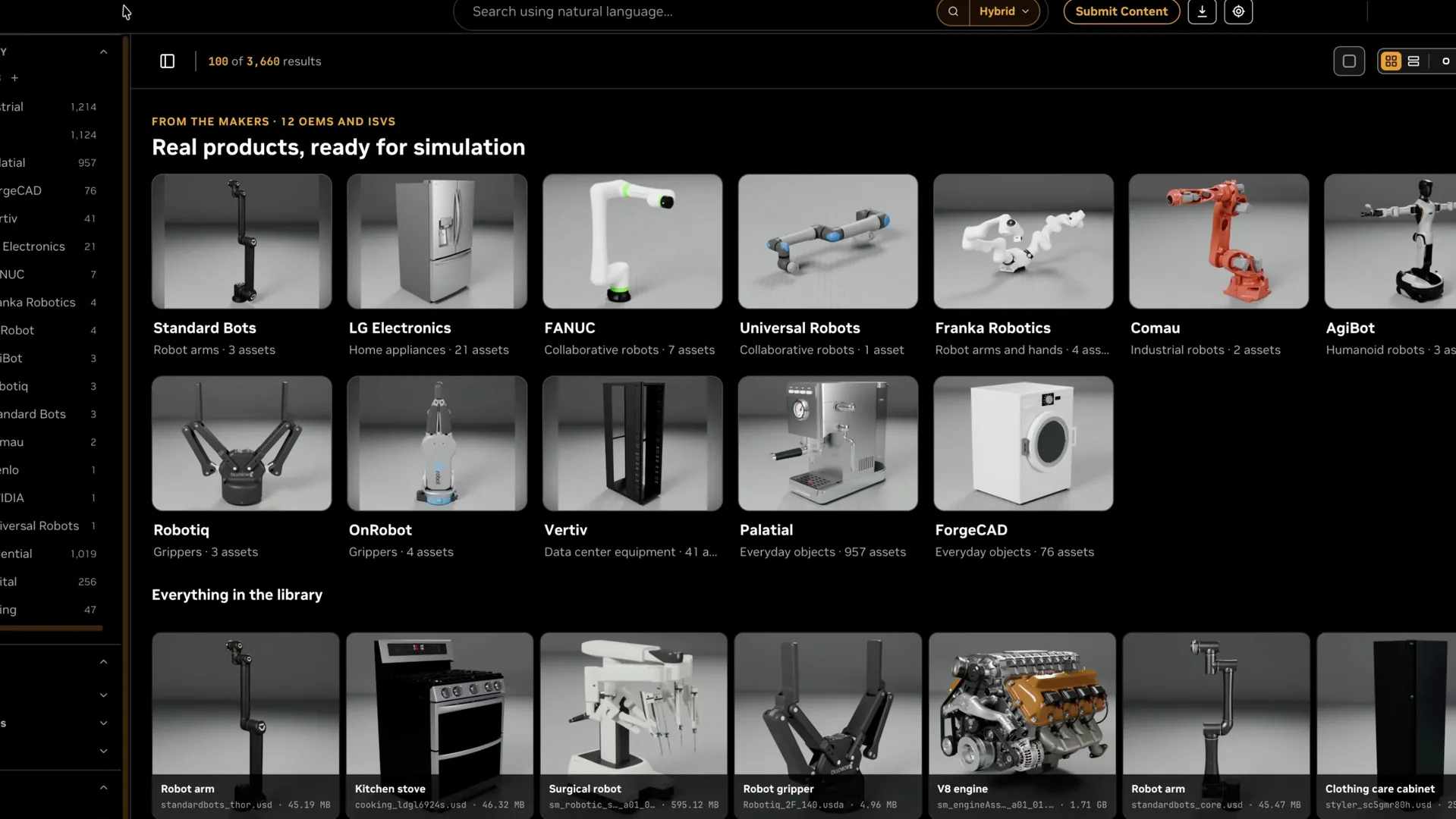
- 2,000+ SimReady OpenUSD assets on Hugging Face; free and ungated; robot arms, grippers, warehouse gear, racks, cooling kit.
- SimReady = CAD-plus: collision geometry, physical properties, joints/limits, semantic labels, materials/sensor attributes via SimReady Foundation profiles.
- OEM path: Vertiv, Comau, FANUC, Franka, Robotiq, Standard Bots, Universal Robots, Palatial, LG Electronics, ForgeCAD cited as contributor classes; submission skill for validate/package.
- NVIDIA USD Search powers natural-language search; HF indexes USD properties for agents.
- Worked examples: pick-and-place workcell assembly; dual AI-factory layout comparison with clearance checks.
Hugging Face’s NVIDIA-authored blog presents SimReady Central as an open library of simulation-ready 3D assets for robotics and AI-factory digital twins. Soft framing is “more 3D on the Hub.” The structural claim is blunter. Teams lose weeks turning pretty CAD into objects a physics runtime will accept, so an ungated, profile-checked asset commons matters more for the next year of robot learning than another foundation checkpoint. If Isaac-class workflows can compose these assets into reproducible tasks at scale, the claim holds. If profiles are aspirational and scenes still need hand surgery, it is a branded folder.
[1]What shipped
SimReady assets are OpenUSD objects prepared with the properties simulation needs: collision and physics, joint structure, semantics, materials and sensor attributes. SimReady Foundation publishes profiles and validators. SimReady Central aggregates more than two thousand such assets and lets developers see which capabilities each asset supports before mixing suppliers in one stage.
OEMs can validate against profiles and publish via their own Hub datasets while remaining discoverable in the central library. Search uses NVIDIA USD Search, including natural-language queries; Hugging Face indexes USD properties so agents can find suitable props. Example prompts show GPT-6 Astra-style authoring: find a FANUC arm plus Robotiq gripper, emit Isaac Sim Python, render a preview; or build two factory layouts and flag aisle-clearance violations.
[1]Evidence on the table
Checkable claims: library size (>2,000), OpenUSD + SimReady Foundation requirements, named OEM categories, USD Search integration, and two workflow sketches (pick-and-place; factory layout compare). The post does not publish download counts, success rates of profile validation, or controlled studies showing faster policy learning from SimReady versus raw meshes.
[1]Steelman and gaps
Steelman. Synthetic data and robot learning repeatedly die on asset prep. Standardizing profiles and giving OEMs a Hub distribution path attacks the supply side. Putting search in agent loop is aligned with how scene authoring is shifting.
Gaps: page date is 21 October 2026, older than a typical 48-hour news hit; inclusion here is for still-thin Chinese-desk coverage of a primary library launch. “SimReady” quality depends on runtime validators users actually run. Mixing OEM assets can still fail on unit conventions and control interfaces. AI-assisted assembly demos are prompts, not measured time-to-scene. A library does not create contact-rich policies by itself.
[1]Who should care, and what to watch
Robot learning teams should prefer profile-matched assets over scraping random USD. OEM marketing and applications engineers get a distribution channel that reaches Isaac users. Digital-twin vendors for AI factories should track whether cooling and rack metadata is rich enough for power/thermal tools, not only visuals.
Over six months watch: growth in validated OEM datasets; public Isaac Lab tasks that pin SimReady asset versions; whether clearance/physics failures reported in Foundation issues decline as profiles tighten.
[1]Close
SimReady Central is easy to file as another Hub collection. The durable sentence is that physical AI’s near-term constraint is shared, simulation-honest objects, and Hugging Face plus NVIDIA are trying to make OEMs the publishers of those objects. Six months on, either version-pinned robot tasks cite this library as default scenery, or it remains a well-photographed warehouse of almost-ready props.
[1]