
The colleague who lives in the thread
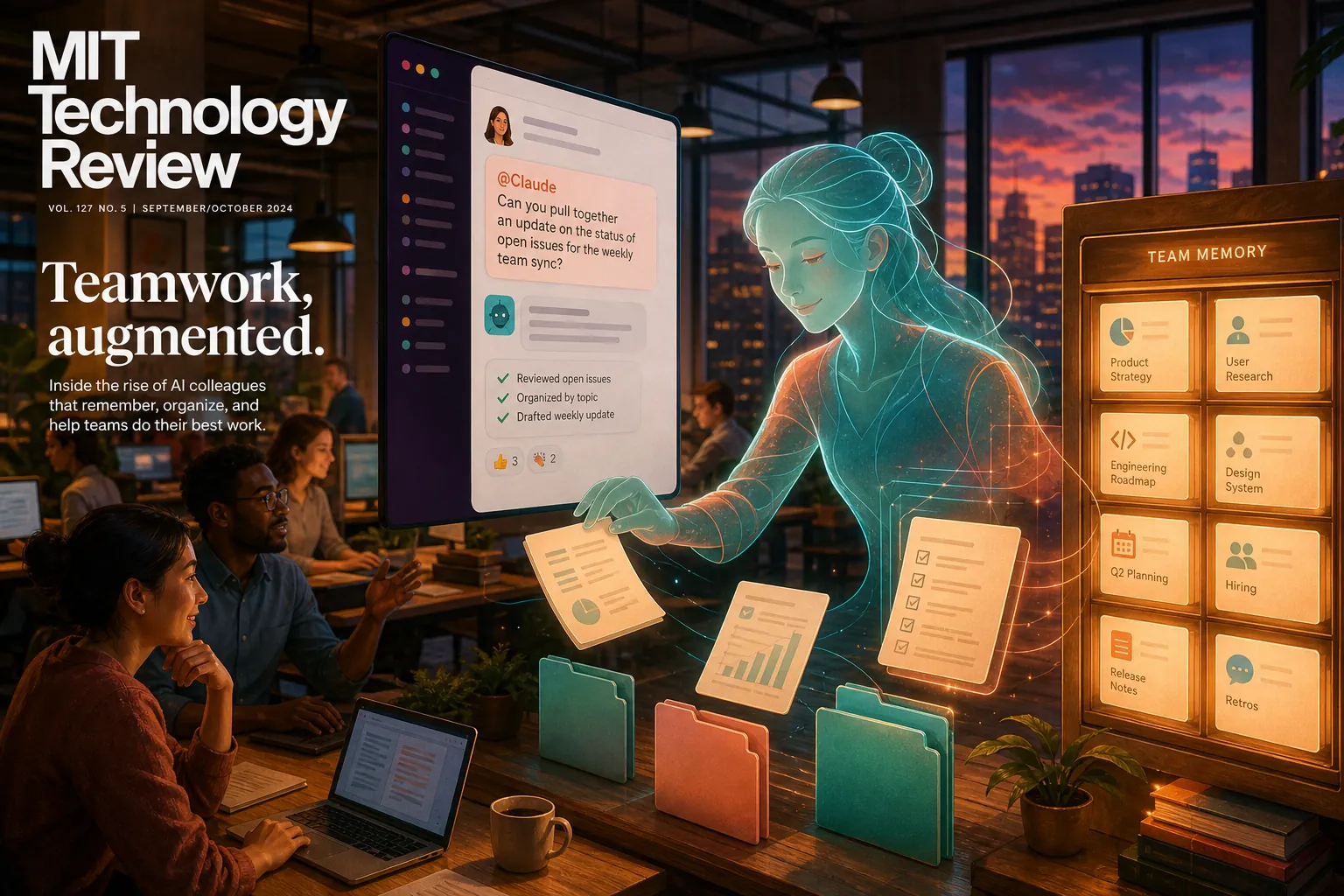
On August 28, 2026, Anthropic product marketer Aleksandra Todorova published what reads like office gossip and functions like a product manual: How Anthropic employees use Claude Tag. Instead of benchmark charts, it drops three real roles—product marketing, product strategy and operations, and legal—into Slack threads and asks what changes when Claude can be @-mentioned like a coworker.
Three days earlier, another official update filled in the other half: Claude’s memory now spans chat and Cowork. One side is being summoned inside collaboration tools; the other is remembering who you are across surfaces. Together, Anthropic is selling less a chat plugin than the ability to seat an agent inside an organization’s everyday operating system.
Three people, three clocks
Claude Tag’s official definition is plain: in chat tools such as Slack, you @Claude; it picks up thread context, finishes the task, and posts back in the same thread. It can also follow conversations and, using available context, memory, and standing instructions, decide when to join. The post says Tag is in public beta on Team and Enterprise on Anthropic’s first-party service, and notes that turnaround times reflect individual employee experiences and vary with the task, connected tools, and setup.
The first story is product marketer Hema Thanki. During a feature launch, sales asked for non-technical customer collateral; a Slack thread already held more than 15 messages and some tension about what was needed. Rather than schedule a clarifying meeting, she typed: @Claude, go through this Slack thread and come up with a one pager that [the requester] is asking for. In about two minutes Claude returned a two-page draft covering what the feature does, the business case, implementation, and an appendix. She then asked it to verify claims; Claude sorted statements into those checked against public docs and those that were its own framing needing product-lead sign-off. She supplied two official resources and had Claude rewrite a section to match approved wording. After four versions and about 45 minutes, the doc went to the product lead. The official point is not “it writes fast,” but that human time moved to challenging accuracy, supplying sources, and deciding what to include.
The second story is operational grit. Steph Soderborg, on product strategy and operations, needed everyone who had asked for an upcoming feature for a customer—Slack handles, teams, accounts, links—before GA. She gave search targets, a one-sentence match definition, and a pasted seven-entry sample. Claude ran about 20 search variants; when the product-feedback hub blocked direct access it used Slack cross-references, folded in another internal assistant’s first-pass list, and deduplicated. In about 26 minutes it returned roughly 24 accounts. A larger job asked for every product problem enterprise customers reported in the prior week. After reading incident, escalation, support, and feedback channels, Claude posted in about 50 minutes a write-up organized by product area: 23 still open, 14 resolved, condensed from about 120 raw findings; a self-check surfaced 15 more. Steph estimates the same synthesis would have taken at least a full-time week—or never gotten done.
The third story is legal. Product counsel Molly Villagra created a dedicated Slack channel where marketers drop document links and Claude Tag examines each asset first: spotting unsubstantiated marketing claims and checking facts against company Slack, an internal knowledge index, and the public web. Flags come with fix instructions and iterate with the requester; items needing counsel sign-off get the right lawyer tagged. In one newsletter review, Claude flagged three items, then minutes later resolved one unprompted after finding supporting internal docs. Molly immediately made that the default: @Claude … Will you try to verify these things in real time when you flag them in the future? She also set a Friday routine for Claude to review the week’s counsel feedback and propose shared-instruction updates for approval. Official framing: marketing legal review compressed from a day or longer to about 30 minutes per asset.
equally important engineering details recur: access is deliberately scoped to granted channels and documents, and Claude says when it lacks access. Employees often work in private channels with long upfront instructions while Claude posts progress checklists in the background. Images in the post are generated illustrations without real names or information—also stated by Anthropic.
What memory adds
If Tag answers “finish work where it already happens,” memory answers “will the next surface still know you?” The August 25 update says chat memory and Claude Cowork share one store; when Cowork runs a cloud task, chat context is there and vice versa. Memory now writes topics as you chat rather than mainly summarizing after a session ends. Under Settings → Memory → Topics, short files can be read, edited, or deleted, and one fix applies everywhere.
Sensitive topics—health, race, ethnicity, religious beliefs, politics, gender identity, and similar—are off by default; users can enable them, get a notice on each save, and nothing is saved retroactively. Even when enabled, SSNs and similar IDs, criminal history, immigration status, and Acceptable Use Policy violations stay out. Memory is on by default for Free, Pro, and Max (sensitive topics still off by default). For Team and Enterprise, admins control availability, and memory stays off for individuals until they turn it on.
Read together, the product intent is clear: collaboration should live in Slack; personal continuity should span chat and Cowork. The agent is no longer a box you paste into—it is a named node on the org graph.
What is actually valuable
For developers, Claude Tag models a stack of scoped permissions, thread context, and rewriteable standing instructions—not another webhook bot. Channel-level instruction iteration (Molly’s Friday review) means agent behavior can be versioned like a runbook. Graceful degradation when a hub blocks access makes “missing data” a first-class state instead of silent hallucination.
For enterprises, the pull is concrete: launch collateral, customer-voice consolidation, and legal first-pass review are high-frequency, cross-system chores that used to burn human hours. The official times—45, 26, 50, and 30 minutes—are stories, not SLAs, but they point the same way: strip search, synthesis, drafting, and triage out of knowledge-work calendars. Risk scales with value. Slack mixes secret and semi-secret traffic; once an agent joins incident channels and customer complaint threads, prompt injection, oversharing, and bad dedupe become organizational incidents, not just model failures. Turning memory off by default for Team/Enterprise and scoping Tag to granted channels shows Anthropic knows that default-on is default liability.
For individual knowledge workers, the feel is “another colleague who never sleeps.” The upside is fewer meetings and less history diving; the cost is learning to write match definitions and output samples—and keeping the habit of challenging facts. In Hema’s workflow, the highest-value step remains “is this true?”
Where it sits in the competitive map
Microsoft welds Copilot into Teams and M365; Salesforce bets on Agentforce; Slack ships its own AI; OpenAI keeps pushing workspace and computer-use narratives. Anthropic’s difference is publishing a forkable internal playbook for an @-able coworker, with scoped access, layered fact checking, and hot-updatable instructions. It does not claim one mega-portal; it claims the agent should live where work already lives—in the thread.
That continues the same product philosophy as Fable/Mythos capability tiers and the Chrome-extension versus isolated built-in browser trust split: stronger capability, more separable delivery. Unified memory then fights ChatGPT memory and Gemini cross-app context for the same stickiness: whoever makes people re-introduce themselves less often becomes the daily OS.
Competitive contrasts here rest on public product narratives only; this piece makes no claims about unpublished rival internals.
Limits, motives, and fog
Anthropic’s own disclaimer matters: turnaround times vary by person and task. All three cases are Anthropic employees—early users with good tools and permissions. When the feedback hub blocks direct access and Claude falls back to cross-references, recall ceilings are integration coverage, not model IQ. A model that “unprompted” clears a legal flag is impressive and dangerous: wrong confidence can be written into shared instructions if Friday approvals go soft.
Commercial motives are obvious. Tag sits on Team/Enterprise; memory defaults on for consumer tiers and off for enterprise individuals—one path raises seat value, the other eases procurement and compliance. Employee stories are sales assets. Channel ACL, sensitive memory off by default, and permanent bans on ID numbers are real upsides. Still, “decide when to participate” can create noise in busy channels or read context that should stay unread; public materials say little about misfire rates for unsolicited participation, so that gap should be marked as not fully confirmed.
My read
I read Claude Tag as a moment of product honesty about in-org agents: the best door is often not a new app, but the thread you already inhabit. The memory update extends personal continuity from the chat box into Cowork so context follows people, not tabs. Together they are closer to what enterprises actually buy—fewer meetings, less shuffling, more judgment left for humans—than another coding-benchmark crown.
The critique stands. Nearly every number is an internal story; independent replication, cross-tenant success rates, and error-cost ledgers are thin. Unsolicited participation without auditable trigger logs will be hard for security teams to sign. Over the next 6–12 months, watch three things more than another @-bot skin: whether enterprise knowledge sources get productized read/write boundaries with Tag; whether channel instructions become auditable policy packs; and whether memory files plug into compliance export, eDiscovery, and offboarding erasure. If those land, Anthropic gets harder to displace on the in-org agent track. If they stay pretty internal case studies, deeper office-suite distribution can still catch the experience.
Close
Claude Tag’s employee playbook, plus unified cross-surface memory, marks Anthropic’s push from “you go find the agent” to “it shows up where work already happens.” The company published checkable workflows, permission constraints, and default policies; limits are equally clear: public beta, non-extrapolatable timing anecdotes, and real integration gaps.
If you keep one line: the next office-AI contest is who dares to live inside Slack threads while still letting legal and security sleep. Anthropic’s homework this time scores less on flash and more on turning “@ a colleague” into a reproducible way of working.