
要点
- SuperCLUE released its November 2026 Chinese-oriented evaluation on 5 November. A Hugging Face post dated 6 November, by VIDRAFT_LAB, SeaWolf-AI, and FINAL-Bench, transcribed the 19-model table and SuperCLUE's rule for the numbered column.
- Among all 19 models, Gemini-4-Argon has the highest overall score at 73.62, then GPT-6.1-Sol at 71.76, then Kimi-K3.1-Pro at 61.46. SuperCLUE's numbered column gives Kimi a 1 and prints dashes for Gemini and GPT.
- SuperCLUE's own rule, restated in the post and shown on SuperCLUE's homepage, excludes international models and some domestic models from numbered ranks and lists them for reference only. That is why Gemini, GPT, Grok, and Darwin show dashes. It is a ranking convention, not a missing evaluation.
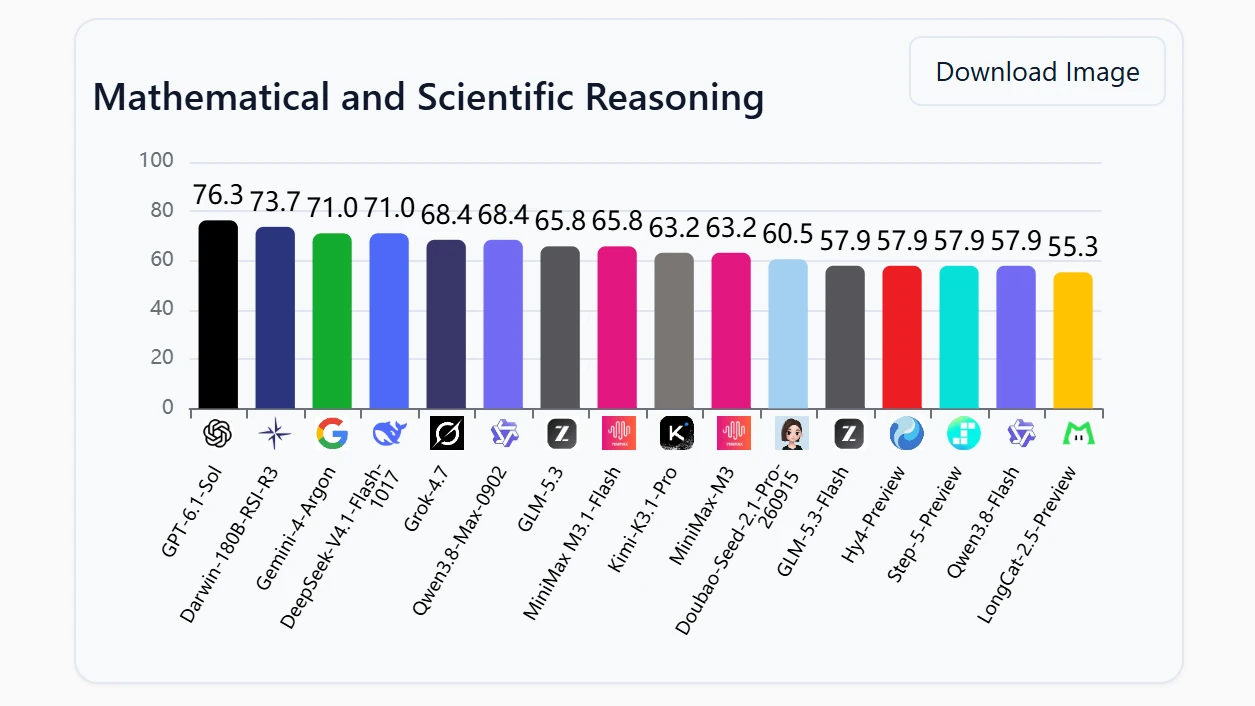
- Category leaders among the 19 differ from the overall order. GPT leads agentic coding at 69.23 and mathematical and scientific reasoning at 76.32. Gemini leads hallucination control at 83.19 and ultra-long context at 95.63, and ties GPT at 68.97 on precise instruction following.
- Among models SuperCLUE labels open, DeepSeek-V4.1-Flash-1017 leads coding at 65.38, matching Gemini. Darwin-180B-RSI-R3 leads mathematical and scientific reasoning at 73.68, second of the 19. Kimi leads the other three open-model categories and has the highest overall score among the 12 labeled-open models.
On 5 November 2026 SuperCLUE published a Chinese-oriented evaluation of 19 models. The next day, a Hugging Face post by VIDRAFT_LAB, SeaWolf-AI, and FINAL-Bench walked through the official table and the numbered column printed beside it. That column's first place is Kimi-K3.1-Pro. The highest overall score on the same table is Gemini-4-Argon's 73.62, followed by GPT-6.1-Sol at 71.76. Kimi's 61.46 is third by score. The mismatch is SuperCLUE's published ranking rule, not a missing mark or a failed run. International models, and some domestic ones, are left out of the numbered ranks and shown for reference only.
[1][2]What the table actually shows
The published table has 19 models, 12 labeled open and 7 labeled closed. Those labels are SuperCLUE's classification. They are not an independent check of licenses, training-data disclosure, released code, or whether a model may be used commercially. Anyone buying or deploying still has to read each model's repository, model card, and terms.
By raw score Gemini is first at 73.62, GPT second at 71.76, and Kimi third at 61.46. Kimi is first among the 12 models labeled open, 2.51 points above DeepSeek-V4.1-Flash-1017 at 58.95. Darwin-180B-RSI-R3 sits ninth at 43.08, just below Qwen3.8-Max-0902 at 43.22 and just above Hy4-Preview at 42.96. Gemini, GPT, Grok, and Darwin all carry a dash in the numbered-rank column. Kimi carries a 1, DeepSeek a 2.
The Hugging Face authors say this dash is a policy convention, not a judgment that those models were left unevaluated or were too weak to rank. SuperCLUE's homepage states the same rule, and adds that models within a one-point difference are treated as tied. That is why Qwen3.8-Max-0902 and Hy4-Preview can share numbered rank 5 while Darwin, sitting between them by score, has no number at all.
[1][2]Evidence on the table
The post then splits the same table into five SuperCLUE categories, naming for each the leader among the 19 and the leader among the 12 labeled open.
On agentic coding, meaning coding work that takes multiple steps and calls tools, GPT leads at 69.23. DeepSeek is the open-model leader at 65.38, matching Gemini's published coding score and trailing GPT by 3.85 points. DeepSeek also leads the next-highest open model in that category, Kimi at 57.69, by 7.69 points. A buyer who only looked at overall rank would see Kimi ahead of DeepSeek and miss that reversal.
On mathematical and scientific reasoning, GPT leads at 76.32. Darwin is second among all 19 at 73.68, 2.64 points behind GPT and 2.63 points above Gemini and DeepSeek, which share 71.05. That is Darwin's strongest published result in this evaluation. The Hugging Face post is signed in part by VIDRAFT_LAB, and VIDRAFT develops Darwin, so that category lead should be read as a number on SuperCLUE's table, not as an independent lab's endorsement.
On hallucination control, a test of how well a model avoids making unsupported claims, Gemini leads at 83.19. Kimi is the open-model leader at 67.78, 15.41 points behind Gemini and 4.17 points above GPT. These figures are benchmark scores, not hallucination rates. An 83.19 cannot be turned into an 83.19 percent hallucination rate or a 16.81 percent error rate.
On precise instruction following, Gemini and GPT share 68.97. Kimi leads the open models at 44.83. The 24.14-point gap between those overall leaders and the open-model leader is the largest numerical gap of that kind across the five categories. The post warns that category difficulty and scoring may differ, so this is not automatically the largest real-world capability gap. Kimi and DeepSeek are close here, 44.83 against 43.10.
On ultra-long context, meaning very long input documents, Gemini leads at 95.63. GPT is at 88.14 and Kimi at 87.25, so GPT sits only 0.89 points above the open-model leader. A long-context score also does not state a model's maximum context window. Accepting a long input is not the same as reliably finding a fact in the middle of it.
[1][2]Why one overall rank is the wrong shopping list
Taken together, the open-model shortlists split by job. DeepSeek belongs on a coding shortlist. Darwin belongs on a mathematical and scientific reasoning shortlist. Kimi belongs on shortlists for hallucination control, instruction following, and long documents among models SuperCLUE labels open, and it remains the highest overall open-model score. None of that is visible if a buying shortlist copies SuperCLUE's numbered column and stops at "Kimi is No. 1."
The overall score should be read from the published table. It should not be rebuilt as a simple average of the five categories. The Hugging Face authors say they did not verify SuperCLUE's task definitions, evaluation settings, confidence intervals (the published range of uncertainty around a score), or the formula that turns category results into the overall number. This column has not verified those either.
[1][2]Steelman and gaps
Steelman. SuperCLUE is a Chinese-oriented benchmark. Numbering the models that matter to its domestic ranking, and placing international entries beside them for reference, is a disclosed choice, not a hidden trick. Anyone who reads the note can see why Gemini and GPT have dashes. Within the set SuperCLUE chose to number, Kimi does lead, and Kimi also has the highest overall score among the 12 models labeled open. For a reader who only wants the strongest open model on this particular overall score, that claim holds.
Gaps. The table covers 19 models, not every model available worldwide. Open and closed are SuperCLUE's labels. Darwin is labeled open and still omitted from the numbered column, which matches the international-model rule and shows that "open" and "numbered" are not the same selection rule. The Hugging Face post is a secondary reading of SuperCLUE's table and Excel export. Its authors include the lab that builds Darwin, and their closing paragraph focuses on that model's Korean origin. The category numbers can be checked against SuperCLUE's public homepage. The methods behind those numbers cannot be checked from the post alone.
[1][2]Who should care, and what to watch
News desks and engineering teams who treat a SuperCLUE "No. 1" as a shortlist of one, and teams choosing among open models for coding, reasoning, or long documents, should read the category columns. Over the next six months, watch whether SuperCLUE keeps publishing both the score-order table and the numbered ranks after that exclusion rule, whether other Chinese-oriented boards adopt the same split, and whether buyers start asking for the task column that matches the job rather than the headline rank.
[1][2]Close
The November table is worth reading as two separate things: a score ordering of 19 evaluated models, and a numbered ranking that omits a whole class of entries by rule. Kimi can be SuperCLUE's numbered first and still sit third by score. DeepSeek can trail Kimi overall and still match Gemini on coding. Darwin can sit ninth overall and still stand second of 19 on mathematical and scientific reasoning. The mistake is to treat any one of those facts as the shopping list.
[1][2]