
Artificial Analysis dates the article October 26, 2026. The title says GPT-6.1 Terra pushes the cost-efficiency frontier. The opening sentence says OpenAI has released GPT-6.1 Terra, that this is the first Terra-class model since GPT-5.6, and that the new model is more intelligent for less than a third of the cost. The page prints that date and no clock. The sentence is the evaluation site’s own summary. Later sections separate an intelligence index, a coding index, and a token price list. They do not place every effort setting on the frontier named in the title.
[1]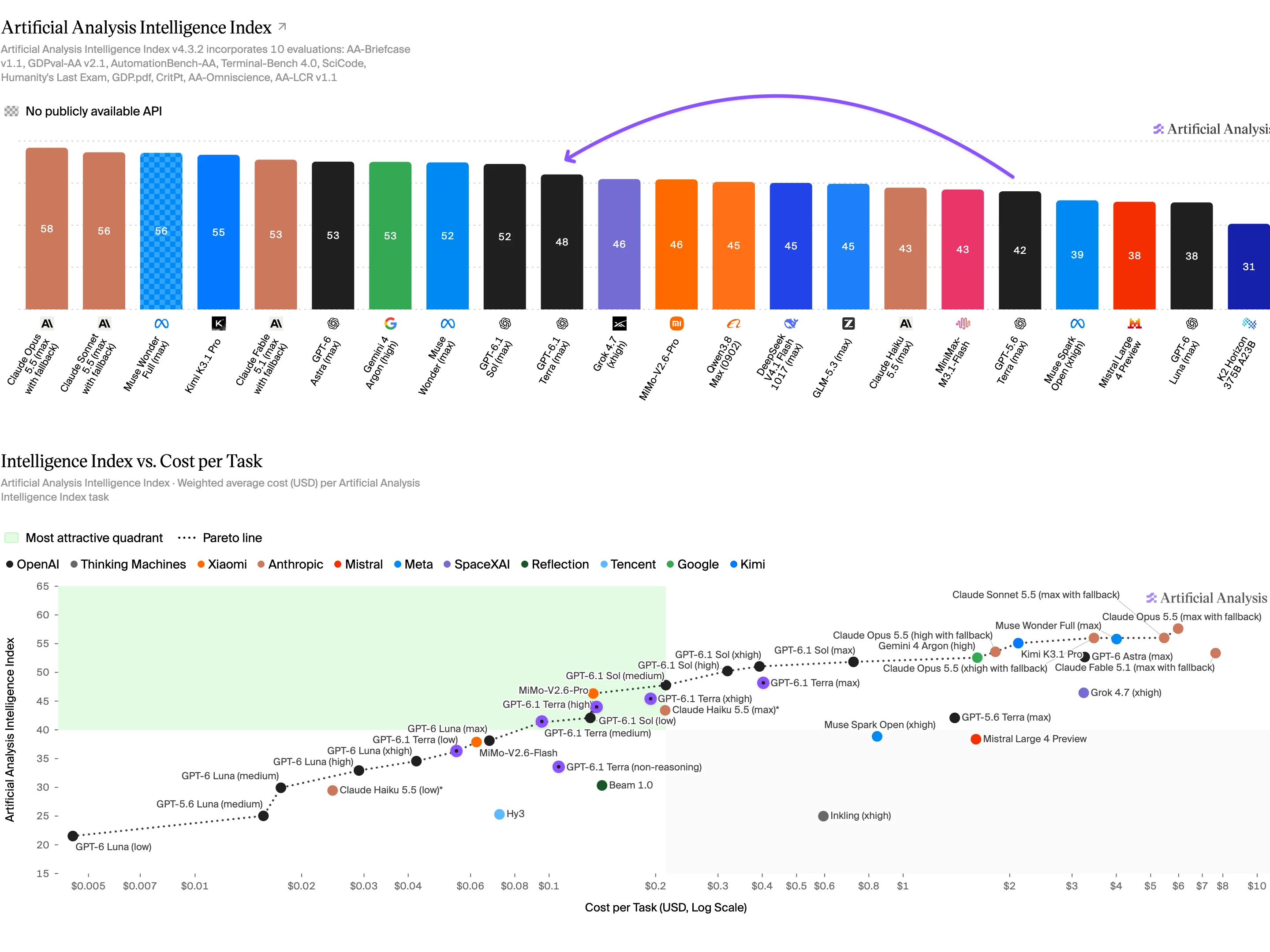
Token prices are stated at half or less of GPT-5.6 Terra. Input and output are $1 and $5 per million tokens, against $2 and $12 for the previous model. Cache writes are also described as halved, now $1.25 per million tokens. Cached input is one quarter of the earlier rate, $0.05 against $0.20 per million tokens. Those are prices the article lists. The index gaps are measurements the article itself reports. The prices are a list of figures on the page. The page does not attach an API receipt, and it does not say the figures were checked again on the date printed at the top.
[1]On the Artificial Analysis Intelligence Index, the article says maximum effort gains 6 points over GPT-5.6 Terra, at less than a third of the cost per task, $0.40 against $1.40. At lower effort the gain is larger, between 7 and 13 points. The same paragraph then narrows the claim. Low and medium effort are called Pareto-optimal for cost efficiency. The other effort levels sit behind the frontier. At maximum effort the model scores 4 points below GPT-6.1 Sol and 10 points above GPT-6 Luna. Read against this paragraph, the opening line about pushing the frontier covers low and medium effort. Maximum effort is cheaper on the article’s account and is still placed behind the frontier. A later line names Intelligence Index v4.3.2 as the breakdown of the individual evaluations. The article does not print an absolute index score for Terra, only these gaps.
[1]The Artificial Analysis Coding Agent Index v2.0 does print absolute scores. The article gives Terra a score of 48, six points below GPT-6.1 Sol at 54 and 17 points above GPT-6 Luna at 31. It says the xhigh and low effort settings sit on the cost-efficiency frontier for that index, and that the other effort levels sit behind it. The settings named here are not the settings named for the intelligence index. The intelligence section names low and medium. The coding section names xhigh and low. Both sections use the word frontier. The settings that land on it are not the same set.
[1]On AA-Omniscience, the article says the model guesses 38 percent of the time when it does not know the answer, and that GPT-5.6 Terra’s hallucination rate was 88 percent. The article itself calls that gap a 50-point drop, paired with a 2-point rise in accuracy. It calls the test a private knowledge and hallucination benchmark. On Terminal-Bench 4.0 the article reports a gain of about 20 points, and says maximum effort now rivals GPT-6.1 Sol. It says gains on most other evaluations are smaller, and gives GDP.pdf a 5-point rise as the example. The line of about 20 points does not print the two absolute scores being subtracted. The page also does not say the indexes were finished on the calendar date at the top. Farther down, the same page restates the intelligence gaps, the coding score, and the hallucination rate. That restatement still carries no printed clock and no absolute intelligence score.
[1]