
要点
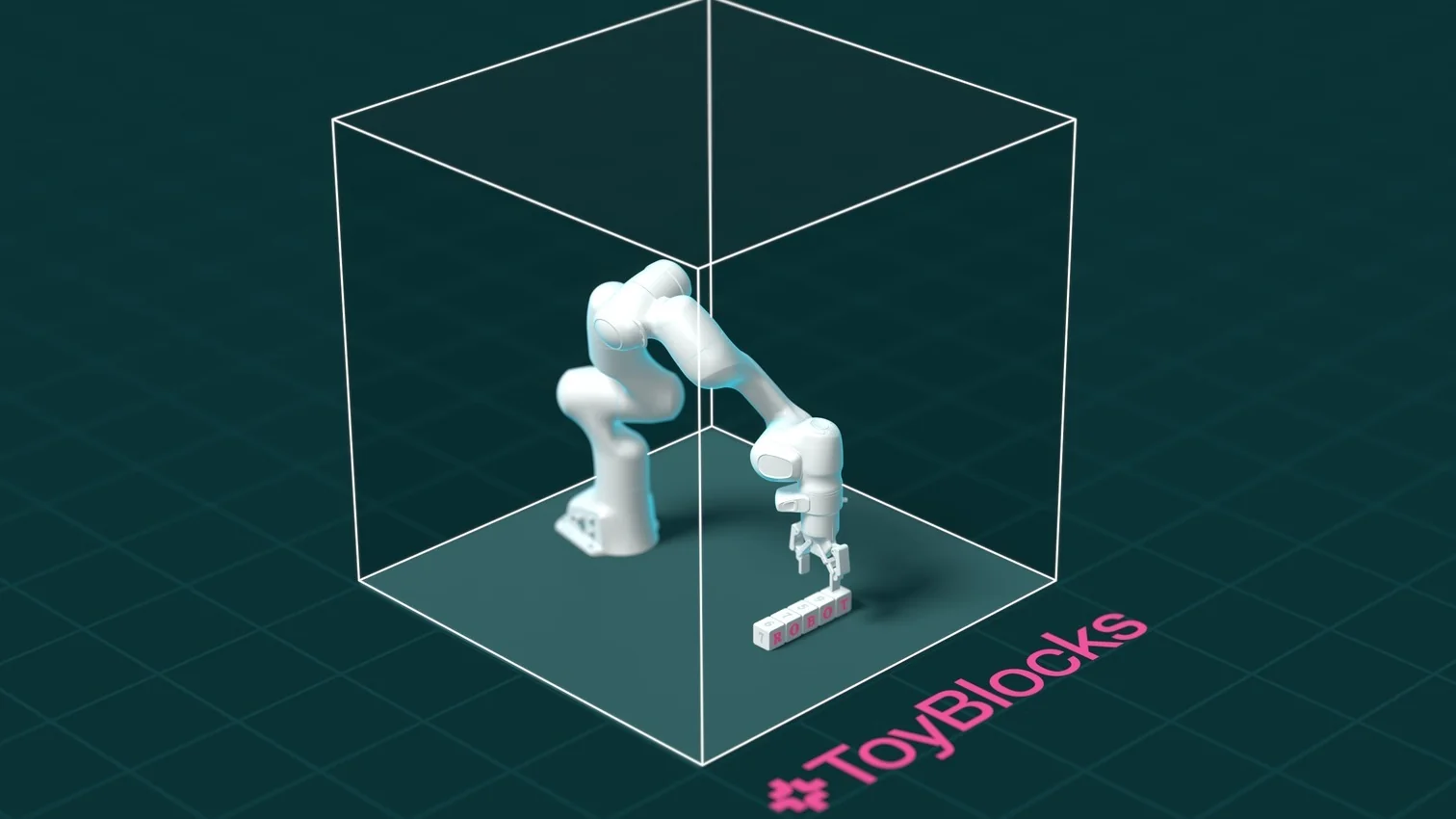
- ToyBlocks is the first "FoundationWorld": a narrow robot-arm + blocks sim with automatic demos, tasks, and metrics; Ai2 plans more complex worlds later.
- Initial open release: 85,336 long-horizon demos (~6 to 12 skills each), nearly 1,600 robot-hours, 144 million frames; larger drop planned in weeks.
- Spatial tests of ManiFlow, π0.5, and MolmoAct 2: popular action models generalize poorly on interpolation/extrapolation of stack/unstack/flip/rotate until specific fine-tuning tricks are added.
- Hierarchical Molmo 2 + ManiFlow: 55.5% sim success (111/200) vs 50.0% real Franka FR3 (15/30) on easiest three-block spelling; ManiFlow atomic skills ~80% sim / 81.1% real.
- Claude Opus 5.5 agent via MCP: 63% search-and-spell (or correctly call infeasible); learned skill descriptions raise success from 24% (default) to 63%, beating human-written 36%.
On 6 November 2026, the Allen Institute for AI published "ToyBlocks: A controlled world for robot learning and evaluation" on Hugging Face. Robots already fold laundry and sort parts in demos, yet those clips rarely explain what a policy learned or why it fails. ToyBlocks argues robotics needs petri dishes: small, repeatable worlds where researchers change data or model design, rerun the same test, and see the failure mode. The first cut is a tabletop arm and lettered blocks. The durable claim is methodological, not a new household robot.
[1]What shipped
ToyBlocks is framed as the first FoundationWorld: a controlled sim plus generators for tasks and demonstrations, plus metrics over time. The setting is deliberately narrow so four requirements can hold together: realistic physics and look, automatic task and demo generation at scale, tasks that mix reasoning with dexterity, and coverage of what the domain allows.
Blocks carry letters and pictures, so robots must search, flip, and stack, not only grasp. Domain randomization varies size, table height, and other properties. Skills for short tasks are trained with reinforcement learning and motion planning in NVIDIA Isaac Lab, including non-prehensile push and flip. A task-and-motion planner sequences skills and can run hundreds of plans in parallel on one GPU, up to about 24× real time. High-level planners (Molmo 2 or frontier models via MCP) choose skills; low-level models such as ManiFlow execute them. A web UI can connect Claude or another frontier model for natural-language trials.
The open package includes simulation assets, generators, demos, trained Molmo 2 and ManiFlow examples, training and evaluation code. The first data drop has 85,336 long-horizon demonstrations, nearly 1,600 hours of robot execution, and 144 million frames. Ai2 says a larger second release with more skills and benchmarks is weeks away, plus fuller RL training.
[1]Evidence on the table
The spatial-generalization study is the hardest evidence for the thesis. Low-level vision-language-action models are often sold as rapid generalizers after large pretraining. ToyBlocks tests ManiFlow, π0.5, and MolmoAct 2 on Stack, Unstack, Flip, and Rotate under interpolation (new layouts inside the training region) and extrapolation (beyond it), including left-region train / right-region test and stack-height holdouts. Ai2 reports that these popular action models generalize poorly in the initial results, then improve only after techniques such as LoRA fine-tuning are added. The post's reading: action-model generalization is far from solved, and a controllable world is how you measure that claim.
On long-horizon spelling of three-letter words with Molmo 2 on top and ManiFlow or a motion planner below, difficulty rises when letters start face-down or hidden. Real-world transfer used a Franka FR3 with Robotiq gripper across thirty scenes of 4 to 10 training blocks. ManiFlow atomic skills succeeded at 80.0% in simulation and 81.1% on the real robot. The hierarchical system succeeded at 55.5% in sim (111 of 200) and 50.0% in the real world (15 of 30) on the easiest configuration. The authors note that more trials are needed for statistical confidence.
Agentic runs with Claude Opus 5.5 through MCP tools solved classical text and closed-loop stacking at 30/30. In search-and-spell with up to eight blocks and 50% infeasible scenes, the agent solved or correctly declared infeasible 63% of tasks. Main errors were look-alike letters (13%) and wrong letter orientation (15%). When the agent wrote its own skill descriptions from self-run experiments, success rose from 24% with default descriptions to 63%, beating 36% with human-expert descriptions. Separate world-model tests ranked Wan 2.2 best on block motion and outcome prediction; adding 100 rollouts from the best video model raised a policy's success in an unseen region from 19% to 78%.
[1]Steelman and gaps
Steelman. A tabletop of wooden blocks is not a kitchen. Critics can say FoundationWorlds buy clean metrics by shrinking the world until failures look scientific. The real-robot hierarchical sample is only 30 episodes. Frontier-model agent numbers depend on Claude Opus 5.5 and a specific MCP skill set. Vendor framing on Hugging Face still sells an open stack.
Fair. The point of a petri dish is control, not spectacle. Conflicting prior studies on VLA brittleness versus robustness often used real datasets with limited spatial variation; ToyBlocks answers that design flaw directly. The sim-to-real gap for atomic skills is small in this report, which is a checkable claim other labs can attack. The falsifiable tests are public: can another group reproduce poor left-to-right extrapolation for the named VLAs on the released eval sets, and does the hierarchical 50% real-world rate hold under a pre-registered larger trial?
[1]Who should care, and what to watch
Robot-learning labs and funders who currently buy scale via more teleop hours should ask whether their evals can separate planning failure from control failure the way ToyBlocks oracles do. Model vendors advertising VLA generalization should publish ToyBlocks-style interpolation and extrapolation splits, not only success on familiar demos. Safety and product teams watching "AI scientists" that self-write tool docs should note that learned skill descriptions beat expert text here, which raises both capability and audit questions.
Next six months: the promised larger dataset and RL package; whether independent labs confirm the VLA extrapolation failure; whether FoundationWorlds expand to bimanual and force-sensing hands as sketched; and whether world-model rollouts remain a cheap way to lift unseen-region success.
[1]Close
ToyBlocks is strongest as a measurement bet. Six months out, either other labs use these controlled worlds to show which data mixtures actually fix spatial extrapolation, or the field keeps shipping impressive demos whose failure modes stay untraceable.
[1]