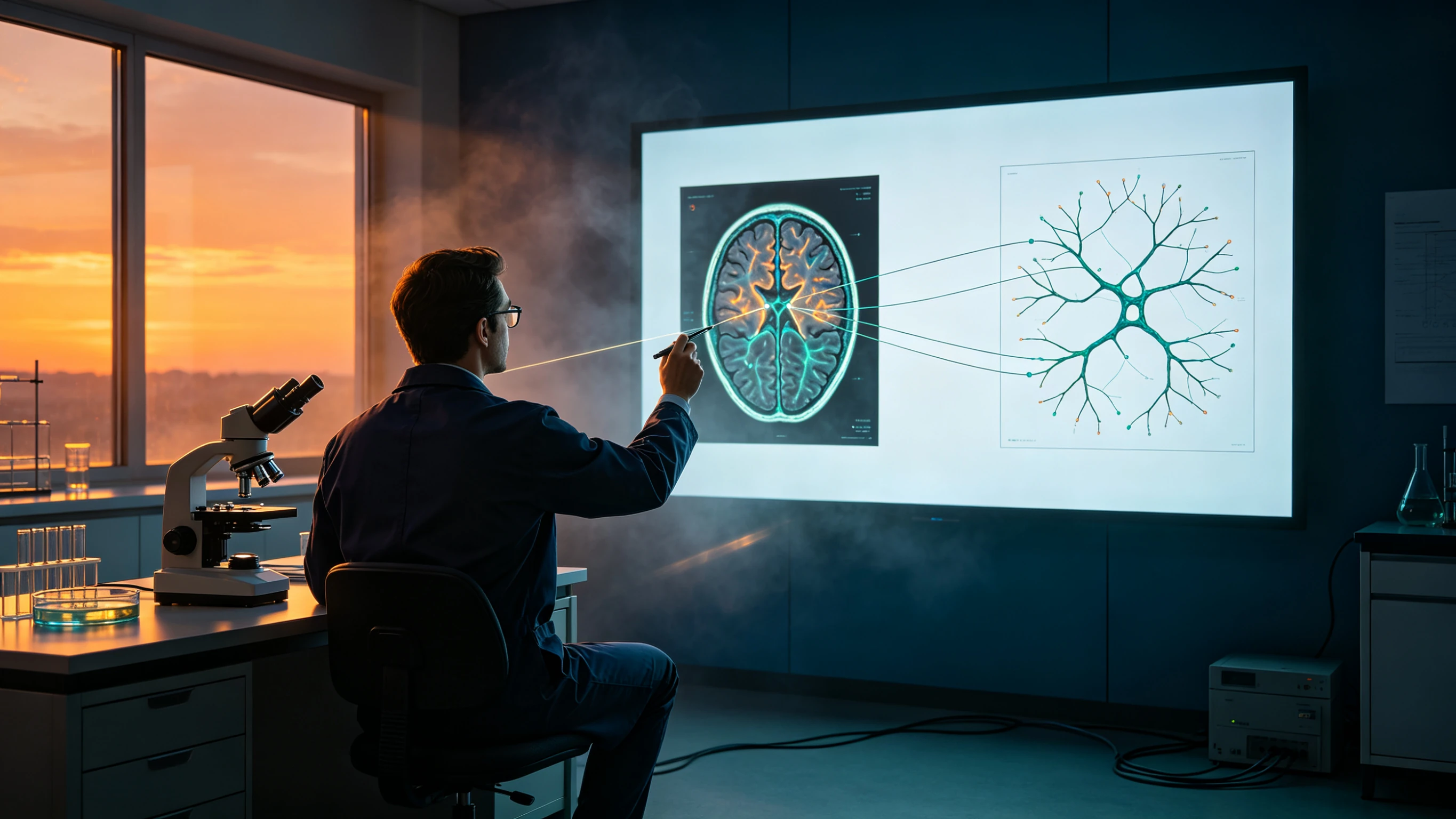
On September 18, Christopher Summerfield of Oxford's experimental psychology department and Kimberly Stachenfeld of Columbia's Center for Theoretical Neuroscience published a commentary in Cell Press' Neuron titled "The recipe for intelligence in natural and artificial systems." The question the two neuroscientists ask is direct: what new principles about intelligence have the past decade of AI breakthroughs actually revealed, and are natural and artificial systems converging on a shared computational logic?
Their answer is yes — with deeper overlap tha
[1][2]n most people assume. The essay maps four shared principles. Generative learning: transformers trained to predict across vast text and code have forced a rethink of the old claim that understanding requires perception and action. Associative memory: the stable abstractions learned via self-attention and scale echo the associative-memory principles of hippocampus and medial temporal lobe — key-value indexing, pattern completion, Hebbian fast encoding. Structured representation: in-context learning and the brain's explicit encoding of embedding spaces both point to "flexible response to novelty depends on representing content and structure together." Precomputed semantics: complex reasoning need not rely entirely on online search — pre-learned semantic structure can simplify planning problems directly.
The most valuable part of the essay is its naming of three unresolved gaps. First, continual learning and memory consolidation: models typically stop updating parameters after deployment, and extending context windows or adding retrieval-augmented generation does not answer "what to store, how long, how to retrieve" — while biological memory consolidation (experience converted into stable knowledge through replay and prioritized selection) offers a possible template. Second, self-monitoring and metacognition: models perform complex tasks while mis-calibrating confidence and drifting goals; the essay notes that current mainstream improvements concentrate in external harness design — control loops, resource allocation, stop mechanisms — which is precisely external control circuitry compensating for weak internal self-monitoring. This converges, from the neuroscience side, with last round's empirical paper on agent harnesses. Third, exploration and creation in open environments: models excel at formal tasks with verifiable outcomes but weaken under noise and ambiguity — discovery comes from sustained interaction with the world, the thing current models do least well.
Placed in the September 2026 context, the commentary offers a coordinate system outside the benchmark race. While the industry competes to refresh leaderboards, two neuroscientists ask which mechanisms these capabilities correspond to in the brain — and which are missing. Continual learning, self-modeling, open-ended exploration: these three gaps are also where agent products most often fail. That is not coincidence. If large models really approximate the brain's computational principles, then the solutions the brain evolved over hundreds of millions of years are likely the next lessons large models must learn.
The stance should be stated: this piece interprets a commentary, not an endorsement of "the brain equals a transformer." The authors themselves stress that transformers do not faithfully simulate biological temporal processes — what is shared is computational principle, not implementation. The real information lies elsewhere: the neuroscience list of three gaps overlaps almost exactly with the problems engineers keep hitting in agent products. When two fields arrive at the same conclusion independently, that conclusion deserves to be taken seriously.
[1][2]