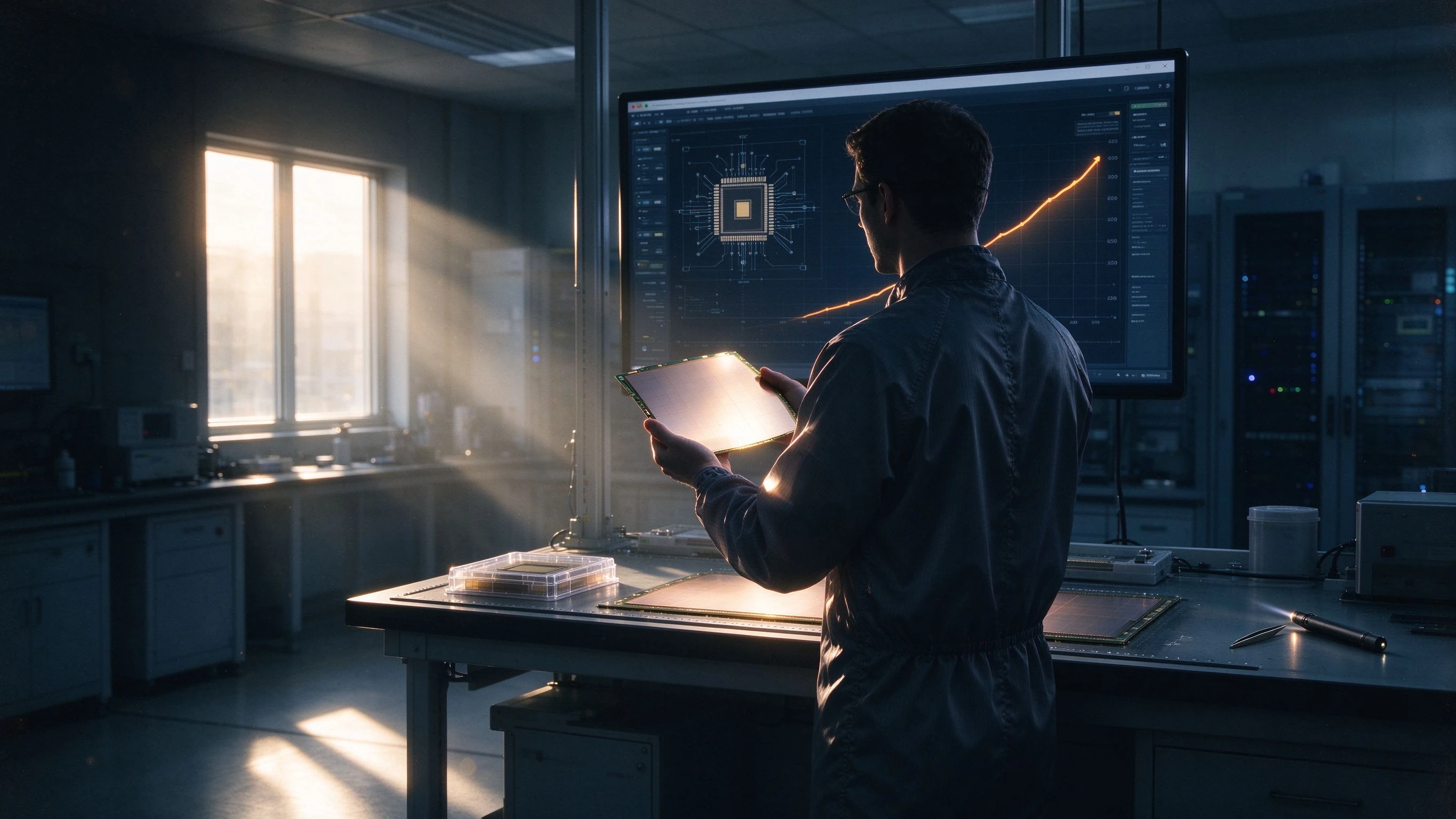
On September 22, at the 2026 Apsara Conference in Hangzhou, Alibaba's chip subsidiary T-Head unveiled its next-generation self-developed AI chip, the Zhenwu V900. Alibaba Group CEO Wu Yongming called it "the most powerful AI chip in China today," claiming three times the performance of the previous-generation Zhenwu M890, with a single cluster scalable to 500,000 accelerator cards. On the same stage he disclosed the ambition for the next flagship model: training a 5-trillion-to-10-trillion-parameter model — roughly four times the size of the current flagship.
[1][2]This is not a routine product launch; it is an infrastructure declaration in which Alibaba plays model, chip, and cloud cards at once. On the chip side, the Zhenwu V900 targets both training and inference, is designed for trillion-parameter-scale models, and mass production and commercial sales are scheduled to begin in the first quarter of 2027 (per People's Daily). On the cloud side, Wu set a target for Alibaba Cloud's global data center capacity to exceed 20 gigawatts by 2032, and framed demand with the judgment that the total amount of machine thinking will reach more than 1,000 times that of humanity. Read together, Alibaba's logic is clear: the scale of the next model generation dictates owning its own chips and compute pools rather than queuing with external suppliers.
Place V900 in the coordinates of domestic Chinese compute and its meaning exceeds "another domestic accelerator." T-Head started with the Zhenwu 810E in 2023, progressed to the M890 (144GB on-chip memory, 800GB/s inter-chip bandwidth), and now the V900, keeping a roughly one-generation-per-year cadence. More importantly, it carries Alibaba Cloud's own training loads — what domestic chips lack is not benchmark scores but "a flagship model actually running on them." Wu's same-stage announcement of a 5T-10T parameter model is precisely the proof problem prepared for V900: the day such a model completes training on a domestic cluster is the day the compute-sovereignty narrative becomes real.
Separate the claims from the uncertainty. The 5T-10T parameter count and the 500,000-card cluster are disclosed planning targets, not delivered facts. The 2027 Q1 mass-production timeline and the "most powerful in China" framing are company claims without independent third-party evaluation; the "3x performance" over M890 holds under the company's definitions, but cross-generation comparison across benchmarks awaits external verification. The verification nodes worth tracking: when new-model training starts, which chip cluster it runs on, and whether the capital expenditure behind the 20GW target can be sustained. A chip launch is only the starting line; the real test happens in the data center.
Read the timing, too. Alibaba announces the V900 and a 5T-10T parameter model plan on the same day that xAI ships Grok 4.7 and Xiaomi open-sources a trillion-parameter MoE — the week's releases form a pattern of Chinese compute and open-weight players pushing on the same axis: model scale, domestic silicon, and aggressive RL investment. Alibaba's specific bet is vertical integration: unlike Xiaomi, which buys its compute, Alibaba can feed its own foundry-level orders through T-Head and run its own flagship training on the result. That is also the risk — a 5T-10T parameter training run is an enormous, high-stakes commitment, and if the V900 cluster underperforms expectations, the schedule of the entire model roadmap slips with it. The company's stated 2032 capacity target implies sustained capital spending that will be judged quarter by quarter in cloud revenue growth. For observers, the cleanest leading indicator is not the chip launch video but the next Qwen flagship release and the chips listed in its acknowledgments: that sentence will say whether the sovereignty story is real.
[1][2]