
On August 26 the Claude blog showed how a terminal company turns “the user was right to complain” into mergeable code. How Warp builds self-improving agents on Claude leads with loud growth stats—$73M raised, 800K monthly developers, 56% of the Fortune 500, 10M Claude Code sessions inside Warp (400K+/week), 40M Warp Agent conversations—but the asset is the two-layer skill loop.
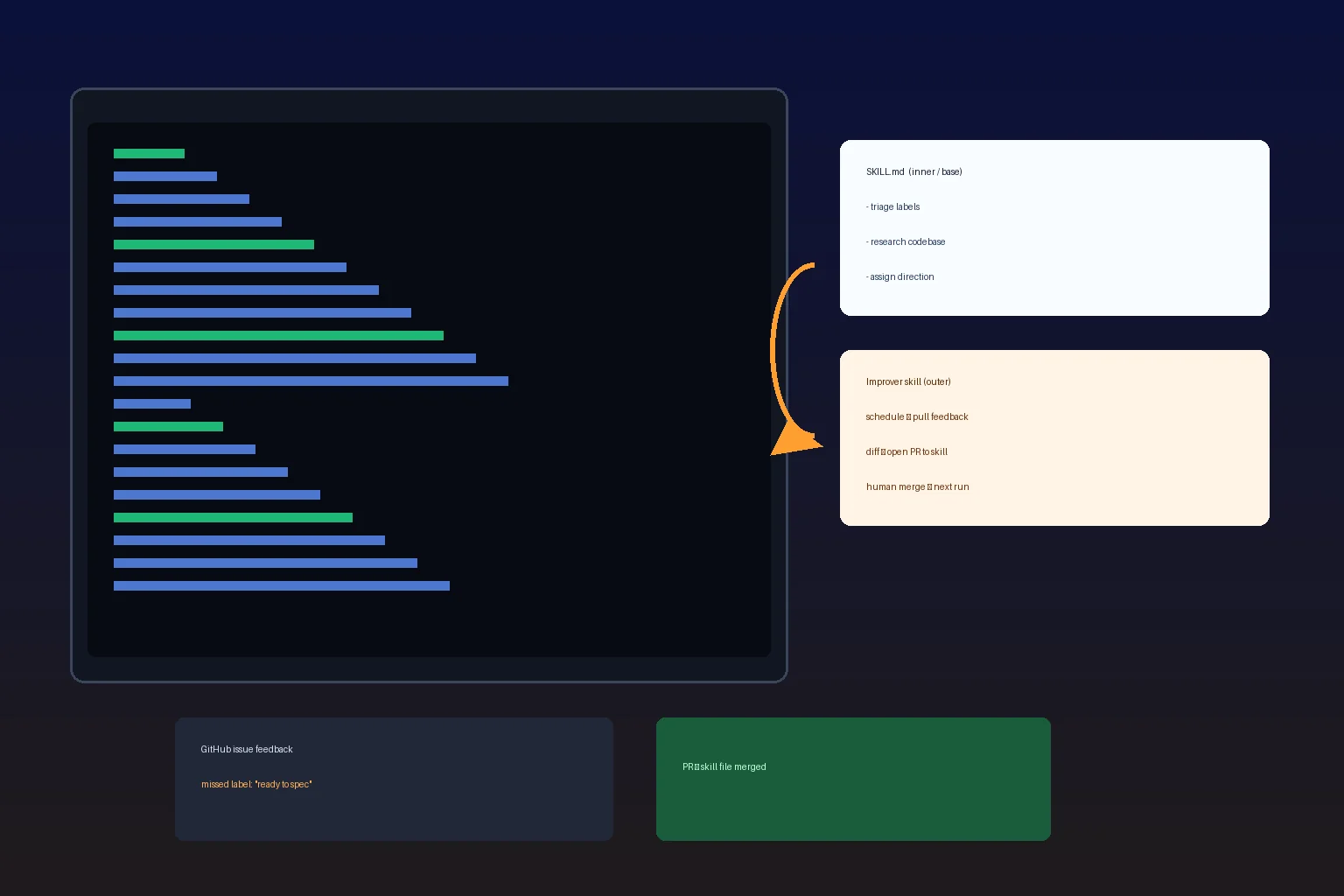
The pain is concrete: a first-pass prompt that scores 80% leaves a noisy product. Warp’s answer is inner base skill + outer improver skill + in-situ human feedback → PR against the skill file.
[1]How the two skills turn
Officially, the base skill holds domain knowledge and instructions—for example, a code-review agent runs from it when a PR opens. Human feedback can be a thumbs-up; better is spelling out why a rename violates global naming conventions.
The outer improver does not ride every task. On a schedule it pulls accumulated feedback, compares agent suggestions to human responses, and proposes a small, focused edit to the base skill. Because skills are plain files, agents are good at editing them; changes flow through normal PR review, and the next inner run inherits the merge.
Issue triage is the worked example: a new GitHub issue fires an Action; the agent gauges complexity, applies labels, suggests a fix direction. The inner skill defines label meanings and research steps. In one sample it missed ready to spec—the signal that contributors can start product/technical specs. A maintainer wrote expectations and reasons on the issue; a scheduled “update triage” agent on Oz (Warp’s orchestrator) authenticated to GitHub, ran a Python helper bundled with the skill, summarized feedback to JSON, and opened a PR against the skill file. Warp says the pattern now spans spec-writing, review, and triage agents across its open-source repo.
Why file-based skills beat longer prompts
Author’s judgment: the leap is not a smarter Claude, it is fishing improvement out of session memory into a diffable, reviewable, revertible artifact. Longer prompts rarely become organizational memory; skill files in Git align agent improvement with human engineering culture.
Bundling scripts instead of regenerating code each run is a practical detail—less drift, more reproducibility. For agent-product teams, the message is blunt: stop shipping chat wrappers; ship feedback→artifact→merge loops.
[1]What it means for the devtools fight
Warp sits in the AI terminal / agentic IDE lane on the Claude Platform. The numbers show distribution; the self-improve loop argues for quality slope and retention. For Anthropic, it is a customer story: Claude is not only writing code, it is inside a customer’s agent OS.
For other coding agents, the comparison is less “who chats better” than “who turns corrections into versioned policy.” Limits are clear: this is a case study without public before/after accuracy; feedback quality caps the ceiling; humans still own the merge gate.
[1]Columnist view
I like the piece because it drags “agents learn” from myth into engineering: learning happens in Git, not mystical memory. Missing ready to spec shows first skills will be wrong; the value is that wrongness can be written into the next file.
The risk is outsourcing every product fix to “run the improver again”—sparse or emotional feedback will drift the skill. Over 6–12 months, watch whether Warp publishes before/after metrics, and whether peers copy the outer-observer + skill-PR skeleton.
[1]