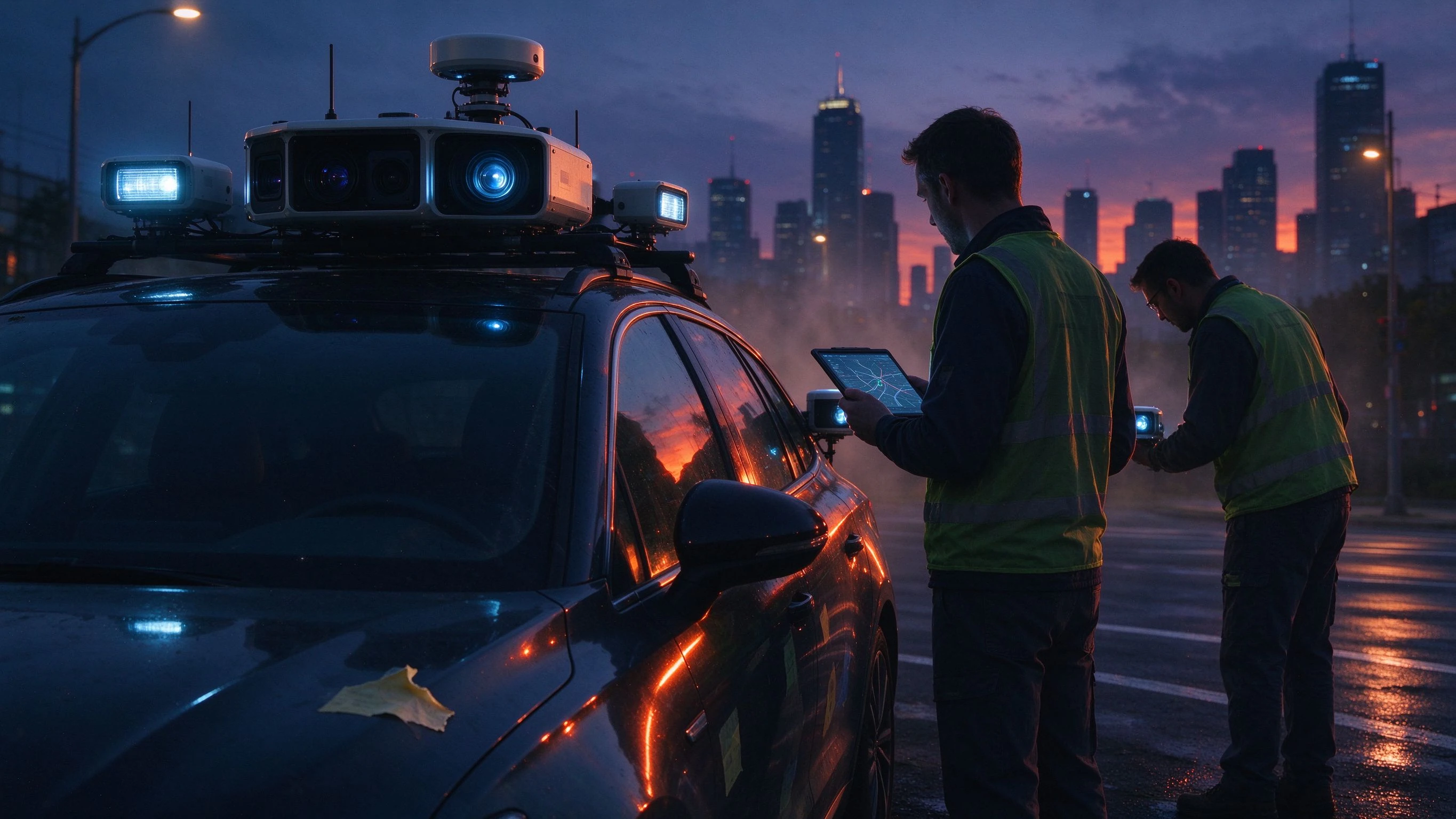
On September 22, Mercedes-Benz and UK-based embodied AI company Wayve announced a definitive production agreement: within two years, the Wayve AI Driver will be integrated into Mercedes-Benz production vehicles, delivering point-to-point urban and highway advanced driver assistance. It follows Mercedes-Benz's strategic investment in Wayve's $1.5 billion Series D in February — the step from an investor relationship to a delivery relationship.
[1][2]The nut graf: the weight of this deal is not the money; it is that a European luxury automaker is willing to hand "the brain that drives" to an end-to-end AI company. Wayve's approach replaces HD maps and rule stacks with cameras plus an end-to-end driving model. The system is currently L2, requiring continuous driver supervision, but its pitch is human-like driving behavior at lower hardware cost. Mercedes choosing Wayve is a public admission that, in intelligent driving, the software stack an automaker builds in-house may not beat the model of an AI startup.
Stretch the timeline and this is not out of thin air. Wayve raised $1 billion Series C in 2024 (Microsoft, NVIDIA, SoftBank participated) and closed a $1.5 billion Series D in February 2026 with Mercedes-Benz, Nissan, and Stellantis as investors — the industry's strategic capital was already betting on the end-to-end route. What is genuinely new is the word "production": Wayve moves from technology validation into the automaker supply chain, while Mercedes obtains an advanced-driving solution without building and feeding a thousand-person software team from scratch. Electrek's coverage stresses the timeline: on the road within two years, an unusually fast cadence for automotive.
It also puts the global route divergence in advanced driving on the table. Chinese vendors mostly take an engineering path of HD maps plus perception plus rules, prioritizing controllability and explainability. Wayve represents the opposite pole: vision-only end-to-end, trading data and model scale for capability. Each route carries costs: the engineering path is expensive and map-heavy; the end-to-end path demands expensive training data and makes accident attribution hard. Mercedes' choice hands the latter a production endorsement — but the L2 designation also says it is not yet ready to hand the steering wheel fully to the model. What to watch next: whether the urban point-to-point capability actually lands on the vehicles in two years, and who owns liability when something goes wrong.
One more layer worth noting: this deal lands as Wayve's robotaxi program with Uber is starting in London in 2026 and expanding to more than ten cities. The company is simultaneously selling two products — an L2 driver-assist system to automakers and a fleet service to ride-hailing platforms — and the Mercedes deal is the part of that strategy that produces revenue without owning cars. For Mercedes, the deal is also a hedge: it keeps a European luxury brand in the end-to-end conversation without committing the resources DeepSeek-style Chinese players are pouring into the engineering route. The interesting tension is whether Wayve can serve two masters — a cautious automaker that wants predictable L2 behavior, and an autonomous-fleet business that needs aggressive disengagement reduction — with the same model family. That tension, more than the chip count on the sensor stack, will determine whether the production agreement survives its first real-world winter.
[1][2]