
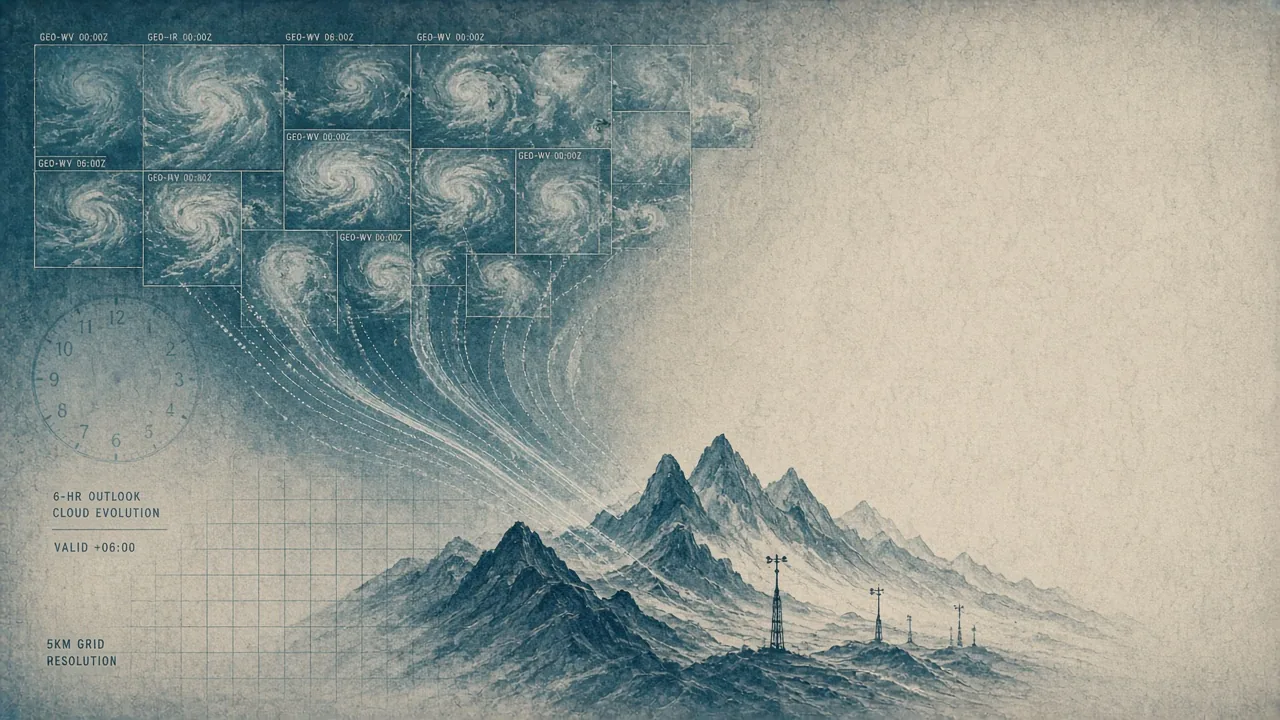
On 3 September 2026, Google DeepMind and Google Research published a WeatherNext team post introducing WeatherNext 3. Fact: the model is described as learning from live geostationary satellite mosaics and emitting a new global forecast every hour, rather than relying only on numerical weather prediction (NWP) analyses that the post says carry about a six-hour data lag. Claim (Google, citing Brightband): it is the most advanced and accurate global weather AI model to date, according to independent live evaluations by Brightband. Also stated: for official forecasts, severe-weather warnings, and public-safety advisories, users should still consult their local meteorological agency or national weather service.
That pairing—an observation-native technical leap plus immediate distribution across Google products—is the story. The science claim is bounded; the product claim is large.
[1]What actually changed in the model
Most recent AI weather systems, including WeatherNext 2 on Google’s own telling, were trained primarily on NWP reanalyses or analyses: physics-based, supercomputer-driven fields that are already a processed representation of the atmosphere. Useful, but lagged. WeatherNext 3’s central design move, as described in the post, is to ingest a mosaic of live global geostationary satellite data into a single Functional Generative Network (FGN) mesh transformer, alongside traditional historical analysis. The architecture diagram on the page also shows dense gridded fields, discrete cyclone tracks, and native prediction at sparse station coordinates.
Resolution is not one number. Fact (as stated): key surface variables such as temperature and moisture are visualized at 5-kilometre resolution; other surface variables at 10 kilometres; atmospheric variables such as wind speed at 25 kilometres. Overall, the post says this is roughly five times sharper than WeatherNext 2, which ran on a 25-kilometre grid in six-hour increments. Hourly refresh matters for storms and fronts that organize faster than a six-hour cycle; five-kilometre surface fields matter for valleys, coasts, and ridgelines where temperature and humidity can change over a few kilometres.
The model also trains directly on sparse weather-station observations so that a global five-kilometre grid can reflect local topography—an explicit attempt to escape the over-smoothed thermal fields the post illustrates for WeatherNext 2 over the UK. Precipitation is trained on NASA’s IMERG satellite retrievals and on Google’s own satellite-radar precipitation reanalysis. Clean-energy variables are named explicitly: 100-metre wind (roughly turbine height), high-resolution cloud cover, and sun radiation at the surface.
[1]Evidence, company numbers, and what is still thin
What is relatively strong on the page’s own terms: a named architectural shift (live mosaics → FGN mesh transformer → hourly output); a concrete resolution ladder against a named predecessor; named precip training corpora; named distribution paths; and an independent evaluator named in public (Brightband), with a link to live leaderboards.
What remains company-reported and should be labelled as such: Continuous Ranked Probability Score (CRPS) improvements of up to 60% against IMERG, 30% against MRMS, and 10% against rain-gauge measurements at early lead times; and, on the product side, “up to 50% more accurate precipitation forecasts” when planning a day or more ahead inside Google surfaces, with the greatest gains “in regions where forecasts have historically been less reliable.” Those percentages are not accompanied, in the blog text, by full lead-time tables, geographic masks, or a peer-reviewed methods appendix. The linked paper is advertised; this desk did not re-parse it.
Steelman counter: grant Brightband’s live ranking and grant that CRPS gains against IMERG/MRMS/gauges hold under outsider scrutiny. Then WeatherNext 3 is doing something the field has wanted for years—closing the gap between AI weather models and the sensors that actually see convective systems form—while shipping the result into tools people already open. On that steelman, skepticism about “another Google weather demo” undersells a real data-path change. The fair test is not tone; it is whether independent live scores stay up, and whether national services find the fields usable or merely pretty.
[1]Distribution is the product thesis
Research applied “across the ecosystem” is not a footnote here; it is half the announcement. Fact: Google says high-resolution forecast data, updated hourly, is queryable in BigQuery and Earth Engine, or bulk-downloadable from Google Cloud Storage, with no model setup required. The same generation is said to begin powering weather experiences in Google Search, the Gemini app, Google Maps, the Google Maps Platform Weather API, and Google Earth Engine.
That is a different kind of power from publishing a checkpoint. A five-kilometre, hourly field that lives only in a research bucket changes conference slides. The same field inside Maps and Search changes weekend packing decisions for hundreds of millions of users—and changes the default weather layer available to developers who never train a model. The post’s own human-scale examples are deliberate: packing for a weekend trip; choosing a day for outdoor activity; emergency responders, air-traffic controllers, farmers; grid operators matching turbine-height wind and surface radiation to demand.
Inference (labelled): the commercial and civic leverage of WeatherNext 3 is Google’s surface area more than any single CRPS headline. Rivals can match mesh transformers; fewer can put a refreshed global field into Search, Maps, and a Maps Platform API on the same day.
[1]Underserved regions, and the disclaimer that still matters
The post argues that high-fidelity regional modelling has historically been expensive to run, leaving parts of Latin America, Africa, and Asia-Pacific underserved. A global five-kilometre observation-aware model is offered as a way to bring localized forecasts to those regions without spinning up a traditional regional NWP centre. That aspiration is morally attractive and technically plausible; it is also, for now, a company aspiration measured largely by company metrics and Google product telemetry.
Hence the closing disclaimer is not boilerplate to skim past. National meteorological services remain the authority for warnings and public-safety advisories. Brightband can rank live skill; Google can improve precip probability in Maps; neither replaces a duty meteorologist issuing a flood warning. The atmosphere, the post itself concedes, retains unpredictability. Observation-native training reduces one class of lag bias; it does not repeal chaos.
[1]Six-month watchpoints
Watch three concrete signals. First: do Brightband’s independent live leaderboards continue to place WeatherNext 3 where Google says it sits, against named rivals, through a full season of convective weather—not only the launch window? Second: do the company-reported CRPS gains against IMERG, MRMS, and gauges appear in a paper or third-party eval with reproducible lead times and regions, or do they soften? Third: do national services and energy operators treat BigQuery / Earth Engine / Maps Platform fields as operational inputs—or as a convenient consumer-grade layer that still needs official guidance on top?
If the observation-native path holds under outsider scores, the lasting shift is methodological: weather AI stops being mostly an NWP mimic with a nicer decoder, and becomes a system that refreshes from the sensors that see the sky now. If the scores fade or the product claim outruns the science claim, what remains is still formidable—Google’s ability to put a new field into the apps people already trust for umbrellas, flights, and weekend plans. Either way, the fences named on day one—Brightband and the national-service disclaimer—are the right ones to keep watching.
[1]