
要点
- Xiaomi open-sources MiMo-V2.6 Pro/Flash and frames RSI around scaled RL on verifiable complex tasks.
- Six days of live RL: about $0.85M (Flash) and $2.62M (Pro), ~750k trajectories, with clear out-of-sample DeepSWE v1.1 gains.
- API pricing holds at V2.5 levels—roughly 1/20 to 1/60 of overseas peers at comparable intelligence—eroding frontier price power.
- The release ships 7k+ RL task environments, an end-to-end RL stack, and composable harnesses, putting the recipe into the commons.
While the industry still argues whether large-scale pretraining has plateaued, Xiaomi answered with a six-day live reinforcement-learning run: the next jump in intelligence may live less in ever-larger corpora and more in longer, harder, verifiable interaction trajectories.
The Xiaomi MiMo-V2.6 family (Pro / Flash) is now released and open-sourced. It is not merely another set of open weights—it publicly schedules scaled RL compute and a recursive self-improvement (RSI) narrative. For frontier labs such as Anthropic and OpenAI, the headline is less the leaderboard number than the fact that open models are closing on a training paradigm once reserved for closed stacks, with a reproducible engineering path.
[1]The event: six days of live RL on the public calendar
The release cadence is itself news. The team aired the RL run live: under six days, Flash and Pro cost about $850k and $2.62M, completed 30 steps each, and accumulated roughly 750k trajectories.
On outcomes, average pass rates on training tasks rose 25% (Flash) and 12% (Pro); the out-of-sample long-horizon software-engineering benchmark DeepSWE v1.1 gained about 17 points (48.8 → 65.68) and 14 points (58.4 → 72.57). Together these numbers show sample efficiency, continued improvement, and out-of-sample generalization—reproducibility turned from slogan into deliverable.
[1]Three axes of RL compute scaling
Batch and throughput
- Key practice
- 1,568 samples per update; 1M context; 2.7–3.7B tokens per step
- Effect
- Moves RL from lab stovepipe to industrial pipeline
Tasks and environments
- Key practice
- Code / General / Visual / Cyber multi-task mix with multiple harnesses
- Effect
- Forces generalization to unseen frameworks
Grader compute
- Key practice
- Within-group relative comparison for long-horizon rewards
- Effect
- Closes the self-improvement loop and shortens solutions
Technical path: RSI as measurable scaling, not mystique
Xiaomi splits RL compute scaling into throughput, task complexity, and grader compute. On stability, the team froze the MoE router to curb expert-load drift and built reward-hacking defenses spanning reward design, adversarial evaluation, anomaly detection, and verifier cross-checks. Unified trajectory schemas, control/data-plane decoupling, and mixed-batch sampling discipline often decide whether large-scale agentic RL finishes—or collapses.
Desk view: Xiaomi’s RSI framing is relatively restrained—no claim that models rewrite their own weights, but a recursive loop of verifiable complex tasks → scaled RL → expanding boundaries. That definition is closer to a research program the community can falsify.
[1]From Vibe Coding to Vibe World
3D open-world games
- Representative capability
- Multi-agent scene building, interaction logic, visual verification
- Industry meaning
- Lower cost curves for game/sim content
Blender 3D modeling
- Representative capability
- Text/image to assets for animation, print, and games
- Industry meaning
- Agentified design toolchains
Embodied AI
- Representative capability
- Closed-loop Franka Panda control from multi-view cameras
- Industry meaning
- VLA and software-agent skills converge
Computer Use
- Representative capability
- Complex GUI and office/productivity tools
- Industry meaning
- Direct CUA productization race
Science and creation: general reasoning absorbs specialized work
Two research cases merit frontier-lab attention. First, a materials co-scientist workflow for MOF designs targeting PFAS adsorption: literature/patent synthesis, hypothesis generation, novelty assessment, then dry-lab screening with open computational tools. Second, guided by a researcher-designed exploration strategy, the model helped fully formalize the main theorem of Li–Yorke’s Period Three Implies Chaos in Lean 4—about 6,000 lines of kernel-checked source with no sorry placeholders—and without Lean-specific post-training.
On the creative side (frontends/PPT, end-to-end video, orchestral demos), aesthetics and engineering are being pulled into the same objective. If Design Arena parity with Claude Opus 5 and GPT-5.6 Sol holds, “looks good” is becoming an optimizable metric rather than soft taste.
[1]The intelligence–cost curve: open models’ sharpest weapon
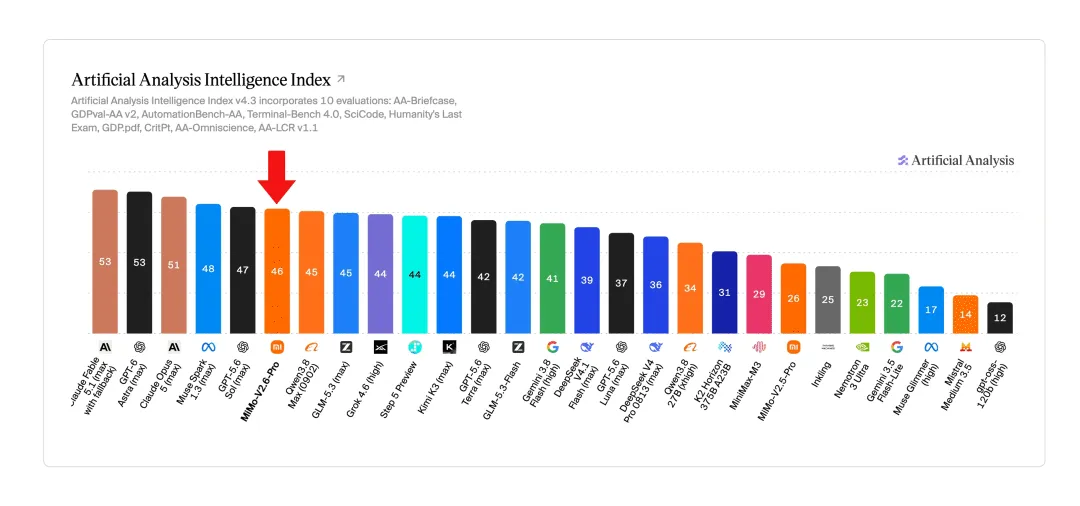
On the official account, MiMo-V2.6-Pro scores 46 on the Artificial Analysis Intelligence Index—above Kimi K3 and Qwen3.8 Max as the strongest open model, still short of the top closed models. The industrial shock is pricing: V2.5 API prices hold while intelligence rises, about 1/20 to 1/60 of overseas models at comparable intelligence.
Two consequences follow. For enterprise buyers, open weights plus very low inference cost plus local deployment turn frontier capability from a subscription product into embeddable infrastructure. For frontier labs, the gap remains—but the pricing power attached to that gap is thinning, as buyers price unit-task cost rather than brand reassurance.
[1]Open delivery: the training recipe goes public
Beyond weights and a tech report, the release ships 7k+ high-quality RL task environments (software engineering, vulnerability reproduction, knowledge work, web design/dev), an end-to-end RL stack on verl / uni-agent / mini-swe-agent, and lightweight composable harnesses supporting Multi-Harness Training.
Reproduction deltas from MiMo-V2.6-Distill-Qwen-9B are also public: SWE-bench Verified 61.1→66.2, MiMo Cyber Bench 31.3→47.0, Terminal Bench 2.1 37.1→52.8, MiMo Visual Coding 64.0→72.4—11 evaluations improved over SFT baselines.
An indirect question for closed labs: when environments, reward pipelines, and harness composition enter the commons, how long can advantage rest on bigger clusters and tighter data flywheels alone?
[1][2]Three implications for frontier labs
1. Scaled RL is becoming the differentiation front. Pretraining races continue, but the center of gravity moves to longer interactions, more trustworthy rewards, and out-of-sample transfer.
2. Verifiability is the entry ticket to RSI. Anchoring RSI in verifiable complex tasks avoids bolder self-rewriting claims and elevates reward-hacking defenses and verifier cross-checks—expanding the research dialogue with scalable oversight.
3. Open models are tracing the outline of the capability frontier. Tracing an outline is not matching the peak, but it reshapes markets. Competition shifts toward latency and throughput, vertical integration, and enterprise control and compliance.
[1]Where the way is easy, travelers crowd; where it is hard and far, few arrive. Easy to copy are weights and demos; hard to copy is pouring compute into real environments and letting models learn by trial and feedback.