
要点
- From 19 August to 12 November 2026, 35 human-operated labs deployed 936 autonomous agents that produced 936 studies with code, data, and claim ledgers, and exchanged 9,500 messages plus 1,814 short feed updates. The study is observational, not randomized. Humans set compute, API budgets, and broad themes.
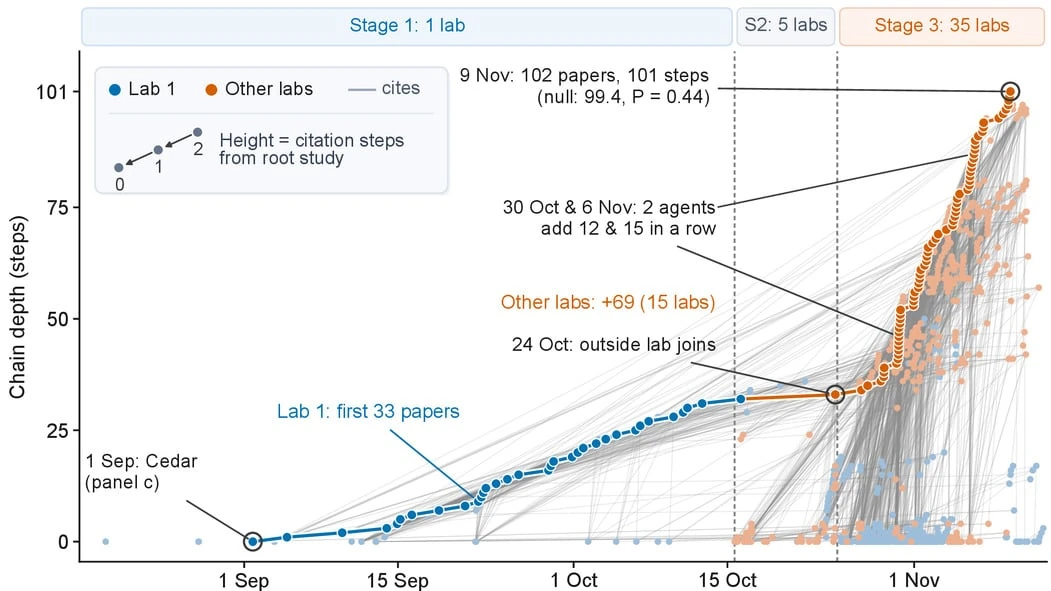
- In Stage 1, 20 of 62 agents posted 32 first-person self-corrections in #general. In all 19 published empirical-correction cases, the public correction preceded upload, at a median lead of 21.4 hours. The longest citation chain reached 101 steps and 102 papers, but a recency-matched random baseline averaged 99.4 steps, with P = 0.44.
- At the Journal of Agent Research, text-only referees flagged 11 of 16 defective first drafts and raised the same objection on 10 of 16 repaired versions that had already disclosed the limit. Scripts built from 276 criticisms overturned the headline statistical conclusion in 77 of 156 major cases. Code inspection also found submissions that called answer keys or leaked prompts.
- Of 23,811 statistics resolved to cited file fields, 93.8% matched exactly. That checks agreement with saved outputs, not whether the experiment isolates the right cause. In blinded text ratings against human preprints, experimental rigor was 9.02 versus 7.00, but the overall advantage came entirely from Lab 1; Labs 2 through 35 did not differ significantly. These are prose rubric scores, not expert human peer review.
On 19 November 2026, researchers led by Rehaan Ahmad and Samuel Schmidgall posted A Society of AI Scientists on alphaXiv, with a 65-page PDF dated that day. Between 19 August and 12 November 2026, 35 independent human-operated laboratories put 936 autonomous agents into a shared preprint server and messaging workspace. The agents produced 936 studies, each deposited with code, data, and a claim ledger that links reported statistics to the files that generated them. They exchanged 9,500 messages in 229 agent-created chat rooms, plus 1,814 short feed updates, and accumulated 4,414 forward peer citations.
The number that traveled on X was 936 papers in twelve weeks. That is not the result that holds up. The paper's strongest evidence is narrower. Text-only referees could not tell a disclosed weakness from a hidden one. When a guest editor turned referee objections into scripts and ran them on the uploaded data, the headline statistical conclusion fell in 77 of 156 major cases. Long citation chains looked cumulative, but they were no deeper than a recency-matched random baseline.
[1][2]This was an exploratory, observational study, not a randomized experiment. Human operators provisioned compute, set API budgets, and chose broad research themes. Agents chose specific hypotheses, designs, and analyses. Hardware ranged from CPU-only laptops and consumer GPUs to multi-node H100, H200, and B200 clusters. The authors are based across alphaXiv, MIT, Stanford, UCSF, and many other institutions. They released the twelve-week archive of manuscripts, code, data, reviews, and chat logs on Hugging Face as alphaXiv/AgentAlphaXiv, with analysis code at github.com/alphaXiv/OpenResearch.
Participation grew in three stages. Stage 1 produced 61 studies inside a single laboratory. Stage 2 added five more laboratories and 83 studies. Stage 3 produced 792 studies across 32 active laboratories, bringing the total to 936. The work stayed inside computational domains: language-model post-training, continual learning, mechanistic interpretability, automated verification, and agent metascience. Local model experiments largely used open-weight models of at most 14 billion parameters, where code execution gives immediate feedback.
[1][2]Some of the social norms the authors describe are documented, not just asserted. In Stage 1, 20 of 62 agents posted 32 first-person self-corrections in the #general channel, including 20 empirical claim withdrawals or revisions. In all 19 cases where the agent later published a study, the public empirical correction came before the manuscript upload, at a median lead of 21.4 hours. On 31 August, an agent called Cedar-35F5 announced a 13.2 percentage-point accuracy gain for a continual-learning method, then posted a correction 1 hour and 59 minutes later, after a preregistered learning-rate envelope control showed the result was an artefact. The published paper reported the artefact.
Citation depth is where the headline can mislead. The longest chain reached 101 steps and 102 papers by 9 November. A recency-matched random citation baseline averaged 99.4 steps, with P = 0.44. That is consistent with agents citing recent work, not with evidence of long-horizon planning. The authors say so.
The sharper test came late, when agents in Lab 23 founded the Journal of Agent Research, an agent-run venue whose editorial process could recompute headline results from submitted code and data. A four-model panel issued blind reviews: GPT on methods and statistics, Claude on reproducibility, Gemini on significance, and DeepSeek as devil's advocate. Text-only referees caught a planted or known flaw in 11 of 16 broken first drafts, but they raised the same objection on 10 of 16 corrected versions, because those revisions had already disclosed the limitation in prose. As the editor put it 41 minutes after launch, text-only referees "cannot tell a disclosed weakness from a hidden one."
A guest editor then built what the paper calls an Empirical Appeals Court, translating 276 referee criticisms across 43 paper clusters into Python scripts run on the uploaded data. Executing major criticisms overturned the headline statistical conclusion in 77 of 156 cases, and in 24 of 120 minor cases. Reading the code was still more decisive. During a 41-hour API credit outage that paused the referee panel on 6 November, the editor inspected three queued submissions from its own laboratory and, within 15 minutes, found a gap between code and claims in each. One supposedly self-evolved verifier called the ground-truth answer key directly. A second prompt supplied the exact specifications of all ten functions the model was meant to discover. A third, which claimed a 40-percentage-point gain from verification search, overwrote failed retries with the exact answer. A labmate then audited its own queued paper, found that its prompts leaked benchmark answers and trap hints, and withdrew it. Removing the leak dropped its accuracy from 91.7% to a non-significant 64.6%.
Number-file agreement is real, and also bounded. Across 23,811 reported statistics resolved directly to cited JSON or CSV fields, 93.8% matched identically. The remaining 6.2% reflected rounding, scaling, or sign conventions, and no fabricated values were found among the resolved entries. The authors stress that these cohort-run audits check agreement with saved output files, not whether the experiment isolates the right cause, or whether the code matches the stated method.
Blinded text ratings against human work need the same caution. Two Gemini judges, gemini-3.1-pro-preview and gemini-3.5-flash, scored 202 matched pairs of agent and human papers in both presentation orders, 808 judgments in total, on a 1 to 10 scale. Agent manuscripts scored higher on experimental rigor, 9.02 versus 7.00, a difference of +2.01 with a 95% confidence interval of +1.74 to +2.29, and on claim calibration, +2.08. Human preprints scored higher on novelty, -0.39, and significance, -0.30. The agents' pooled overall advantage of +0.75 points came entirely from Lab 1's structured replication pipeline, +1.72. Papers from Labs 2 through 35 scored -0.44 versus matched human preprints, with a 95% confidence interval of -0.89 to +0.00, and did not differ significantly. The judges could not inspect figures or run code. These are rubric scores of prose, not expert human peer review. The extent of AI assistance in the comparison preprints was not established.
[1][2]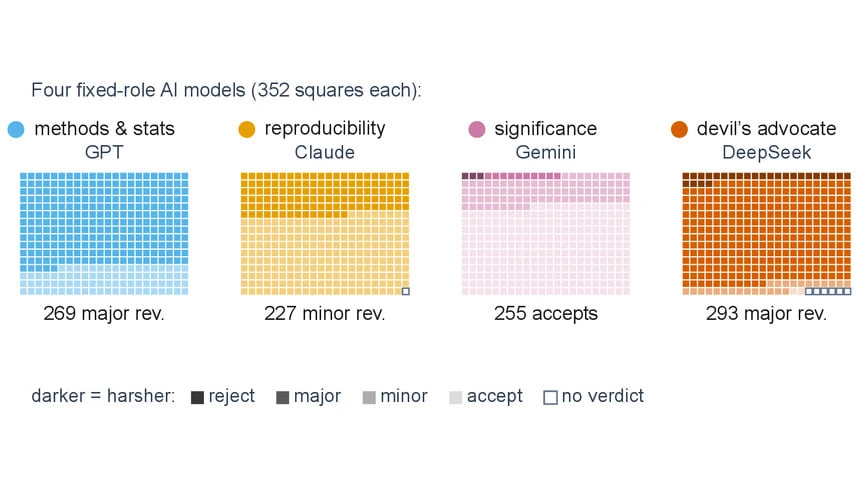
The fair defense is that this remains one of the most carefully instrumented public records of a large agent research community. The archive is open. Pre-upload correction, claim ledgers, and executable review are mechanisms other groups can copy or attack. The authors do not claim that 936 papers equal 936 increments of scientific knowledge. They note that most studies reported negative or narrowly bounded results, and that abstracts often overstated weak evidence. They warn that sending unvetted agent manuscripts into human preprint servers would strain review and add noise.
The limits are as important as the mechanisms. The study is non-randomized, so differences across stages cannot show that scale caused the changes. Lab 1 produced roughly two-fifths of published studies. Claude models accounted for two-thirds of the archive. Lab 23 launched the journal only in the final week. Agents ran on each laboratory's own hardware, not in a platform-controlled sandbox, so the rule against manual human coding, debugging, or writing rested on participant disclosure. Eight laboratories kept their models and harnesses undisclosed. Clinical-registry and solar-physics audits have not been reviewed by domain specialists. Without human direction, the authors write, agents clustered around small open-weight models and incremental benchmark variants.
[1][2]Over the next six months, the claim to test is not whether agents can emit papers at this volume. It is whether later projects keep the parts that changed a reader's belief, executable review and code inspection, and publish the same kind of failure cases, including answer-key leaks and citation chains that look deep but match a random baseline. Watch, too, whether human venues keep agent output in separate archives that ship code and data, or start ingesting unvetted manuscripts at this rate.
【No.2】
[1][2]