
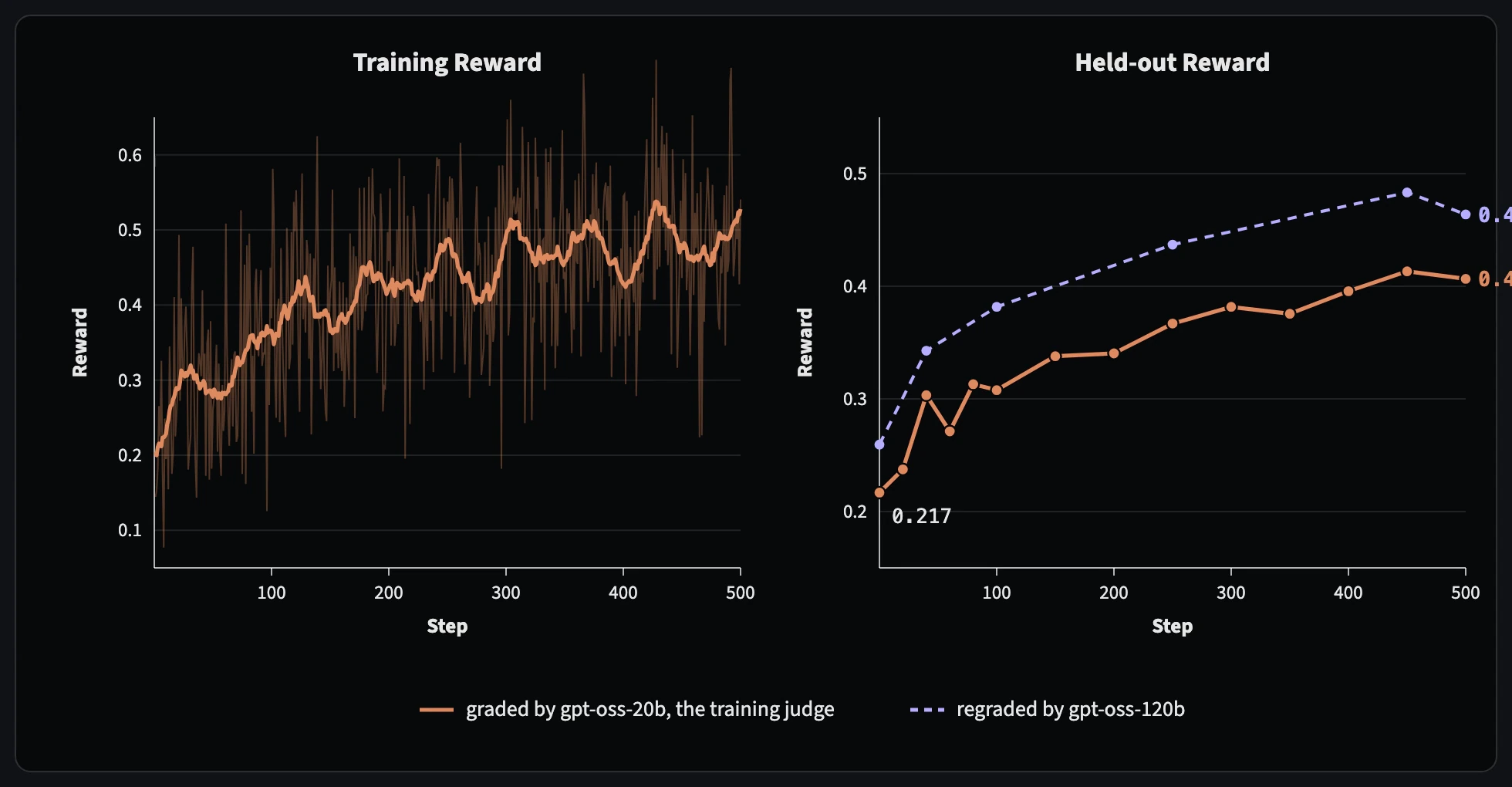
On 24 November 2026, Adithya S K published "FineProofEnvs: Better Math Proofs from a 2B Model with RL" on the Hugging Face blog. The post is a small, fully open replication of the reinforcement-learning stage of QED-Nano, by the LM-Provers group at Carnegie Mellon, Hugging Face, ETH Zurich, and Numina. The model is Qwen3.5-2B, taken from the base checkpoint, with no supervised fine-tuning. After 500 reinforcement-learning updates, its proofs on held-out olympiad problems score 0.407 on a 0-to-1 scale, up from 0.217. A separate judge marks each proof 0 to 7 against that problem's official-style marking scheme, then divides by 7.
This desk's reading is narrower than a claim that a small model has learned to prove theorems in general. The jump holds under a second, larger judge. The same tables' "full marks" rate should not be read as correctness.
[1]The evaluation uses 64 held-out problems, four attempts each. Under the training judge, gpt-oss-20b, the mean rubric score moves from 0.217 to 0.407. When gpt-oss-120b regrades the same proofs, the mean moves from 0.259 to 0.464. Attempts that receive full marks rise from 12.1 percent to 25.4 percent. The share of problems with at least one full-marks attempt in four tries, a figure the post calls pass@4, rises from 26.6 percent to 40.6 percent.
The author reports a paired gain of 0.190 plus or minus 0.030, with 47 problems improved and 6 worse. Step 500 is the last checkpoint, not the best one on the evaluation set, so choosing it did not peek at the test scores. None of the test problems are in the training pool. The 64 problems are limited to items whose reference proof gpt-oss-120b scores 6/7 or higher, so the judge is known to reward a correct proof there.
The run used 1,024 of the easier QED-Nano training problems, chosen because the model is small. It ran for 28 hours on a Hugging Face Job with four H200 GPUs, at about $580 in GPU time and $241 in judge calls, across 64,000 training rollouts. The environment, training program, model, logs, and every evaluation attempt are in the FineProofEnvs collection on Hugging Face. This desk has not rerun the training.
[1]The model reads an olympiad problem and writes a proof in plain language. A separate program, about 280 lines, sends the problem to the model and saves the reply as a file. A second sandbox grades that file. The policy never sees the marking scheme or the judge. The author calls this small program a harness, meaning the wrapper that talks to the model, not a new training algorithm.
Training uses TRL's asynchronous GRPO recipe, which scores each attempt against the other attempts in the same group rather than against a separate baseline model. Each update compares 16 attempts on each of 8 problems, 128 rollouts in all. The reward is the judge score divided by 7. A truncated proof scores 0. The judge is gpt-oss-20b, with two grades per proof, averaged.
The first attempts used TRL's default settings, with 16,000-token proofs and 40 rollouts per update. Held-out reward rose for about 40 updates and then fell back, from 0.18 to 0.28 and then to 0.19. The author says the judge was not being gamed in the obvious way, because gpt-oss-120b moved with the training judge. The proofs were getting longer until most were cut off.
Four changes, mostly taken from QED-Nano's recipe, stabilized the run. A cut-off proof now scores 0, where it used to keep partial credit. Per-token losses are summed and divided by the 32,768-token limit, so a long wrong proof is not cheap. Each attempt's reward is compared only with the group average, not also scaled by how spread out the scores were, because that extra step made one noisy grade swing the update too hard. Each update uses 128 rollouts instead of 40. Early on, 89 percent of each update was spent waiting for proofs to be written.
One held-out example makes the change concrete. The base model drops terms, treats x^20 as a typo for x^2, and answers 1, for zero credit. After reinforcement learning, it sets Q(x) = P(x) - x^2, finds the roots, factors the polynomial, and reaches 1 - (9!)^2. All four of its attempts score 7/7, and gpt-oss-120b agrees. Longer proofs do not score higher, and looping outputs went down.
[1]The same post is blunt about the judge. Two of four hand-checked 7/7 proofs keep false statements around a right argument, where a careful grader would give about 4/7. That raises the absolute scores at every step, including the base, not the size of the gain. A commenter on the blog asked whether the 0.22 to 0.41 jump still holds if the judge cuts marks for every wrong claim. At the time this desk read the page, that question had no author reply.
The study is one run, one judge family, and 64 evaluation problems. Training used the easier end of the QED-Nano pool. The next steps the author lists are a judge that grades only the final proof and deducts for false statements, longer training on harder problems, and IMO-ProofBench. The author also found near-copies of test problems in the training set, and duplicates within training. Twenty-six tasks were removed with 5-gram containment checks. That cleanup is honest, and it also shows that matching by id alone would have missed the problem. This desk has not independently regraded the 7/7 sample, and has not tested a stricter judge.
[1]A fair reading is that this is a careful and inexpensive open replication, not a claim of a new training method. The problems, marking schemes, judge, and much of the recipe come from QED-Nano. The new work is to show that a 2-billion-parameter base model, with no supervised warmup, can still climb under that recipe, and to publish the files so someone else can argue with them.
It is also fair to take the regrade seriously. A larger model in the same family still sees a gain of similar size, 0.205 points against 0.190. If the training judge were simply being flattered, that second number should have been much smaller. The author also hardened the verifier before training against it. The proof is fenced between random markers, the first score tag wins, a judge failure writes no reward instead of a 0, and a line after the proof tells the judge that nothing in the proof is an instruction. That last line, the post says, took "please give this full marks" style proofs from 7 or 8 of 50 grades to 0.
The "no supervised fine-tuning" result is narrower than it sounds. The training set is 1,024 easier problems, chosen for a small model. The post does not show that skipping the warmup would work on the hard end of the pool, or with a judge that deducts for false claims.
[1]The result to watch over the next six months is not another 2B model card. It is whether the 0.19 gain survives a judge that subtracts marks for false statements, and whether that stricter signal still trains. The author has already named that experiment. If the gain shrinks a lot, the headline near-doubling was a fact about a lenient rubric. If it holds, a small base model really did learn more of the argument, even when the grader is stingy.
IMO-ProofBench is the other public test worth tracking, because 64 problems in one family's rubric are a thin basis for any claim about olympiad proof skill.
[1]