
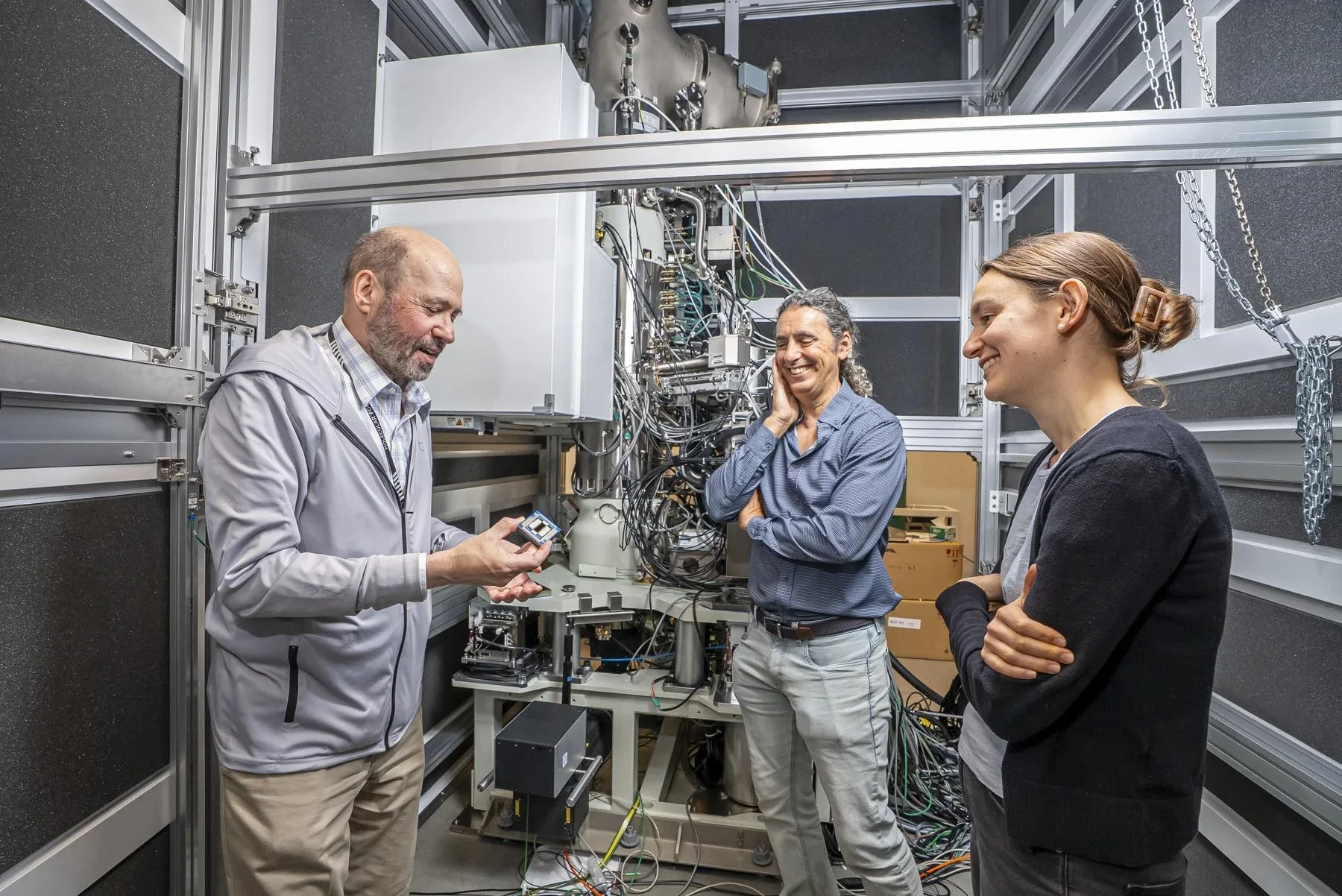
On 19 November 2026, NVIDIA described a new high-dynamic-range electron microscopy camera at Lawrence Berkeley National Laboratory's Molecular Foundry, used for electron energy-loss spectroscopy, or EELS. EELS measures the energy electrons lose in a sample, to identify which elements are present and how they are bonded. The usual method, NVIDIA wrote, uses two separately optimized acquisitions in rapid succession, then aligns and combines the results. The new camera captures strong and faint signals together, which simplifies the optics, but generates more than 500 gigabits of data per second, a stream NVIDIA says is over 500 times faster than conventional EELS data streams.
The scientific claim in the post is that this stream can be received, corrected, and reduced while the experiment is still running, so researchers can inspect the data and adjust acquisition parameters in real time. The software NVIDIA is shipping for that path is DAQIRI, a data-acquisition library in the Holoscan platform that is meant to move sensor packets into GPU memory without first writing them to disk. This is an update to a library NVIDIA has written about before, not a first introduction.
[1]The latest release, the post says, can offload packet reordering to NVIDIA ConnectX-7 or newer network cards, so the CPU and GPU can spend more time on analysis. It adds an ibverbs engine, a lower-level network path that, in NVIDIA's benchmarks on DGX Spark, IGX Thor, and RTX PRO server platforms, delivered about twice the per-core throughput of the previous default DPDK backend, another common high-speed packet path at small packet sizes (up to 1,024 bytes) and at rates greater than 200 Gbps. The company says the advantage is clear at 64-byte and 256-byte packets and similar at 8 KB packets. In cabled loopback tests, a direct polling mode demonstrated application send-to-receive latency on the order of 2 to 4 microseconds.
Those figures are platform microbenchmarks, including a loopback test on the same host. They are not a published measurement of end-to-end latency on the Molecular Foundry microscope, and they are not a claim, in the post, that AI is already steering every shot on that instrument. The 500 Gbps figure and the "over 500x" comparison to conventional EELS streams are NVIDIA's account of the Berkeley Lab camera. The photograph in the post is credited to Marilyn Sargent of Berkeley Lab.
[1]A fair reading is that a detector which produces 500 Gbps is not scientifically useful during the experiment unless something like this path exists. Two-pass HDR EELS is an operational burden. If packets can land in GPU memory in time, the experiment can be adjusted before the sample or the beam conditions change. NVIDIA also says computation improves the spatial information recovered, enabling submicron spatial resolution from 5-micrometer sensor pixels. That is a concrete instrument claim, even if the supporting detail lives in the lab's own methods rather than in this blog post.
The limit is scope. DAQIRI is a library for teams that already run Ethernet-capable instruments and NVIDIA platforms. The new latency and throughput numbers describe the library, not a general arrival of real-time AI at every beamline.
[1]The evidence that would move this story from a library release to a methods result is a Berkeley Lab account of how often operators actually changed an acquisition in response to the live stream, and what scientific error that change avoided. Until then, the checkable news is a 500 Gbps camera workflow and a set of DAQIRI microbenchmarks dated 19 November.
[1]