
要点
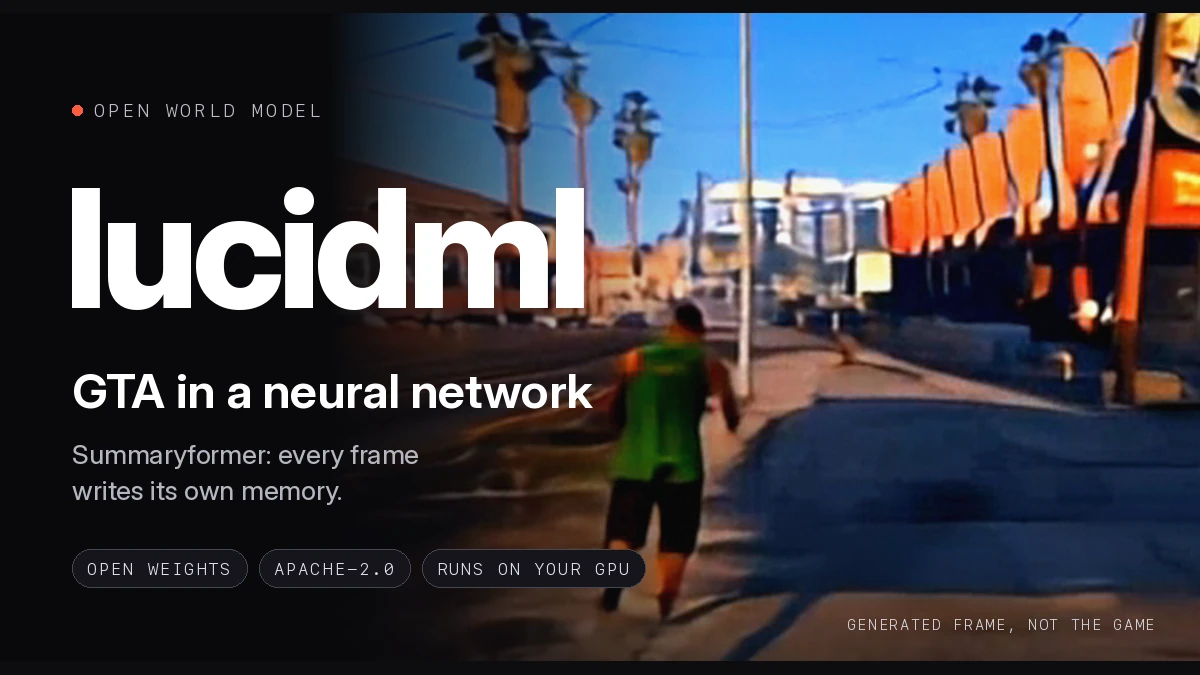
- On 15 November 2026, Abhishek Sensharma, who writes as lucidml, published "GTA in a neural network: an open world model, and the Summaryformer" on the Hugging Face blog. He says this is not the game. Every frame in the demo is generated by a neural network while he holds the keys, from one start image and WASD, with no game engine underneath.
- The model is a transformer of exactly 630,205,008 parameters, designed and trained from scratch. The weights and complete inference code are open under Apache-2.0 and can be played in the browser. The release is inference only. There is no training code in the repository. The weights are at huggingface.co/lucidml/gta.
- The post focuses on how the model manages context, in an architecture the author calls Summaryformer. A recent frame is kept in detail. An older frame is kept only as 96 summary tokens, a short description written by the generator itself in the same forward pass, with no separate summarizer. With the trained window, the memory buffer holds 6,528 keys, against 26,208 if every frame were kept whole.
- The model was pretrained on 100 million images, 4 million videos and 200,000 very long videos, then trained on GG800, the author's dataset of about 800 hours of GTA V gameplay (100,000 videos) with recorded controls. The GTA model has no text. A general model with text prompts is in the Hugging Face Space lucidml/general-world-model.
- The author writes that the memory problem is not solved. The architecture gives a window of 24 latent frames at low cost, but this checkpoint was not trained to convergence, for budget reasons, and he does not yet know whether it can fully use that window. Right now, he says, it cannot hold context for long. The model card says the demo serves a 16-frame window by default.
On 15 November 2026, Abhishek Sensharma published a Hugging Face blog post that is easy to misread as a game running in a neural network. This is not the game, he warns. Every frame in the demo is generated by a neural network while he holds the keys, from one start image and WASD, with no game engine underneath. Google's GameNGen, Decart's Oasis and DeepMind's Genie already made that demo familiar. The news is a bet about memory.
A world model has to remember where it is in a scene to generate the next frame. At 384 by 672, one frame is 1,008 tokens, the units the transformer reads and writes. Keeping the whole history at full resolution would make every new-frame token attend to 26,208 keys, in all 28 blocks, on every pass that cleans noise into a frame. That is too much work to stay playable. The author's bet is that a recent frame matters in detail, while an older one should matter only in outline. Summaryformer lets the generator write that outline, then evicts the raw frame. This checkpoint of saved weights was not trained to convergence, for budget reasons, and cannot yet hold context for long.
[1][2]In Summaryformer, each frame is stored twice, at two sizes, and the model writes both. The raw part is 1,008 tokens, one per cell of a 24-by-42 latent grid, a compressed picture of the frame. The summary part is 96 tokens that go through the same 28 blocks, in the same forward pass, with no separate summarizer. A new frame can see itself, the last two frames in full, older frames in a window of 24 as 96-token summaries only, and the start image, which is never evicted, as a whole record. This lives in one key-value buffer per block, a stored memory of earlier keys and values, with a raw region for the current frame and the two before it, and a summary region of 22 sets of 96 rows. When a frame leaves the raw region, its 96 summary keys and values are copied over the oldest summary, and its raw rows are overwritten, which is the entire cost of the move. There is no attention mask. The buffer contents decide what a frame may see.
Raw and summary tokens of the same frame share a time position, so rotary position embeddings, which encode position by rotating vectors, cannot tell them apart. Summary tokens get an exact quarter turn on the two slowest of each head's 12 temporal rotary planes. The start image, written at id 0, has its keys rotated forward whenever the gap to the oldest frame reaches 5. Values are untouched. The player's keys become a five-number action. After any eviction, the new frame is cleaned up in three denoising passes, at timesteps 999, 878 and 669, plus one more pass so memory holds only clean frames. An autoencoder then decodes that latent frame into four RGB frames, streamed as H.264. The GTA model has no text.
[1][2]The model has 630,205,008 parameters, with 28 blocks, a width of 1,280, 20 heads of 64, and a SwiGLU feed-forward. The latents have 48 channels on a 1/16 grid, from the author's autoencoder, trained from scratch. The start image is one latent frame. Every later latent frame stands for four RGB frames, so a window of 24 covers 96 RGB frames. Diffusion uses v-prediction on a cosine noise schedule with a log-SNR shift, credited to earlier papers. Action, frame rate and grid shape are gated into the denoising-timestep signal.
With the trained window, the buffer holds 6,528 keys, against 26,208 if every frame were kept whole. The architecture was trained for 24 latent frames. The model card says the demo serves a 16-frame window by default. Pretraining used 100 million images, 4 million videos and 200,000 very long videos. The model was then trained on GG800, Sensharma's dataset of about 800 hours of GTA V gameplay, 100,000 videos, with recorded controls. The release is inference only, with no training code. Sessions stop at the last of 4,096 frame ids, and the server has a default time limit of 180 seconds. It needs a CUDA GPU, and one GPU process serves one player.
The author does not claim the ingredients are new. He credits Self-Forcing and Wan2.1, and points to self-written summaries, an eviction buffer, and rotary methods that mark token kind and keep the start image next to the window. He notes that lucidml is not affiliated with Rockstar Games or Take-Two Interactive.
[1][2]A fair objection is that this kind of demo is now familiar, and the post offers no side-by-side score against GameNGen, Oasis, or Genie. The author says the memory problem is not solved and the checkpoint was not trained to convergence. He writes, "I don't know yet whether it can fully use that window. Right now it can't hold context for long." The public demo serves 16 frames rather than 24, and training code was not released.
If the summaries are written and then barely used, the cut from 26,208 keys to 6,528 is a computational saving, not yet evidence that a longer horizon has been earned. In a comment on the post, a reader asked what drifts first when a player looks back at a landmark after its raw tokens have been evicted. Sensharma replied that the scene's response to the controls in general never drifts, because AdaLN, a per-block adjustment that also carries the denoising timestep, guides it every new frame. The layout, he said, is the first to drift. That is an informal reply, not a measured study. The release is an open test of that idea, with the warning attached.
[1][2]The thing to watch over the next six months is whether a later, more fully trained checkpoint can use the 24-frame window. After a landmark's raw tokens have been evicted, and only the 96-token summary remains, does the layout still hold when the player looks back? If a more fully trained checkpoint still loses the layout, the compact-memory bet will have been cheaper to run than useful to play. If layout holds at 24 frames, rather than only at the 16-frame default, the design will have shown a practical way to keep a longer past without attending to every old frame in full.
A second signal is whether other groups adopt the pattern and report how far the summaries carry a scene. Until then, the right weight is the one the author suggested. The memory design is the claim. The current checkpoint is not yet the evidence that the window works.
[1][2]