
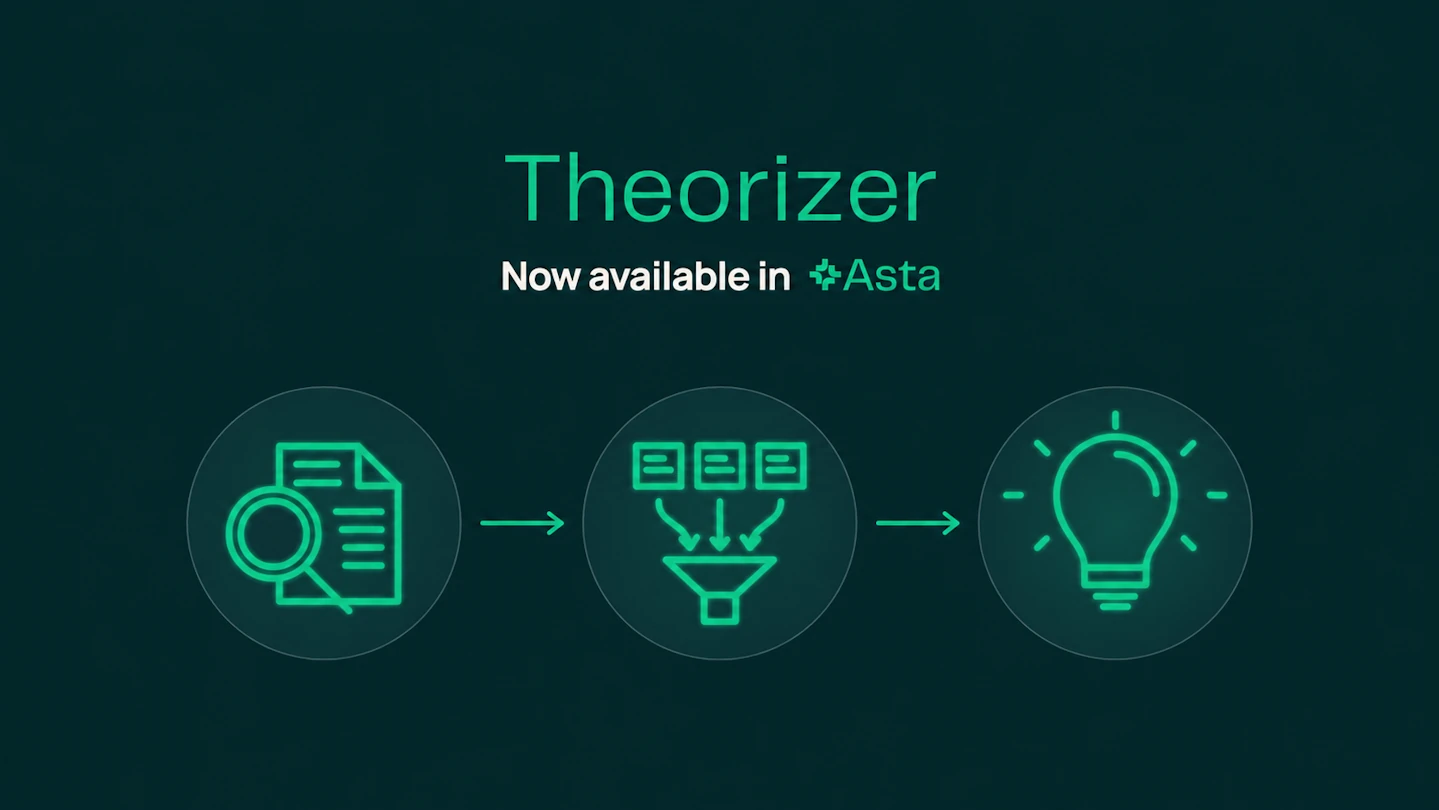
On 19 November 2026, the Allen Institute for AI said it was launching Theorizer in Asta, its platform of AI agents for scientific research, and open-sourcing the code. Theorizer searches published papers, builds a template for what to extract from each one, and proposes explanations linked to those studies. Through Asta's web interface, Ai2 said it covers token costs up to a limit. Researchers can also run the library on their own machines and pay for tokens themselves.
The launch post is built around named scientists, not a benchmark table. The most careful of those accounts is not a confirmed discovery. It is a case in which the agent's hypothesis failed a test, and that failure was useful.
[1]At the International Potato Center in Peru, data scientist Piero Palacios and systems and data management officer Henry Juarez were extending the dew-point record in PISCO, a dataset that uses weather-station observations to estimate climate conditions across Peru. PISCO's dew-point records end in 2016, while its minimum-temperature records continue through 2020. Some of their reconstructed values exceeded 35 degrees Celsius, which they described as implausibly high daily dew points for the affected areas, and the high values clustered in November.
They used Theorizer to generate possible explanations. One proposal was a rise in humidity as the Amazon shifts from dry to wet conditions. Testing that seasonal explanation against their data ruled it out for the study area, but it prompted them to look at how the original climate record had been constructed. "Having a specific, falsifiable mechanism on the table is what drove us to measure the November spike by distance from the stations in the historical record," Palacios and Juarez said. "That was an analysis we had no particular reason to run while the anomaly was merely unexplained, and it is the analysis that produced the actual answer."
They traced the implausible values to how the original dataset estimated conditions far from weather stations. They are still seeking independent station observations to validate their reconstruction, and they say the source record's November spike remains an open question. Ai2 links a paper titled "Four Missing Years of Peru's Dew-Point Record: What an AI Hypothesis Got Wrong, and Why That Mattered." Even in Ai2's telling, Theorizer did not supply the correct mechanism. It supplied a testable one.
[1]Dr. Sid Devarakonda, medical director of the thoracic oncology clinical and research program at Providence Swedish Cancer Institute, used Theorizer on "driver-negative" lung adenocarcinoma, the large minority of cases (Ai2 says roughly 20 to 30 percent) in which sequencing does not reveal a recognized driver alteration. After several iterations, the tool helped him formulate three hypotheses. Work with AutoDiscovery, another Asta agent that writes and runs code against datasets, and with The Cancer Genome Atlas and laboratory-grown cells, gave him preliminary support for the idea that some cancers with low RAS activity may depend on CDK2. Ai2 and Devarakonda are explicit that these findings still require experimental validation. His longer-term goal, the post says, is to identify ideas that could be tested in clinical trials, not to announce a new standard of care.
A second scientific user, Jerome Lecoq at the Allen Institute, evaluated an early version on VIP interneurons and received 50 candidate theories where he had expected one or two. One theory, the post says, had already been proposed in the literature. The value for Lecoq was in connecting computational work with experimental findings in an account that matched his own view. That is synthesis, not a new result.
Ai2 also notes a general limit: Theorizer flags claims it considers new, but a search can miss earlier work and the model can misjudge originality. Researchers still need to check a claim against the wider literature.
[1]The fair case for Theorizer is that a literature agent which cites its sources, admits it can be wrong about novelty, and is useful even when it is wrong, is a more honest scientific tool than a system that only reports wins. Devarakonda compares the work to wearing Iron Man's suit: "The suit is fantastic, but you still need somebody inside it because it's a question of allocating resources and making sense of what's being done." Open-sourcing the code, at https://github.com/allenai/asta-theorizer, lets other groups inspect how theories are generated, which a closed demo would not.
What the post does not provide is a controlled evaluation: how often the proposed theories are novel, how often they survive a test, or how that rate compares with a scientist working without the tool. Until someone publishes that, the launch is a set of carefully told cases, including one in which being wrong was the point.
[1]The near-term test is whether the CIP reconstruction is confirmed with independent station data, and whether Devarakonda's CDK2 lead is actually tested in experiments, not only in public molecular datasets. Ai2 has scheduled a webinar for scientists on 10 December. A methods paper with an error analysis would do more than a webinar to show whether Theorizer changes the scientific process, or mainly changes how hypotheses get written down.
[1]