
要点
- On Nov. 12, 2026, Anthropic published a product update saying Claude Meetings is now in beta. Claude can join a video call as a visible participant, follow the discussion, and start work during the meeting. Teams can ask questions out loud or in chat. By default, Claude answers in writing, and it can use a person's connected tools with that person's permission. It can also build docs, whiteboards, or other artifacts live, and teammates on the invite can edit them during the call. After the call, notes, action items, and anything it built appear on that meeting's page in claude.ai. The supported platform at launch is Google Meet, with other video platforms described as coming soon. The beta is rolling out on Team and Enterprise plans.
- The same article sets security and pricing bounds. Claude creates a separate page for each meeting, which people from the organization who were on the invite can view and edit, and which can be shared with others in the organization. By default, Claude stays out of calls when someone from outside the organization is invited, and it leaves if someone from outside joins partway through. An admin can allow Claude on calls with outside guests. On those calls, it posts its notice in the call chat but does not reply there, and what guests say is included in the notes and transcript. When Claude joins, it appears as a participant and posts a notice in the call chat. It saves a transcript, a summary, and screen descriptions, not audio. Users are told to make sure everyone on the call is OK with being transcribed before adding Claude or turning on auto-join. During the beta, notes and transcripts are free on Team and Enterprise plans, as are answers that do not use connected tools. Answers that use a connected tool count toward plan usage. Docs, whiteboards, and other artifacts made in a call are free through Feb. 10, 2027. During the beta, the feature is not available to some organizations, including those with zero data retention (ZDR), a HIPAA-ready configuration, or customer-managed encryption keys (CMEK). On Team plans, inviting Claude is available by default and an admin can turn it off. On Enterprise plans, an admin turns it on for all or part of the organization.
- Anthropic's Help Center article on the same feature, retrieved the same evening and marked as just updated, adds operating detail. Claude can stay on a call for up to eight hours and warns before it leaves. Anything it posts in the Google Meet chat is visible to everyone on the call. The chat on the Claude meeting page is internal to the organization. The Help Center also says that, when outside guests are not allowed, Claude stays out of calls that include outsiders, including another company's notetaker bot. When outside guests are allowed, guests do not get the meeting page or the recap email. Enterprise plans default to internal meetings only, and an owner must allow external guests. Team plans allow them by default, and an owner can turn that off. Users can set auto-join for themselves. Owners cannot set auto-join for other people. The official product post also says Anthropic is working with Gong, Attention, Granola, Fireflies.ai, Otter, and Plaud so a meeting's transcript can later be sent to tools teams already use. That export is described as forthcoming, not as something already shipping.
On Nov. 12, 2026, Anthropic published a product update saying Claude can now join a video call as a visible participant. The feature, Claude Meetings, is in beta on Team and Enterprise plans, and the first supported platform is Google Meet. The company presents this as a change in timing: start the plan or the whiteboard while the meeting is still going, rather than waiting until everyone hangs up. That is a product claim about workflow. Neither official page gives a quality measure, so the update does not show that notes, plans, or whiteboards from a real call are ready to use without a human check.
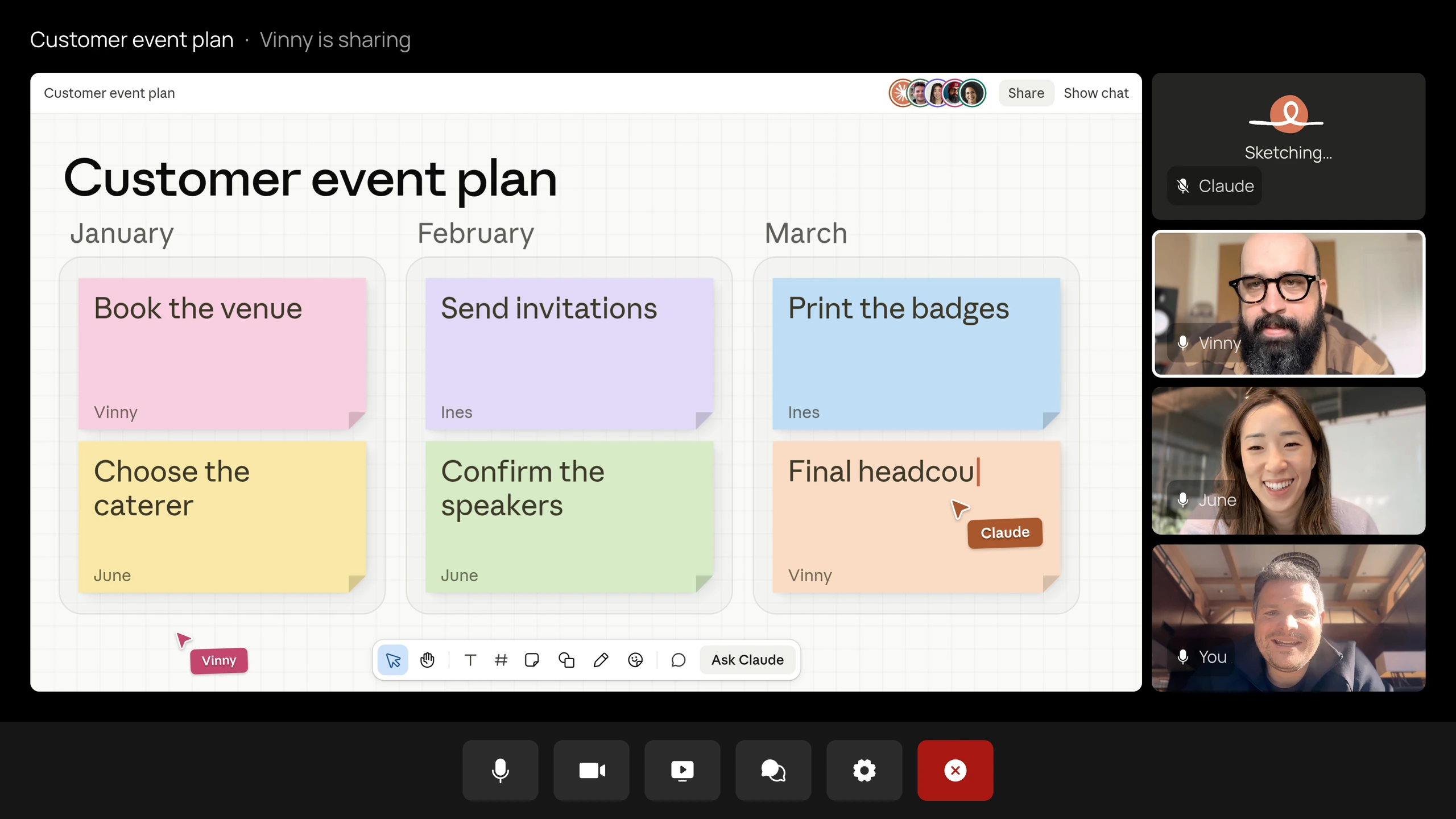
[1]The mechanics are specific. Someone adds Claude, or turns on auto-join, and the assistant appears in the call, posts a notice in the chat, and follows the conversation. People can say its name and ask a question, or type in the chat. By default it answers in writing in the Meet chat. If it uses a person's connected tools, it needs that person's permission first. In Anthropic's example, a team planning a customer event asks Claude to start a doc from what has already been said, then asks it to look up last year's event cost. After approval, it posts the figure in the chat and compares it with the current plan. When the talk turns to timelines, someone can ask it to put the schedule on a whiteboard, and teammates on the invite can edit while the call continues. Afterward, notes, action items, the plan, and the whiteboard live on the meeting page in claude.ai. People can later return to meetings they were part of and ask Claude about them, or add Claude to the next meeting from the calendar in claude.ai.
The Help Center is more precise about live collaboration. Anyone on the team can ask Claude to make a doc or a whiteboard. Each artifact is attached to the meeting page, the number is not capped in that article, and all artifact types are supported. When Claude joins, it posts a link to the meeting page in the Meet chat. That page has the live transcript, the chat, and everything it has made. People can ask it to stop listening, or use the meeting page to pause or remove it. If it is added again, it returns to the same meeting page.
[1][2]What can be checked now is what is available at launch, and the stated limits, not a quality score. Support is currently Google Meet, with other platforms still described as coming soon. On Team plans, inviting Claude is on by default and an admin can turn it off. On Enterprise plans, an admin has to turn it on. During the beta, organizations with zero data retention, a HIPAA-ready configuration, or customer-managed encryption keys cannot use the feature. Those settings usually belong to customers with stricter data rules, which means the organizations most sensitive to meeting transcripts are not in the first group to run this in production.
The pricing terms are also specific. During the beta, notes, transcripts, and answers that do not use connected tools are free on Team and Enterprise plans. Answers that use a connected tool count toward usage and can create charges. Docs, whiteboards, and other artifacts made in a call are free through Feb. 10, 2027. Neither page says what those artifacts will cost after that date.
The privacy defaults can be checked line by line. By default, Claude stays out of a call when an outsider is invited, and it leaves if an outsider joins later. An admin can loosen that rule. On calls with outside guests, Claude still posts its notice in the call chat but does not reply there, and guest speech goes into the notes and transcript. The Help Center adds that guests do not get the meeting page or the recap email. Claude saves a transcript, a summary, and screen descriptions, not audio. Anthropic tells users to confirm that everyone on the call is willing to be transcribed before adding Claude or turning on auto-join. The Help Center also states a limit that is easy to miss: Claude can stay for up to eight hours and warns before it leaves.
[1][2]The fair reading is that this is easier to notice than a silent notetaker bot. Claude appears as a participant, posts a notice first, asks before using a person's tools, and is set to leave when an outsider joins. If a shared doc or whiteboard really takes shape during the discussion, the usual gap between talking about a plan and writing it down later gets shorter. For teams already in Google Meet and already on Claude Team or Enterprise, this is now a public beta they can turn on.
What these pages do not provide is evidence that the artifacts are accurate enough to use without a close human pass. There is no reported error rate for notes, no comparison with a human notetaker, and no independent test of how often Claude misattributes an action item or pulls the wrong figure from a connected tool. Auto-join is a personal setting, and owners cannot set it for other people, which blocks one kind of organization-wide surprise. It does not block another: a colleague walks into a call and finds that someone else already turned auto-join on.
The visible-chat rule also makes a casual question riskier. The Help Center says that anything Claude posts in the Meet chat is visible to everyone on the call, including guests when outside participation has been allowed. A question meant as an internal prompt can appear in the shared chat. That is documented behavior, not a guess. Sending transcripts to Gong, Attention, Granola, Fireflies.ai, Otter, and Plaud is also still a planned partnership, not a shipped capability.
[1][2]Meeting assistants are already a crowded product category, which is one reason Anthropic named those transcript partners. The distinctive claim here is not another summary email. It is that Claude will start the work in the room: draft the plan, fill the whiteboard, query a connected system, and leave a page that the team can keep editing. If that holds, the cost of meetings shifts toward supervising an assistant live, including permission prompts and the risk of putting a draft in front of the wrong audience. If it does not hold, teams will still get notes, and the more expensive artifacts may be heavily edited or discarded once the free period ends on Feb. 10, 2027.
[1]Over the next six months, the checks are practical. Watch whether support extends beyond Google Meet, whether organizations with zero data retention, HIPAA-ready setups, or customer-managed encryption keys are included or still excluded, and whether Anthropic publishes a price for in-call docs and whiteboards after Feb. 10, 2027. Also watch whether Enterprise plans still default to keeping Claude out of calls with external guests, and whether any public incident shows a chat answer or a connected-tool result reaching the wrong people. The beta makes a product with a stated surface available to use. It does not show that meeting output can be trusted without review.
【No.2】
[1][2]