
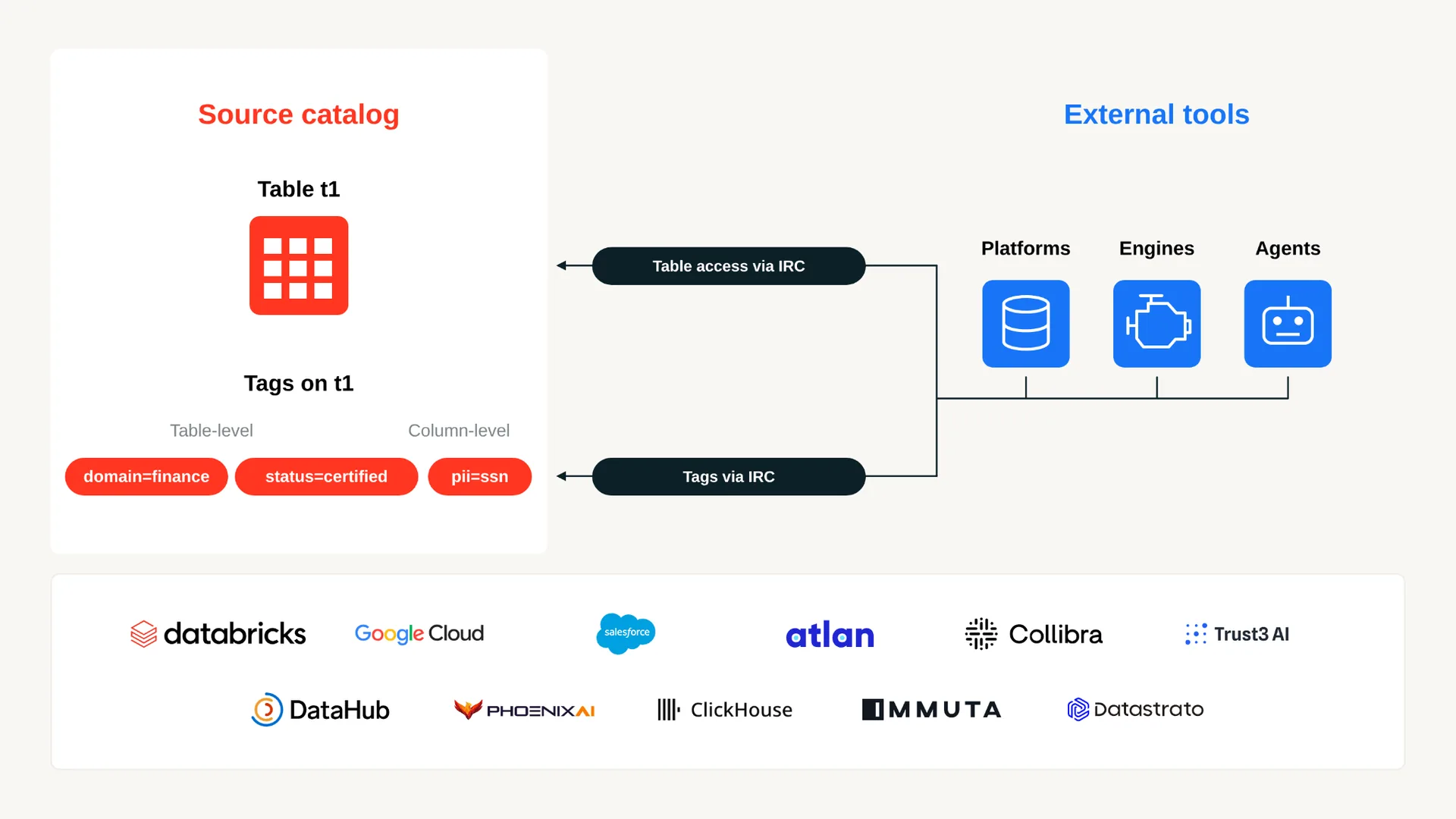
On 24 November 2026, Databricks announced catalog labels: an optional field on the Apache Iceberg REST Catalog LoadTable response, intended to carry table- and column-level context to other platforms, engines, and agents. The same post introduced Tag Exchange, a beta feature that exposes Unity Catalog's table- and column-level tags through that field. To turn it on, a customer enables "Tag Exchange via Iceberg REST Catalog" in the Databricks Previews portal.
The standard, as described, is a common format without a mandated vocabulary. Labels are string key-value pairs that can record ownership, intended use, sensitivity, or other catalog-maintained context. Each receiving platform decides how to interpret them. The claim to test is whether that context actually arrives where access is decided, or whether it stays as metadata in the catalog that published it.
[1]The post is by Daniel Weeks, Andrei Tserakhau, Jason Reid, Michelle Leon, and Alex Jiang. Databricks says it worked with the Apache Iceberg community to add the optional labels field to the LoadTable response. The field is the interoperability mechanism. Tag Exchange is Databricks's implementation of that field for Unity Catalog tags.
A worked example uses a table named support_cases, with columns case_id, opened_at, and issue_summary. An authorized steward assigns domain=customer_support and the Databricks system tag system.certification_status=certified to the table, and content_type=support_case_summary to the issue_summary column. A catalog exposing those tags would include them in the labels portion of its LoadTable response. Intended uses include showing the business domain in search results, helping an agent find a certified dataset and the case-summary column, and letting a governance platform map a sensitivity label to a locally defined masking rule, with the receiving platform responsible for enforcement.
PyIceberg, the post says, has added support for accessing catalog labels in Python, and applications will be able to inspect table- and column-level labels in the next 0.13 release. That is a stated upcoming release, not a claim that the support is already in a published 0.13 package.
Databricks says it is joined in this effort by Google Cloud, Salesforce, ClickHouse, Atlan, Collibra, DataHub, Immuta, Trust3 AI, PhoenixAI, and Datastrato. Those names are presented as alignment with a shared vision, not as a measured adoption study. The post includes short quotations of support, including from Gaurav Saxena of Google Cloud, Don Bosco Durai of Trust3 AI, Chandru Sugunan of Atlan, and Narinder Singh of Salesforce. Durai's comment restates the testable claim: classification is only useful if it reaches the place where access is decided, and a sensitivity label set once in Unity Catalog can now drive policy in platforms such as Trust3 AI. Those are partner comments in a launch post.
Tag Exchange is available in beta today, according to the post. Databricks does not report a count of customers who have enabled the preview, or a count of engines that already enforce a policy from a received label.
[1]The practical problem is familiar. A table's meaning, owner, and sensitivity often live in the catalog that first recorded them. Other engines and agents then see the table without that context, so teams rebuild the same classifications. An optional labels field on LoadTable is a way to send those key-value pairs at the moment a client loads a table, using an interface many Iceberg tools already call.
Because the standard does not prescribe vocabulary or interpretation, a label is a hint rather than a portable rule. domain=customer_support can improve search in one system and be ignored in another. A sensitivity label can drive masking only if the receiving platform already has a rule that maps that string to an action, and only if it enforces that rule on the query path. Tag Exchange is the Databricks-side publisher for Unity Catalog tags. It does not, by itself, execute policy in Google Cloud, Salesforce, ClickHouse, or a downstream governance tool. That division of labor lets each platform keep its own controls. It also means the value of the field depends on work that happens after the catalog response is sent.
This is an announcement plus a beta toggle, not a measured study of adoption or enforcement. The post does not show an independent engine consuming a LoadTable labels field and applying a policy in production. It does not define a shared vocabulary, a conflict rule when two catalogs attach different values to the same key, or a versioning rule when a tag changes. It does not say what a client should do if the field is absent, which it may be, because the field is optional.
Partner alignment should not be read as a list of shipping integrations. The quotations describe a direction. They do not report traffic, error rates, or policy outcomes. PyIceberg support is tied to a future 0.13 release. This desk has not checked a PyIceberg changelog, opened a live LoadTable response with labels populated, or enabled the Databricks preview. The example labels are also Databricks-flavored, including a system.certification_status tag. How cleanly those keys travel into a non-Databricks engine remains an open question.
A fair reading is that a standard field is still better than a set of one-off metadata pipelines, even if the vocabulary is not shared yet. If Unity Catalog tags can leave Databricks through an Iceberg interface that other tools already speak, some of the copying and synchronization work can shrink. The beta toggle is a concrete way to start that experiment. Partner interest from catalogs, governance vendors, and cloud platforms is the right kind of interest for a protocol change.
It is also fair to keep the limit in view. Without a shared vocabulary, labels may not drive consistent policy across engines. A receiving platform can ignore a tag, map it differently, or fail to enforce it on every access path. Until those mappings are visible in running systems, this remains a catalog-side capability with a plausible distribution path, not a demonstrated cross-engine control plane.
[1]The next six months should be about whether engines and agents actually read the LoadTable labels field and do something checkable with it, such as hiding a column, applying a mask, or refusing a query. Watch whether the PyIceberg 0.13 release ships with the inspection APIs the post describes, and whether any of the named partners publish their own implementation notes beyond the launch quotations. Watch whether a small set of keys starts to recur in practice, even without a formal vocabulary, or whether each catalog keeps a private dialect.
The claim to test is the one in the announcement's own terms. If a sensitivity tag set in Unity Catalog is enforced in another platform without a separate metadata project, Tag Exchange will have done the job described by its partners. If the field is present and the policy still lives only in the source catalog, the portable context will not yet have reached the place where access is decided.
[1]