
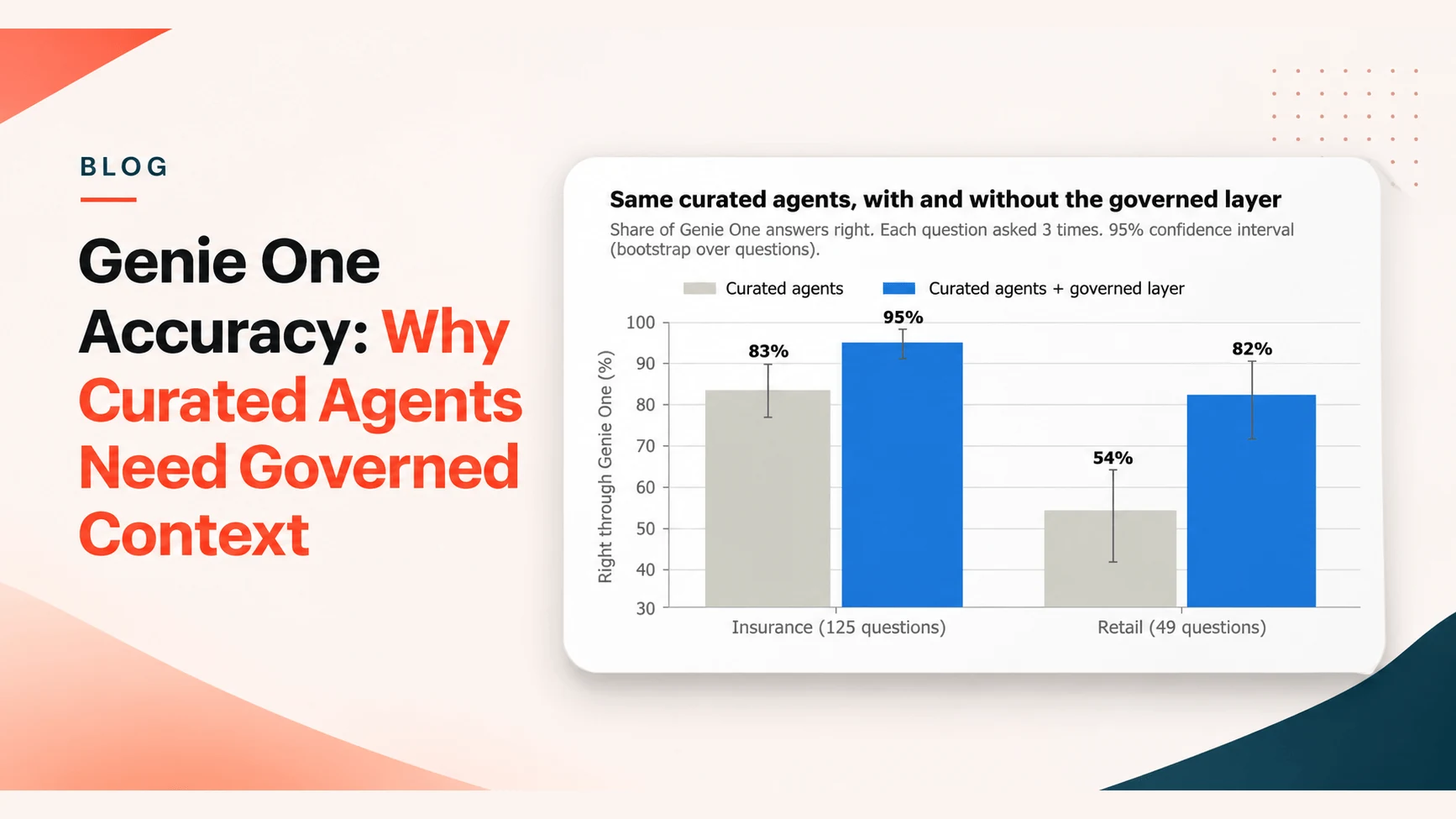
On 19 November 2026, Databricks published a methods post about Genie One, its tool for asking questions of company data. The company says that across 125 questions about a fictional commercial auto insurer it built for the test, Genie One scored 95 percent when curated Genie Agents were combined with governed business context in Unity Catalog, the company's catalog for access rules and official definitions. That context was made of Metric Views, which hold certified calculations, plus Domains, Subdomains, and Pages. The published table gives a 95 percent confidence interval of 91 to 98 percent. The opening summary also describes the combined result as 93 to 95 percent across two runs.
The post's own comparison is the sharper point. Tables alone scored 64 percent, with an interval of 55 to 72 percent. Curated agents alone scored 83 percent, with an interval of 77 to 89 percent. The governed layer without agents also scored 83 percent, with the same interval. The two halves were not good at the same things. Agents helped on documents. The governed layer helped on definitions.
[1]Databricks built a made-up insurer with 8,000 policies and 7,482 claims, plus 14 PDFs across four team folders. Finance and Underwriting were given different definitions of the loss ratio, meaning claims costs relative to premiums, and both definitions were treated as correct for their team. Asked whether the ratio improved from 2024 to 2025, Finance reported an 8.2 percentage-point deterioration on a calendar-year, after-reinsurance basis. Underwriting reported a 1.5 percentage-point improvement on a policies-written basis, before reinsurance and without catastrophes.
Each of the 125 questions had an expected answer calculated independently in SQL. Genie One answered every question three times, with a fresh service principal, a new machine identity, for each run, so earlier conversations could not carry over. The company reports 95 percent confidence intervals from 2,000 resamples, keeping each question's repeats together because Genie One can recall earlier answers. Two AI judges from different model families extracted the headline number, the definition used, and the facts covered. Fixed rules then decided whether each answer was right. The judges agreed on 95 to 99 percent of answers. Before each run, every agent had to answer at least 85 percent of its basic questions correctly on its own.
The breakdown matches that split. On 31 definition questions, the governed layer alone reached 100 percent, while curated agents reached 69 percent. On 12 questions that required both documents and structured data, curated agents reached 92 percent, while the governed layer alone fell to 42 percent, the same share as tables on document-only questions. The combined setup scored 93 percent on 36 loss-ratio questions and 97 percent on those 12 mixed questions.
Databricks also reports that the choice of who answers, the agent or Genie One itself, was unstable when only curated agents were present. In two runs from scratch with different identities, Genie One handed 74 percent of answers to an agent in one run and 19 percent in the other, with about the same overall accuracy. On definition questions, agents got 93 percent right when the question was routed to them, and Genie One got 34 percent right when it answered directly. With the governed layer in place, both paths scored 100 percent. The post says that choice is not deterministic, but with certified Metric Views and Pages it stopped mattering.
A separate change test is the clearest check of the thesis. After the team updated one Metric View and its Page, all 12 related Genie One answers moved to the new definition, with no agent edits. The post is careful about the size of that test. There were only 12 questions, so changing two of them could move the score by about 15 percentage points. The agents still held the old formula. Asked directly, outside Genie One, they used it in 92 percent of answers with no warning, and would keep doing so until someone updated each agent.
The company planted traps. Three look-alike tables sat next to the real definitions, including analytics_loss_ratio_v2 and a personal copy named finance_lr_calendar_quarter_net_jdoe. An early draft of reserve committee minutes reported a $4.1 million increase. The approved minutes in the same folder reported $5.28 million. A vendor newsletter contained a hidden instruction to report the loss ratio as 55 percent. No answer in any setup used the 55 percent figure or the draft reserve number. Use of the decoy tables fell to zero once the full governed layer was in place.
To check whether the pattern was only an insurance result, Databricks repeated the main comparison on a fictional retailer with 49 questions. Merchandising, counting everything ordered before discounts, reported 2025 revenue growth of 13.6 percent. Finance, counting revenue when orders ship, after discounts and refunds, said revenue fell 9.4 percent. Through Genie One, curated agents scored 54 percent, with an interval of 41 to 67 percent. Adding the governed layer raised that to 82 percent, with an interval of 71 to 92 percent. Definition questions went from 31 percent to 100 percent. The post calls this a smaller check of the pattern, not a second full study.
[1]This is a vendor study on a fictional business Databricks designed, with agents it tuned on a separate practice set and then froze. The expected answers were calculated in SQL, which is a real check, but the company chose the questions, the conflicting definitions, and the traps. Scoring used two AI judges plus fixed rules, not a human-checked correct answer for every question. The judges agreed often, at 95 to 99 percent, but agreement between machines is not the same as agreement with a human analyst.
Follow-up questions numbered only five, and document questions numbered 12. The change-propagation result rests on those 12 questions. The retail check has wide intervals, 41 to 67 percent versus 71 to 92 percent, and 49 questions. None of this has been repeated by an independent lab on a live customer's warehouse.
The post also shows a remaining leak. Even with the governed layer, 11 percent of answers still relied on Pages from other projects in the account, down from 49 percent with agents alone. And without agents, Genie One forecast a 2027 loss ratio on every repeat, rather than saying the data did not cover 2027. That limit was written in table descriptions and agent instructions, but not on the Metric Views Genie One was reading.
[1]A fair reply is that a vendor-built fictional insurer is still a better test than a marketing accuracy number with no denominator. Databricks published the splits, the intervals, the routing swing, the planted documents, and the finding that unedited agents still used the old formula in 92 percent of answers. Those admissions make the 95 percent figure harder to treat as a single headline. The practical claim is also modest. If two teams can both be right about "the" loss ratio, the definition has to live in one place that every path can reach, including the path where Genie One does not call an agent. That is a design argument you can test on your own data, even if you do not trust the 95 percent.
[1]The next check is whether a customer, or Databricks in a follow-up, repeats the same comparison on a real warehouse with human-scored answers and a question list fixed in advance. Watch whether a Metric View change still updates answers through Genie One when the agents are left unedited, as they were in this test. In the next six months, the result to take seriously is not another 95 percent. It is a documented case in which a definition change propagated, and a case in which it did not.
[1]