
要点
- On 12 November 2026, Sergey Melnik published Dispelling LTAP myths on the Databricks blog, answering commentary that followed Reynold Xin's earlier post, From monolith to Lakebase to LTAP.
- Melnik's test is whether a layer can be queried, or failed over to, as its own database. If yes, it is a replica. If no, it is a tier. By that test, he says, the lake is the durable copy, and the Postgres caches and pageservers in front of it are not a second catalog.
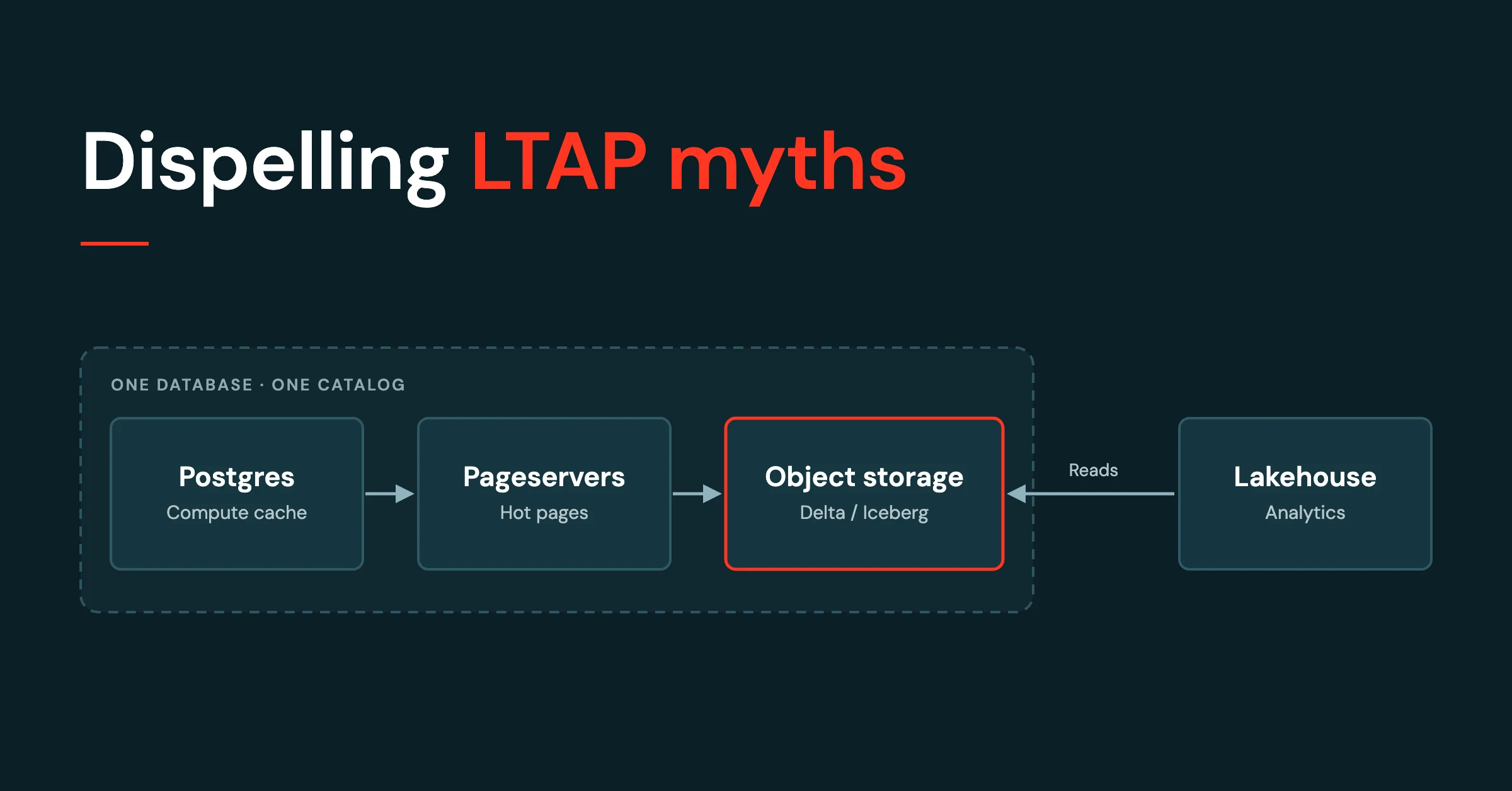
- A write is durable when its write-ahead log has been received by enough safekeepers, the servers that must see the log before the write counts. A pageserver then applies the log, keeps hot pages close, and materializes data into object storage as a Delta or Iceberg table. Point lookups read Postgres heap pages. Scans read Parquet.
- Melnik says every analytical query sees a consistent snapshot, including commits not yet in the lake. That is the freshness claim the argument depends on, and the post does not time it or fail it over in public.
- He argues that Postgres logical replication is a costly way to keep a lake in sync, because it replays every change row by row and cannot collapse many updates to the same page into the current image of that page. LTAP, he says, parallelizes dirty pages, not log records.
On 12 November 2026, Sergey Melnik published Dispelling LTAP myths on the Databricks blog. The piece answers commentary that followed Reynold Xin's earlier post, From monolith to Lakebase to LTAP. Lakebase is Databricks' architecture for running Postgres-style transactions and lakehouse analytics on the same tables. LTAP is the design idea behind it. Xin's claim was that Lakebase can serve Postgres and analytics from one governed copy of operational data, with no change-data-capture pipeline and no second database. Melnik says much of the reaction read that claim through systems people already know, and that four readings keep coming back.
[1]The test Melnik wants used
Melnik draws a line between replication and tiering. Replication keeps two databases aligned by shipping changes from one to the other. Each side has its own catalog and its own timeline. Either side can be queried as a source of truth. If shipping stalls, the copies drift. Tiering keeps one database and puts caches in front of it. If a cache is lost, the table is not lost, and the cache is not itself a database you can fail over to.
The test is simple, in his words. Can this layer be queried, or failed over to, as its own database? If yes, it is a replica. If no, it is a tier. By that test, Postgres has always been tiered. The write-ahead log, the buffer cache, and the indexes all store overlapping bytes, and nobody calls an index a replica of the table.
In Lakebase, he says, a write is durable when its write-ahead log has been received by enough safekeepers, the servers that must see the log before the write counts. A pageserver then applies the log, keeps hot pages in memory and on local disk, and materializes data into object storage. Point lookups read Postgres heap pages. Scans read Parquet. The lake, as a Delta or Iceberg table, is the durable copy. Analytics reads that bottom tier.
[1]The four readings he wants to retire
The first myth is that LTAP is replication, or change-data-capture under another name. From the outside, Postgres writes rows, a process tails the log, changes land in an Iceberg table, and analytics reads Iceberg. That outline is how CDC products look. Melnik says the difference is the catalog. The layers in front of the lake hold some of the same bytes to make the table durable and fast, but none of them is a second database.
The second myth is that a single copy can have only one physical layout, so either point lookups or scans must be slow. The post's answer is that the same logical table is served through different layouts. Heap pages serve lookups. Parquet serves scans.
The third myth is that Iceberg or Delta tables on object storage are inherently stale. Melnik says every analytical query sees a consistent snapshot, including commits not yet in the lake. That is the freshness claim the argument depends on.
The fourth myth is that Postgres logical replication is already the extraction path you need. He calls it a costly way to keep the lake in sync, because it replays every change, row by row, and needs a pipeline that has to keep up. The write-ahead log is a physical log of page edits. Logical decoding turns it into row events in commit order and cannot collapse many updates to the same page into the current image of that page. A replication slot is a cursor into the log. If the consumer falls behind, log data stays on disk until the slot is dropped or the disk fills. Logical decoding also does not emit schema changes such as ALTER TABLE, which can make events inconsistent or invalidate the slot.
What LTAP parallelizes, he says, is pages, not log records. The system finds which pages changed since the last snapshot, transcodes those dirty pages, and commits one Iceberg snapshot. The snapshot is the current pages, not a replay of every record that dirtied them. He adds that logical replication remains the right tool for migrations, major version upgrades, and cutovers to a second Postgres. Using it as storage, in his view, produces a second source of truth.
[1]Where the evidence stops
This is an architecture essay by a Databricks engineer, on the Databricks blog, defending a Databricks product idea. The replica-versus-tier test is clear enough to argue with. The post does not present production measurements of freshness, of how often analytics must merge in commits not yet materialized, or of what happens when a pageserver or a cache is lost. The claim that every analytical query sees a consistent snapshot, including commits not yet in the lake, is stated, not timed or failed over in public. A parallel log-to-Parquet extractor is mentioned as possible in principle and not the path LTAP uses, and as not having been built as a production extractor.
Readers who still see an async pipeline from log to object storage are not being dense. They are looking at the write path and asking whether the catalog test holds when materialization lags. Melnik's answer is that lag in a tier is cache-miss latency, not drift between two sources of truth. That answer is only as strong as the snapshot guarantee.
[1]A fair reading
The fair reading is that Databricks is trying to retire a comparison that would make Lakebase look like one more zero-ETL or CDC product. If the lake is truly the durable copy, and Postgres in front is a cache plus a pageserver, then buying LTAP is a storage-architecture decision, not a promise to keep two systems in sync. That would matter to teams now paying for a pipeline that must never fall behind. The steelman of the skeptics is also straightforward. If analytics cannot read commits that have not yet landed in object storage, or if a lagging materialization can be queried as if it were complete, then the system behaves like the replica pipeline Melnik says it is not. The post names the test. It does not publish the trial.
[1]What to watch over the next six months
The first check is whether Databricks, or a customer, shows analytical queries reading a consistent snapshot that includes commits not yet materialized in the lake, with a measured lag and a clear failure mode when that merge cannot complete. The second is a documented loss of a pageserver or a cache that does not leave a second catalog behind. The third is whether teams who today use logical replication to feed a lake actually switch, and whether they do so because the pipeline cost and slot risk disappear, or only because the marketing distinction is cleaner. If those checks appear in public, the myth-busting will have been earned. If they do not, LTAP will still be judged by the outline people already know: log, delay, Iceberg, query.
[1]