
要点
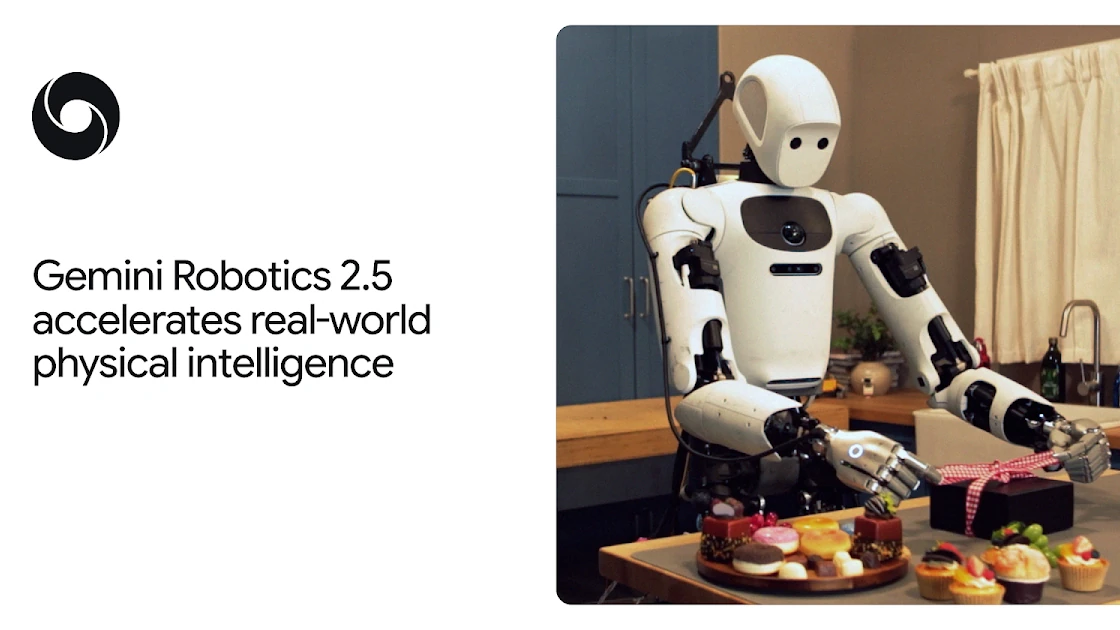
- On Nov. 10, 2026, Google DeepMind published a post under Carolina Parada's name introducing Gemini Robotics 2.5, which it called its most capable vision-language-action model to date, meaning a model that turns what a robot sees and is told into motor commands. The post says the model was evaluated across more than 200 tasks, such as serving food with tongs, tying a bow on a gift box, and pipetting liquid. Against previous baselines, it reports a 30% to 100% higher success rate depending on the type of task, and tasks completed 20% to 30% faster. The model works with several robot types, including Apptronik's Apollo 2 with a five-finger, 22-degree-of-freedom SharpaWave hand, and the Franka Duo platform with two-fingered parallel grippers. Gemini Robotics 2.5, the post says, is rolling out to robotics partners.
- In a proof of concept with Apptronik and Mercedes-Benz, Apollo 2 robots were used on active automotive lines in Kecskemét, Hungary, and Sindelfingen, Germany, to do kitting: sorting metal brackets from bulk bins into trays in the order needed for each vehicle. The post says Gemini Robotics ER kept track of the workflow, while Gemini Robotics 2.5 controlled the hands and arms and corrected for gaps. The company reported a 96% success rate. Jeff Cardenas, Apptronik's co-founder and CEO, is quoted as saying the models improved in a few weeks of post-training and transferred to Mercedes-Benz production with very little drop-off.
- On safety, the official post says Gemini Robotics 2.5 uses inference-time reasoning guidance to steer around physical hazards. In DeepMind's evaluations, safe task completion rose 33% around obstacles and 43% around nearby people. The company is also releasing an open-source benchmark, ASIMOV-Jailbreak, with hundreds of prompts that disguise unsafe requests across dozens of scenes. The official figures are a 99.5% jailbreak resistance for Argon, against 82% for the previous baseline, Gemini Robotics ER 2. A same-day Ars Technica report gives different figures: 98.8% with Argon in the loop, and 73.5% with Gemini Robotics ER 2 alone. This desk cannot reconcile that gap from the two texts alone.
On Nov. 10, 2026, Google DeepMind introduced Gemini Robotics 2.5 with a figure that is easy to turn into a headline. In a proof of concept on active Mercedes-Benz lines, Apptronik's Apollo 2 humanoid robot kitted automotive parts at a 96% success rate, the company said.
The post, signed by Carolina Parada, calls the model DeepMind's most capable vision-language-action system to date, and says it beat prior baselines on more than 200 tasks for both success and speed. Two claims need to be kept apart. One is that the company ran a kitting trial in real factories and published a success rate. The other is that this already means near-human reliability on a production line, or that the system is ready to deploy at scale. The post itself calls the factory work a proof of concept. The second claim is not backed by independent data.
[1]I read the launch post in full. Gemini Robotics 2.5 is described as a vision-language-action model, which means it produces robot motions from camera input and instructions. The official post distinguishes it from Gemini Robotics ER, an embodied reasoning model used to track a multi-step workflow. In the factory trial, the two models work together. ER watches the process, and 2.5 moves the arms and hands.
The laboratory section lists tasks such as serving food with tongs, tying a bow on a gift box, and pipetting liquid. Those examples are used to illustrate tool use, handling of deformable objects, and careful work with delicate items. The comparison is against "previous baselines": a 30% to 100% higher success rate depending on the type of task, and 20% to 30% faster completion. The post does not, in that passage, give raw per-task success rates, a definition of failure, or an independent lab replication.
The factory section is more specific. The sites are active lines in Kecskemét and Sindelfingen. The job is automotive kitting: taking metal brackets from bulk bins, placing them in sequencing containers in the order needed for each vehicle, and filling gaps. The published success rate is 96%. Gemini Robotics 2.5 is rolling out to robotics partners. The acknowledgements thank the Agile, Apptronik, and Mercedes-Benz teams.
[1]The 96% figure should be read as it appears. It is the company's account of a proof of concept. The post does not attach the length of the trial, the number of attempts, or the rule for counting a failure, and it does not include an independent tally from Mercedes-Benz. Cardenas's quote supports the company's story that a few weeks of post-training transferred to the plant with little drop-off, but he is the partner CEO, not an outside auditor.
The laboratory comparison is also against DeepMind's own prior baselines. A 30% to 100% rise in success is a wide band, which means the gain is uneven across tasks. Without a task-level table, a reader cannot tell whether the 96% factory result sits on the same measuring stick as the gift-box or tongs demonstrations.
Ryan Whitwam's same-day Ars Technica report adds context that is not in the official post, and should be labeled as such. He writes that a person doing this kind of repetitive work gets it right almost every time, and that DeepMind director Kanishka Rao called closing the last 4 percent a "steep road." He quotes Carolina Parada, DeepMind's robotics head, as saying the team can be very good at a particular application at the cost of generalization, or can push on generalization and maybe not get to 99.9 in every application. Ars also writes that the current 2.5 release still runs on cloud servers, so the gains in accuracy and speed still come with latency, and that a video in the coverage was sped up by 2 times to make the robot look more human-like. Those points come from Ars, not from DeepMind's own wording.
On the jailbreak test, the two texts conflict. The official post says Argon reaches 99.5% jailbreak resistance, against 82% for the previous baseline, Gemini Robotics ER 2, on a benchmark of hundreds of prompts across dozens of scenes. Ars reports 98.8% with Argon in the loop and 73.5% with ER 2 alone, and describes the open-source set as 1,500 prompts. This desk has not downloaded ASIMOV-Jailbreak to check the item count or the scoring rules. The right move is to report both sets of figures, not to pick one as verified.
[1][2]The launch post does not provide raw logs from the factory trial, and it does not say whether 96% is counted per part, per tray, or per shift. It does not give a human operator's success rate on the same kitting job, and it does not say whether a failure stops the line or how long a person has to step in. Without that, 96% is hard to translate into a reliability level a plant can accept.
The safety figures also lack a public breakdown. The 33% gain around obstacles and the 43% gain around nearby people are improvements against the company's prior level, not absolute rates of safe completion. ASIMOV-Jailbreak is described as open source, which would allow an outside check, but this desk has not read the dataset and cannot explain why the official post and Ars give different percentages.
DeepMind describes Gemini 4 Argon as a simulation engine that can generate thousands of varied practice runs from a real camera scene, build a digital twin, and combine that with real demonstrations. That is the company's account of how it added training data, not a methods paper with enough detail for outside review. Later in the post, DeepMind calls 2.5 a milestone on the path toward solving physical AGI. That is the company's own language for a long-term goal, not a result this factory trial has demonstrated.
[1][2]A fair reading in the company's favor is this. Factories have used specially programmed robots for decades. The claim worth testing is not that a machine can move parts, but that a more general model can be post-trained for a few weeks, placed on a live line to do kitting, and still post a success rate that looks close to usable. Running that proof of concept on active lines, and releasing a robotics-specific jailbreak benchmark, goes beyond a laboratory clip of a robot tying a bow. Cardenas's line about useful work alongside people in real industrial settings also matches what a humanoid vendor would be expected to aim for.
Even if that reading is accepted, 96% remains a company-reported proof-of-concept result. On an automotive kitting job, the remaining 4 percent can mean a wrong part, a line stop, or extra human checking. The Rao and Parada comments quoted by Ars already describe the tradeoff: closing the last stretch of reliability, and keeping the model general, are not the same path. Until partners are no longer the main users, and until the system is no longer running in the cloud as Ars describes, this trial should not be written as humanoid robots already holding a steady job in a Mercedes-Benz plant.
[1][2]Over the next six months, the figures to watch are whether Mercedes-Benz or Apptronik publish checkable hours of operation, a definition of failure, or a formal purchase plan, and whether the ASIMOV-Jailbreak numbers can be repeated by someone outside DeepMind. If the 96% figure keeps appearing only in DeepMind's own post, with no independent line statistics, it should remain a company-reported proof-of-concept result. Large gains against prior laboratory baselines also do not automatically close the last gap in factory reliability. Gemini Robotics 2.5 has put a general robot model into a real plant trial. It has not shown that this line can already run at near-human reliability.
【No.2】
[1][2]