
要点
- On 12 November 2026, Google introduced Gemini 4 Hydrogen as the everyday model in the Gemini 4 family, rolling it out to all tiers of Google AI Studio, the Gemini API, Gemini for business, the Gemini app, Google Search, and paid Google AI Pro and Ultra subscribers in Google Antigravity.
- Gemini 4 Carbon and Gemini 4 Argon remain the models reserved for deep, long-horizon reasoning. The Hydrogen model card, dated November 2026, states that Hydrogen is adapted from Carbon, with a March 2026 knowledge cutoff and a default synchronous output cap of 64,000 tokens.
- Hydrogen is priced flat across its entire 1 million-token context at $1.50 per million input tokens and $7.50 per million output tokens, with four thinking levels: low, medium, high as the default, and a new xhigh tier.
- Google says Orchestrator in Google Antigravity switches between models such as Carbon and Hydrogen in the same session, and on Terminal-Bench 4.0 reached near-Carbon task success rates while, on average, using 24% less quota and finishing 19% faster.
- Google reports Hydrogen at 51 versus Argon at 50 on the Artificial Analysis Intelligence Index at default high thinking, and 54 at xhigh. That one-point comparison is vendor-reported at a specified thinking level.
On 12 November 2026, Koray Kavukcuoglu, senior vice president at Google DeepMind and chief AI architect at Google, introduced Gemini 4 Hydrogen as the everyday model in the Gemini 4 family. It is rolling out to all tiers of Google AI Studio, the Gemini API, Gemini for business, the Gemini app, Google Search, and paid Google AI Pro and Ultra subscribers in Google Antigravity. Google is selling a two-speed stack, not a single new flagship. Hydrogen is the cheaper, faster default for daily work. Gemini 4 Carbon and Gemini 4 Argon stay in reserve for deep, long-horizon reasoning that has to be planned and checked over many steps. This desk has covered Carbon.
[1][2]What shipped, and to whom
Hydrogen is built for rapid execution in everyday sessions and in agentic workflows, where the model calls tools, writes code, and carries out multi-step tasks. It can stand on its own, or sit beside Carbon and Argon as the cheaper execution engine in a multi-model session. Google prices it flat across the entire 1 million-token context window at $1.50 per million input tokens and $7.50 per million output tokens. Tokens are API billing units. Four thinking levels set how much reasoning it may spend before answering: low, medium, high, which is the default, and a new xhigh tier.
In Google Antigravity, Orchestrator switches between models such as Carbon and Hydrogen inside the same session. For parallel work, Google says Carbon can coordinate while Hydrogen powers worker and verifier agents in isolated workspaces.
The November 2026 model card states that Hydrogen is adapted from Carbon, that the knowledge cutoff is March 2026, and that default synchronous output is up to 64,000 tokens, with up to 1 million output tokens available through background long decode. The blog's phrase "up to 1 million output tokens" is a ceiling, not the default. Hydrogen is in the Gemini app model dropdown and in Google Search for all users, and in Gemini in Google Sheets starting with Google AI Pro and Ultra subscribers and eligible business subscriptions.
[1][2]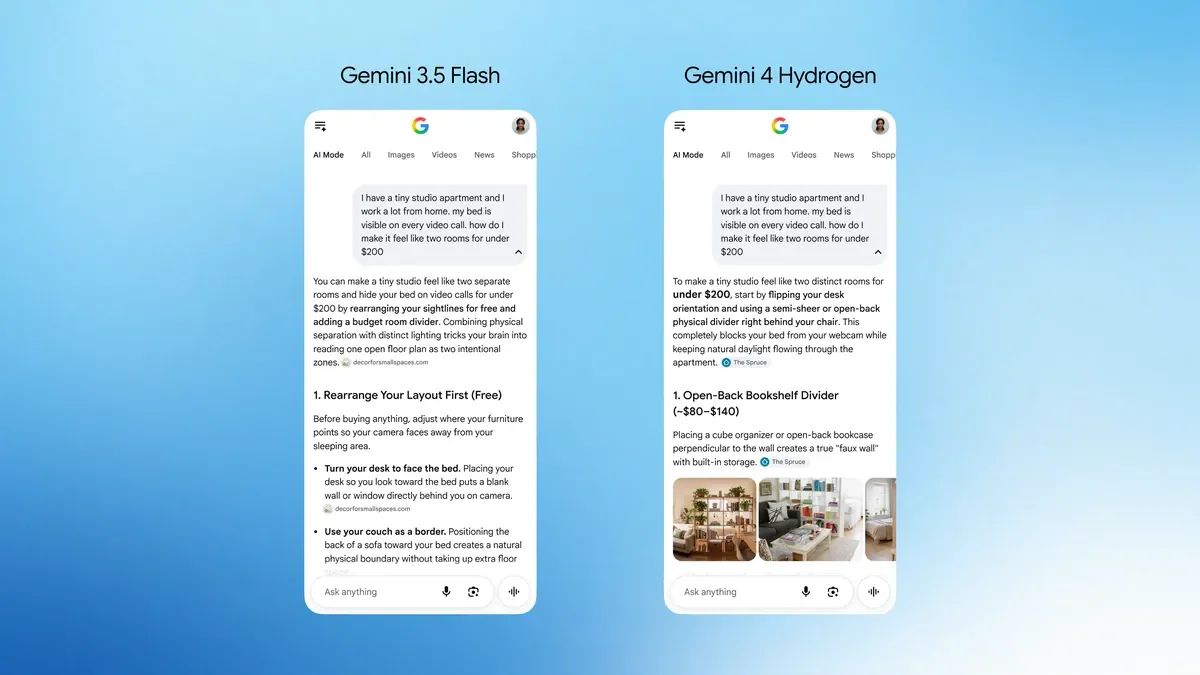
The numbers Google reported
Google leads with a score on the Artificial Analysis Intelligence Index. At Hydrogen's default high thinking level, the company reports 51 against 50 for Argon, and 54 at xhigh. That is a vendor-reported one-point gap at a specified thinking level, not a reason to treat Hydrogen as a new crown model.
On Terminal-Bench 4.0, which tests whether a model can finish real software tasks in a terminal, Google says Orchestrator reached near-Carbon task success rates while, on average, consuming 24% less quota and completing 19% faster. Quota means the usage allowance for model calls. The blog does not publish the absolute success rates for Orchestrator or for Carbon on that bench.
Against Gemini 3.8 Flash, Google reports that Hydrogen is 2.5 times faster at its high default setting, scores 57% on Terminal-Bench 4.1 against 18.2%, and cuts fabricated claims by more than 5 times. Unnamed partners, in early testing on complex graphs, SQL, and data-heavy enterprise workflows, are said to have seen Hydrogen run 2 times to 2.8 times faster than 3.8 Flash, while using 12% to 23% fewer tokens. The same post also reports fifth place on Agent Arena, 58.8% on HLE-Diamond, 52.3% and first overall on Vals Tax Agent Bench, 55.8% and a first-place tie on the Vals Legal Research Bench, a class lead on AutomationBench-AA, 53.4% on Multimodal Knowledge Agent, and 71.6% on Agents' Last Exam v1.1.
Google's safety figures are vendor-reported: overreach in agentic tasks down by up to 81%, under-service down by up to 79%, misaligned actions and task shortcutting cut by 12 times, up to 2 times less likely to bypass permission boundaries on impossible or blocked tasks, a 96.7% honesty rate on an internal evaluation, 99.9% chain-of-thought legibility with zero deceptive reasoning edits across more than 200,000 audited turns, more than 2.3 times higher resilience on the Gray Swan IPI benchmark for indirect prompt injection, which hides instructions in a file the agent reads, and HealthBench Pro false refusals under 0.4%. Overreach is doing more than asked, and under-service is doing too little.
[1][2]What the post does not show
These numbers are Google's account until an independent party repeats them. The Artificial Analysis scores were not independently confirmed here. "Near-Carbon" has no published percentage, so a reader cannot tell how close is close, or how much of the 24% quota cut comes from sending easier steps to Hydrogen. Orchestrator was measured on Terminal-Bench 4.0, the 3.8 Flash comparison on Terminal-Bench 4.1. Partner figures come from early testing and unnamed partners. Search and Gemini app claims are qualitative. An official product compares Hydrogen with Gemini 3.5 Flash on a studio-apartment query, not the 3.8 Flash baseline used in the speed and Terminal-Bench claims. The 1 million-token output figure is not the default synchronous cap. The Safety and Security Report "will be available in the coming days" and was not published with the launch post. On automated internal safety evaluations, not human or red-team tests, unjustified refusals are 5.57 percentage points higher than Gemini 3.8 Flash,, and the card says those results are not directly comparable with earlier Gemini model cards.
[1][2]A fair reading of Google's case
A fair reading is that Google is pricing and routing for volume, not chasing a one-point index lead. Most software work is writing code, running tests, and checking changes, not the hardest architectural judgment. If a cheaper, faster model can do that everyday work, and a router can call Carbon only when the harder reasoning is worth the quota, then a two-speed stack is a cost and latency product. The flat $1.50 and $7.50 rates support that case, because long prompts stay on the same published rates. Putting Hydrogen in Search and in the Gemini app is how a Gemini 4-class model reaches people who will never open the API. That case stands or falls on whether Orchestrator's published savings show up in other people's workloads, not on whether Hydrogen edges Argon by one point.
[1][2]What to watch in the next six months
Watch whether an independent Artificial Analysis listing, or a third-party Terminal-Bench 4.0 run, repeats the 51 versus 50 score and publishes absolute success rates for Orchestrator and for Carbon. Watch whether paying Antigravity users report quota cuts and shorter runtimes around 24% and 19% on their own work. Watch whether the Hydrogen Safety and Security Report appears, and whether anyone outside Google reproduces the honesty, overreach, and injection figures. Watch whether the flat $1.50 and $7.50 rates hold, and whether Hydrogen remains the default in the Gemini app and in Search, or whether hard queries are sent to Carbon or Argon. If the routing savings cannot be repeated, Hydrogen is still a new everyday model at a flat price. It is not yet a demonstrated two-speed system.
[1][2]