
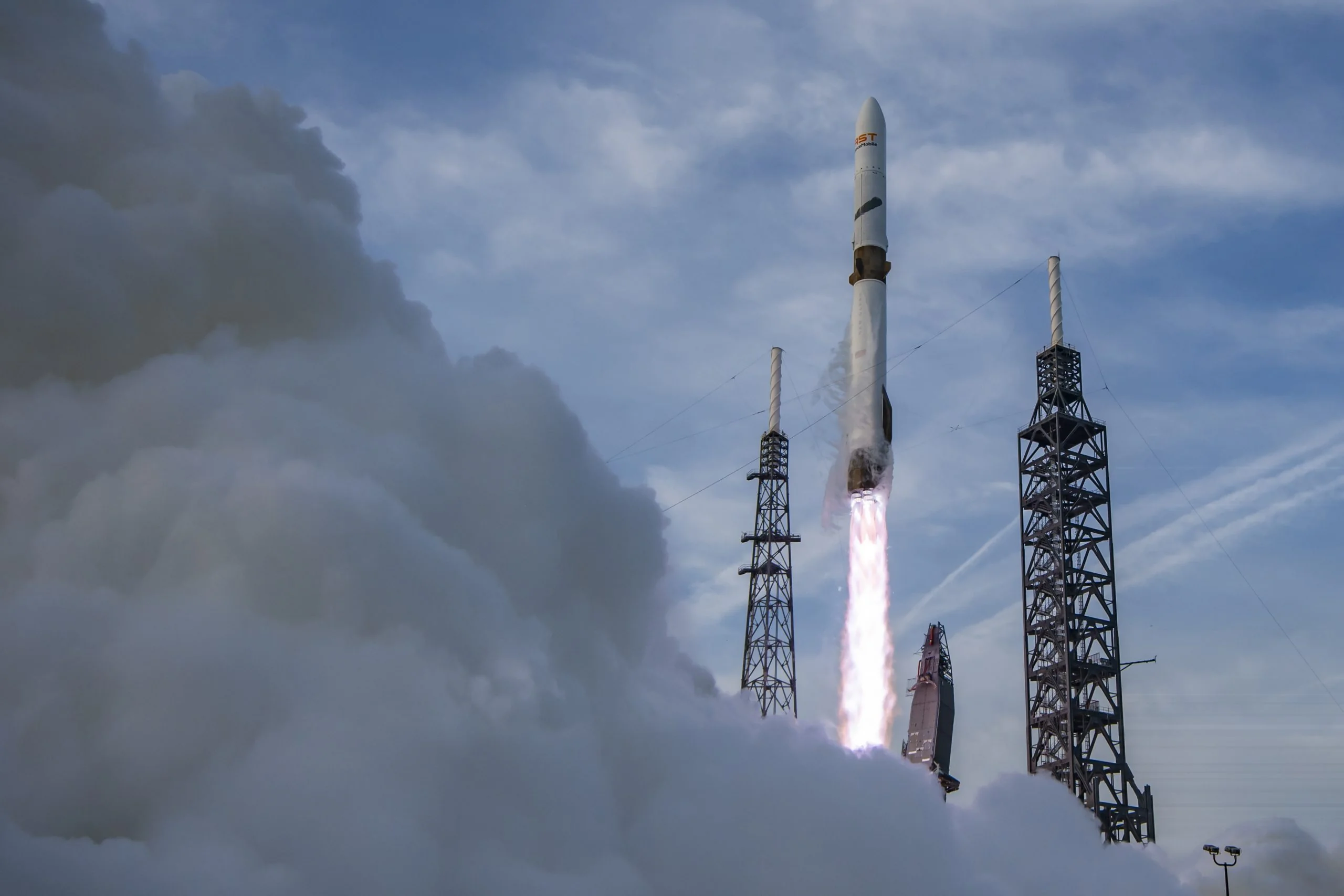
On 19 November 2026, Google said it is partnering with Blue Origin on the first dedicated heavy-lift launch for Project Suncatcher, its long-term research project to run AI computers in space on orbital solar power. The flight is targeted for the first quarter of 2029. Blue Origin's New Glenn rocket would place Google's satellites, "each with roughly the capacity of a data center rack," into a sun-synchronous orbit. That orbit is chosen because it can keep spacecraft in sunlight for most of their path around the Earth. Travis Beals, Google's senior director for Paradigms of Intelligence, called the booking "a crucial milestone on our long-term roadmap." It is a launch-services agreement with a date. It is not evidence that space-based AI computing has moved beyond the prototype already in orbit.
[1][2]What was actually signed
The Google post is three short paragraphs. The new, checkable facts are few: a named launch provider, a named rocket, a target quarter, an orbit type, and a capacity phrase. Blue Origin published a matching note the same day. It describes a "launch services agreement" and, unlike Google's post, states that the satellites would carry Google's Tensor Processing Units, or TPUs, the company's own chips for machine-learning work. Jordan Charles, Blue Origin's senior vice president for New Glenn, said the project "represents the ambitious missions New Glenn was built to support," pointing to heavy-lift capacity and large payload volume.
Neither company said how many satellites would fly in 2029, how many chips each would carry, how many watts they would draw, how they would dump heat in vacuum, or what the flight would cost. Google wrote that the launch "builds on our ongoing work with other satellite and launch partners," but did not name those partners or say what they have already flown.
[1][2]A prototype is already in orbit
Those partners, and that prior work, are not a secret. On 1 October 2026, Beals wrote that a Project Suncatcher prototype, built with Planet, had launched on SpaceX's Transporter-18 rideshare mission, a shared flight with many other payloads rather than a rocket reserved for Google. The team had confirmed contact. Google also pointed to a peer-reviewed paper in the journal Joule on the research behind the mission. That paper is not used as evidence in this article.
On 30 October, Google said the prototype had finished its commissioning checklist, the post-launch steps of turning systems on and checking that they work, including powering up the host and TPU trays and running early machine-learning tests. During a pass over a ground station, engineers uplinked a prompt to an onboard Gemma 4 open model, asking it to write a haiku about being in space. As the satellite passed Svalbard, Norway, it downlinked:
Blue marble below Data streams in silent grace Starlight feeds my core. ✨
Google called this the first AI response from a data-center-class TPU in orbit. It also tested space-themed limericks and prompts that reported the payload's technical status. The next work, it said, was to see how the chips behave under thermal stress and radiation. The "next milestone," in that same post, was "twin interconnected satellites in 2027."
Today's announcement does not mention that satellite, the October tests, or the 2027 pair.
Why a 2029 heavy-lift booking can still be a real step
A fair reading is that Google is laying out a sequence, and that this booking sits on it. First, fly a small prototype on a shared rocket and see whether the chips can be turned on in space. That step has started. Next, fly two linked satellites in 2027 and test whether they can work as a pair, a necessary step if the long-term idea is a network, not a single box. Then, in 2029, use a dedicated heavy-lift rocket to send up larger craft, each compared to a data-center rack, into the orbit that makes continuous solar power more plausible.
On that reading, naming New Glenn and a quarter is how a research blog becomes a procurement schedule. A data-center rack is a standard cabinet, about two metres tall, that holds a stack of servers on the ground. If Google means that comparison even roughly, those 2029 satellites would be a different class of machine from a first prototype that rode along with other customers. Heavy lift and a large payload volume are exactly what such a mass would need. The public date also creates a fact that can later be wrong. If the first dedicated Suncatcher flight slips beyond the first quarter of 2029, this announcement will have been too early, not too vague.
[1][2]The gaps that remain
The weaker reading is available too, because the companies left so much out. "Roughly the capacity of a data center rack" is a comparison, not a chip count, a power budget, or a networking claim. It does not say whether a 2029 satellite would train models, run them, or only repeat the kind of short prompt-and-reply test already done in October. It does not say whether the 2027 twins are still on the calendar. A target of the first quarter of 2029 is more than two years away. In aerospace, a launch window that far out is a reservation, not a countdown.
Google's own October language was more careful than talk of a space data center. The 2026 flight was a prototype. The first successful reply from orbit was a "Hello World" milestone. The 2027 goal was two connected satellites, still a research step. Today's post uses a larger claim, "scale AI infrastructure in space," while giving the reader less hardware detail than the October notes did.
[1][2]What would actually move the story
Over the next six months, the evidence that matters is not another launch-partner note. It is whether Google publishes in-orbit results on heat and radiation from the satellite already flying, and whether the 2027 twin-satellite milestone remains a public part of the plan. If those tests are thin, or if the 2027 pair recedes, a 2029 New Glenn reservation will look like a placeholder. If the chips hold up and the pair is still scheduled, then the Blue Origin booking is what Google says it is: a dated step toward rack-scale craft, still years from anything that should be described as infrastructure.
[1][2]