
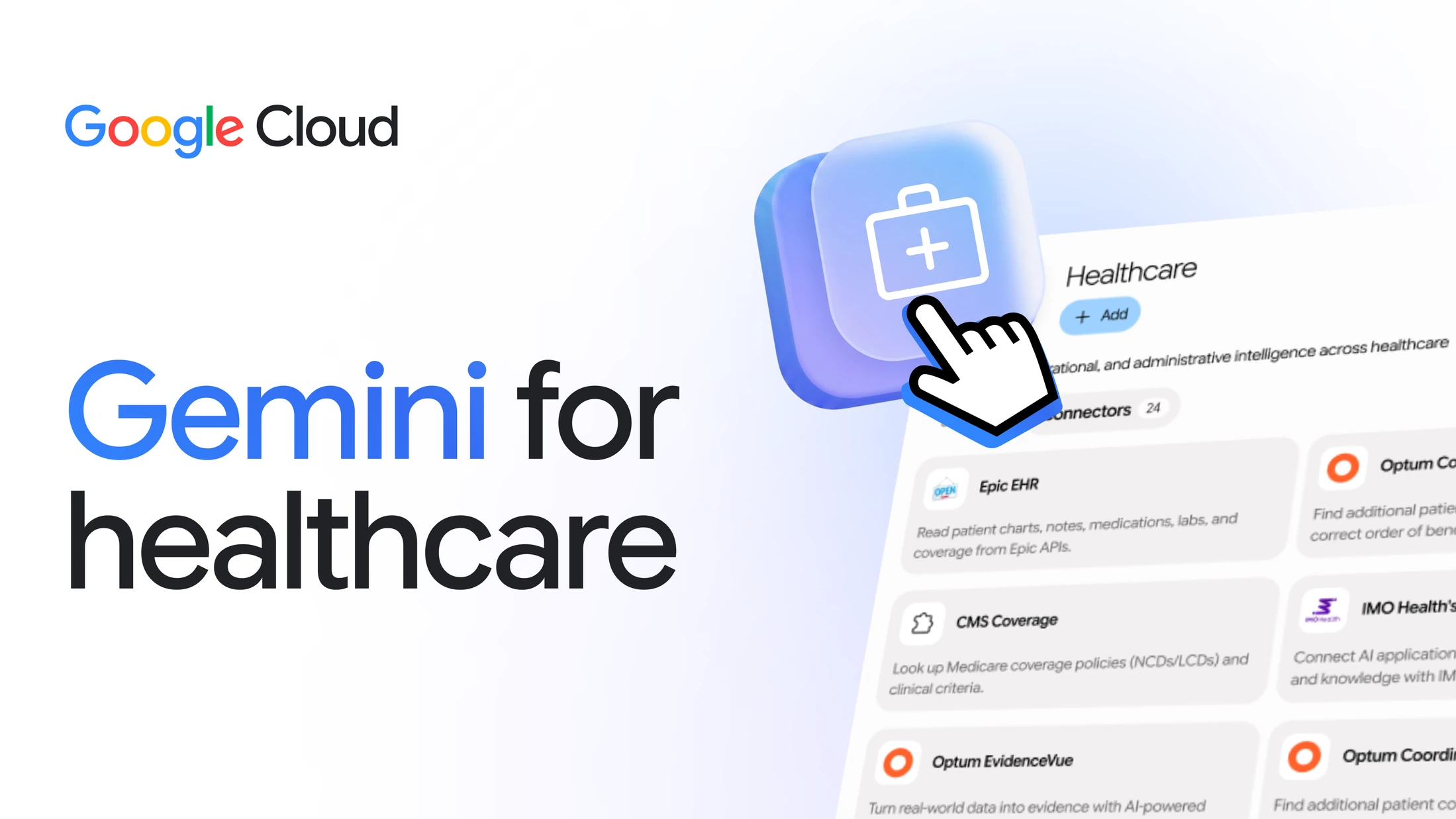
要点
- On Nov. 10, 2026, Google Cloud published a post under Thomas Kurian's name announcing Gemini for healthcare. The post calls it an industry solution for healthcare, built on the universal Gemini agent introduced the previous month at Gemini at Work, and meant to coordinate multi-step work across the systems health organizations already run, with human oversight. The company wrote that the product is built to support HIPAA compliance and is available in the United States in preview starting that day. It also said clinical data, prompts, and generated outputs remain in the customer's governed environment and are never used to train or fine-tune Google's foundation models, and that outputs come with traceable citations and audit logs.
- The official post describes four parts: reusable skills written by domain experts for work such as medical-record synthesis, pre-appointment preparation, coverage and policy review, and benefit determination; connectors to electronic health records, claims, and administrative systems that keep existing identity and permissions in place and, the company says, do not require moving sensitive data; a partner ecosystem; and a governed platform that allows model choice. On electronic health records, the post says the Epic and Oracle Health connections give authorized users read-only access and do not write back to the chart. It also describes a direct connection to Medicare coverage rules from the Centers for Medicare & Medicaid Services. The post includes on-the-record comments from officials at HCA Healthcare, Northwell Health, Highmark Health, Blue Cross Blue Shield of Massachusetts, and Optum.
- A same-day report by Cailey Gleeson in Fierce Healthcare confirms the Nov. 10 U.S. preview and the 'built to support HIPAA compliance' wording, and quotes Kurian's written statement. The report says customers on Gemini Enterprise Standard and Gemini Enterprise Plus will be able to use the product, with a choice between per-user subscriptions and pay-as-you-go pricing. Fierce also names partners including GoodRx, Epic, IMO Health, Oracle Health, Infinitus, and Suki, and organizations including HCA, Northwell, Blue Cross Blue Shield of Massachusetts, the American Society of Clinical Oncology, and Highmark Health. This desk has not seen independent outcome data from the preview in the official post.
On Nov. 10, 2026, Google Cloud CEO Thomas Kurian announced Gemini for healthcare on the company's blog. It is an industry product for providers and payers, built on the universal Gemini agent launched the previous month at Gemini at Work. The company said the product is available in U.S. preview starting that day, and that it is built to support HIPAA compliance.
The preview launch and that compliance wording are what can be checked now. The post describes an orchestration layer that reads from systems hospitals and insurers already use, organizes multi-step work, and leaves a person in the loop. It does not report a measured drop in paperwork time, authorization turnaround, or claim denials. Reading the launch as proof that the burden has already fallen goes beyond what the text shows.
[2]I read the launch post in full. Kurian opens with a problem of fragmented data: patient records, coverage policies, and clinical evidence stuck in systems that do not work together. The post says clinicians spend nearly 28 hours a week manually reconciling information. That sentence does not cite a study in the post, so it should be recorded as a claim in the company's announcement, not as a figure this desk has independently checked.
The product is described in four parts. Skills are reusable instructions written by domain experts for tasks such as medical-record synthesis, pre-appointment preparation, coverage and policy review, and benefit determination, and organizations can also write their own. Connectors reach electronic health records, claims, care-management, and administrative systems while keeping existing identity and role-based permissions. The company says this does not require moving sensitive data or changing those permissions. The governance layer is described as allowing model choice, with stronger models for complex clinical reasoning and faster, lower-cost models for routine administrative steps, under the same policies. Officials say outputs should be grounded in clinical records, plan policies, and an organization's approved guidelines, with traceable citations and audit logs.
On electronic health records, the post is specific. The Epic connection gives authorized users read-only access to conditions, medications, labs, and clinical notes, with no write-back to the underlying chart. The Oracle Health connection likewise surfaces read-only histories, diagnostics, labs, and documentation, and the post says it enforces zero write-back to keep the system of record intact. On coverage, the post describes a direct connection to Medicare rules from CMS, including National and Local Coverage Determinations, so that coverage reasoning can rest on current published policy rather than on static knowledge stored in a model.
[2]The post leaves several product boundaries that can be checked now. First, this is a U.S. preview, not a generally available finished product. Second, the electronic health record connections are described as read-only, with no write-back, which lowers the risk of a model editing the official chart and also means the product cannot, on that path, complete steps that require writing into the record. Third, the company's phrase is "built to support HIPAA compliance," not a third-party certification presented in the post. Fourth, the claim that data, prompts, and outputs stay in the customer's environment and are not used to train or fine-tune Google's foundation models is a company data-handling promise. It has to be tested in contracts and audits, and it is not a runtime result this desk has verified.
The Fierce Healthcare report matches the official post on the preview date and the HIPAA wording, and it adds commercial terms that the official post does not spell out. Fierce says customers on Gemini Enterprise Standard and Plus will have access, and can choose between per-user subscriptions and pay-as-you-go pricing. Those pricing details come from Fierce. This desk did not find the same sentences in the official post. Fierce also quotes Kurian's written statement that the basic problem in healthcare is not a lack of information, but the friction of making that data usable in a highly regulated system.
The on-the-record comments in the official post show that some large health systems and plans were willing to speak at launch. Michael J. Schlosser, executive vice president and chief clinical officer at HCA Healthcare, is quoted on exploring how Gemini can pull together patient information from multiple electronic health records and care settings. John D'Angelo of Northwell Health, Karen Hanlon of Highmark Health, Prem Somasundaram of Blue Cross Blue Shield of Massachusetts, and Sandeep Dadlani, chief executive of Optum Insight, are also quoted. Those are statements of intent and expectation, not measured results. Fierce separately quotes Infinitus CEO Ankit Jain, who describes the partnership as putting agents to work on the processes that connect patients to care, rather than only answering questions. That is a partner's assessment, and it is also not outcome data.
[2][1]The main gap is results. Neither the official post nor the Fierce report provides a before-and-after comparison from preview customers on paperwork time, prior-authorization turnaround, claim denials, or safety incidents. The post's figure of nearly 28 hours a week spent reconciling information does not name a study, a clinician group, or whether it counts all documentation work. That unsourced number cannot be used to prove that the new product has already won those hours back.
This desk has also not read an independent security assessment, the full data-processing terms, or a third-party HIPAA audit. "Built to support HIPAA compliance" and the promise not to train foundation models on customer data are company commitments that can be recorded now. They are not completed outside tests. The read-only, no-write-back design of the electronic health record connections is an important choice, but the post does not say which other systems in the preview are allowed to receive writes, or how a wrong citation or a wrong coverage recommendation would be caught and corrected.
The partners and pricing named by Fierce help show that this is a preview for Gemini Enterprise customers, not a public product for every clinic. Even so, a list of preview names is not the same as a finished deployment, and it is not the same as a change in clinical or operational results.
[2][1]A fair reading in the company's favor is clear. Healthcare systems are fragmented, and letting a general model write directly into the official chart would be a high-risk way to start. Opening a U.S. preview, making the electronic health record path read-only, keeping data and outputs in the customer's environment, and adding citations and audit logs is a cautious way to ship this kind of tool. The fact that HCA, Northwell, and other organizations were willing to speak on launch day also shows that some buyers are testing the orchestration layer. Google Cloud's claim that it can assign work to stronger or cheaper models because it runs both the infrastructure and the models is a coherent product story. Whether costs actually rise more slowly than usage still has to be checked on real bills.
Even if that reading is accepted, the announcement is still a product preview, not an outcomes report. Fewer denials, faster authorizations, and less clinical paperwork are goals named in the post, not results already measured. Human oversight is written into the product description, which means a person is still expected to close the important steps. The next test is whether preview customers publish operational figures that can be checked, and whether the read-only boundary stays in place in later versions.
[2][1]Over the next six months, the facts to watch are whether preview customers publish checkable changes in paperwork time, authorization turnaround, or denial rates, whether the electronic health record connections remain read-only, and whether any privacy or compliance incident has to be disclosed. If the public record is still only the launch post and partner statements, with no operating data, Gemini for healthcare should continue to be described as a U.S. preview with a company HIPAA-support claim, not as a rollout that has already reduced the burden of care. The product boundaries are clear now. The results have not been measured with the same clarity.
【No.2】
[2][1]