
要点
- On 16 November 2026, Google published a short consumer post titled "The era of autonomous attacks has arrived," pointing to a GTIG AI Threat Tracker report on the Google Cloud Threat Intelligence blog, written by Aurora Blum, Kelli Vanderlee, Jess Xia, and David Mainor. The full report's title is "Agentic Threat Activity Crosses a Significant Threshold."
- GTIG says it has independently observed the open-source frameworks CAIRN and PentAGI deployed in the wild, and has seen experimentation with CyberStrikeAI and HexStrike AI. It says CAIRN was used in intrusion activity against targets including in the aerospace sector in the United States. Between late August and early October 2026, it tracked a threat actor using a customized platform built on PentAGI to conduct reconnaissance and vulnerability scanning against organizations in Asia.
- The report says these frameworks can discover and exploit low-complexity vulnerabilities, generate single-use payloads, and adjust tactics from real-time execution feedback. GTIG also describes automated reverse engineering of software patches by differential analysis, used to weaponize n-day vulnerabilities, meaning flaws that already have a patch, against internet-facing servers. It says financially motivated actors and suspected espionage actors with a PRC nexus have been experimenting with such frameworks, and that a PRC-nexus group was developing its own automated attack framework.
- Other trends in the quarter include LLMJacking, in which stolen credentials and cloud resources are used to resell access to high-performance models, and what GTIG assesses with high confidence as full operational integration of language models into information operations by state-sponsored groups, commercial influence vendors, and inauthentic political monetization networks. The report notes that better content quality does not necessarily mean greater influence.
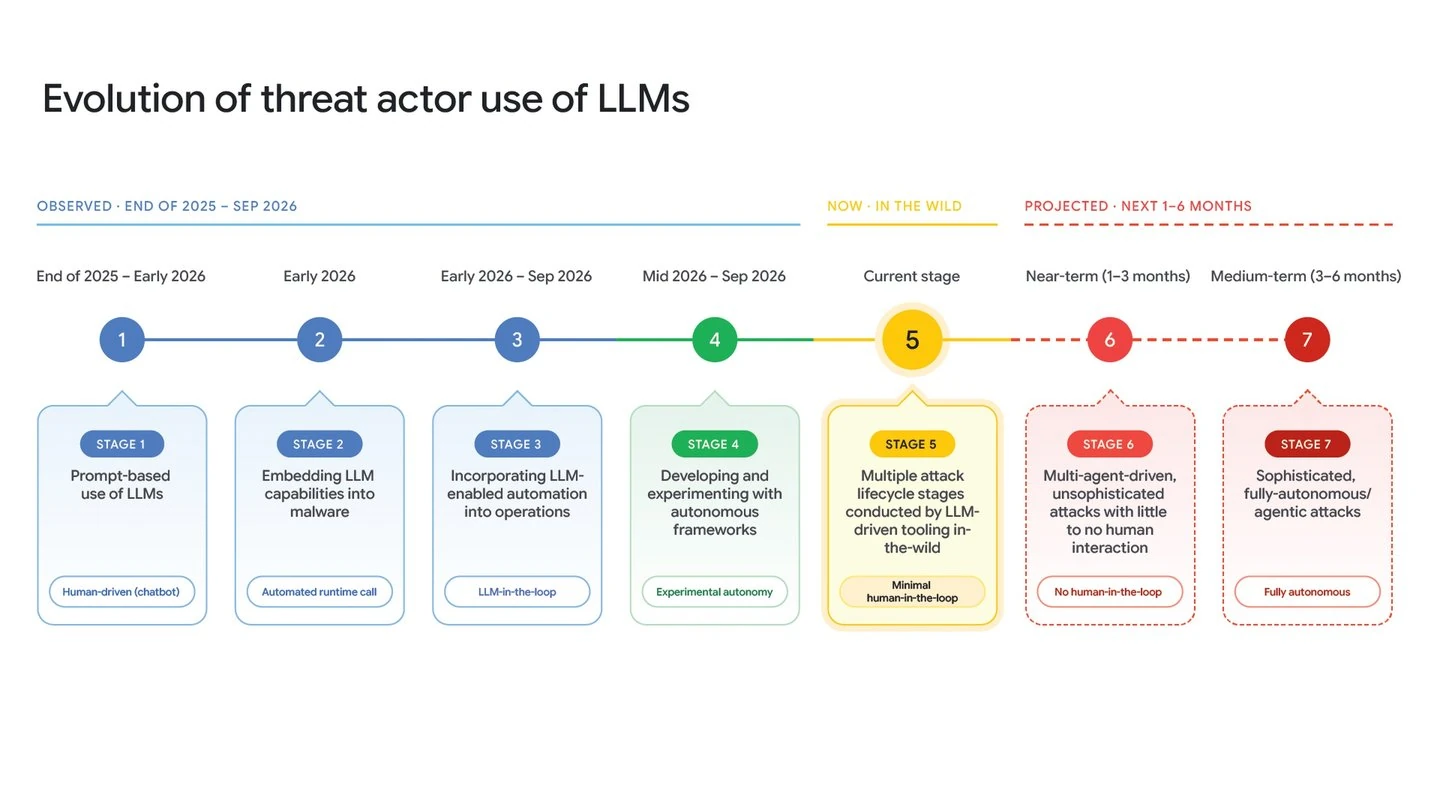
- The consumer post presents Google AI Threat Defense, combining Gemini and other models, Wiz, CodeMender automated patching, and Mandiant, as the answer to machine-speed threats. The cover graphic on that post, titled "Evolution of threat actor use of LLMs," marks the current stage as "minimal human-in-the-loop" and labels "fully autonomous" attacks as a projection for the next three to six months.
On 16 November 2026, Google told a general audience that "the era of autonomous attacks has arrived." The short consumer post points to a longer Google Threat Intelligence Group report, written with Mandiant by Aurora Blum, Kelli Vanderlee, Jess Xia, and David Mainor, and published on the Cloud Threat Intelligence blog as "Agentic Threat Activity Crosses a Significant Threshold."
The report is more careful than the consumer headline. GTIG says it has now seen open-source, multi-agent hacking frameworks used in live intrusions, rather than remaining at the experiment stage. That is a real shift in tooling and speed. It is not, on the evidence provided, a documented wave of attacks that run end to end with no human in the loop. Google's own cover graphic on the consumer post draws that line clearly. The current stage is labeled "minimal human-in-the-loop." Fully autonomous attacks are drawn as a projection for the next three to six months.
[1][2]The hardest evidence in the report is named tooling in named settings. GTIG says it has independently observed CAIRN and PentAGI in the wild, and has seen experimentation with CyberStrikeAI and HexStrike AI, as well as custom harnesses. CAIRN is described as a multi-agent system that uses a shared "blackboard" and an observe-orient-decide-act loop, starting from something as small as a target IP address. GTIG says it observed CAIRN used against targets including in the U.S. aerospace sector. PentAGI is described as an open-source framework that lowers the skill needed to run a complex campaign. Between late August and early October 2026, GTIG tracked a threat actor using a customized platform built on it to scan organizations in Asia.
The report also lists CyberStrikeAI, which it describes as connecting language models to more than 100 security tools and attack recipes, and HexStrike AI, a harness built on the Model Context Protocol, a common interface for models to call tools, wrapping more than 150 offensive tools and more than a dozen sub-agents. GTIG says financially motivated actors and suspected espionage actors with a PRC nexus have been experimenting with these frameworks, and that it has evidence a PRC-nexus group was building its own automated attack framework.
The technical step that most closely matches the "machine-speed" claim is not a sci-fi autopilot. It is faster work on known weaknesses. The report says actors are using language models and agent frameworks to reverse-engineer patches by differential analysis, then weaponize n-day vulnerabilities, flaws that already have a vendor patch, against internet-facing servers, at a pace that can outrun human-operated defense. The mechanics, GTIG writes, remain familiar: compromised credentials, unpatched systems, and known classes of weakness. What has changed is the speed and scale at which those steps can be chained.
[1][2]Two other trends in the quarter are easier to over-read than they are to dismiss. Financially motivated actors continue to steal model credentials and cloud resources and resell access through underground proxy services, a pattern GTIG calls LLMJacking. On information operations, GTIG assesses with high confidence that state-sponsored groups, including actors it links to Russia, the PRC, and Iran, commercial influence-as-a-service vendors, and inauthentic political monetization networks have moved from early experimentation to routine use of language models for synthetic media, persona work, and distribution. The report is explicit about a limit: better output quality does not necessarily mean greater impact.
[1][2]A fair reading of GTIG's threshold claim is that defenders should not wait for a cinematic, fully unsupervised breach before changing how they patch and monitor. If open-source agent frameworks are already in live intrusions, and if patch diffs can be turned into exploits with much less human labor, then a 30-day patch cycle is a different risk than it was when each exploit was hand-built. CAIRN in a U.S. aerospace intrusion and a multi-week PentAGI scanning campaign in Asia are the right kind of observation: specific tools, specific windows, specific sectors. A threat-intelligence shop that waits for perfect, court-ready attribution of a fully autonomous attack would be late.
[1][2]The consumer headline and the product packaging still need to be separated from that core. "The era of autonomous attacks has arrived" is a stronger sentence than "open-source agentic pentest frameworks have appeared in live intrusions." The short post also introduces Google AI Threat Defense, a bundle of Gemini and other models, Wiz, CodeMender automated patching, and Mandiant, as the way to answer machine-speed threats. That may be a reasonable product response. It is also the commercial frame around a research report.
The chart Google put on the consumer post is the more honest object. It places today's activity at stage five, with minimal human involvement, and it places unsophisticated attacks with little or no human interaction, and then sophisticated fully autonomous attacks, in a projected window of one to six months. That is a claim about direction, not a claim already proven in the case studies. Over the next six months, the test is whether GTIG, Mandiant, or an independent incident-response shop publishes intrusions in which the agent framework selected the targets, wrote the exploits, and moved through a network with only token human approval. Until then, the accurate story is that the tools have crossed into live operations, and that the fully unsupervised era is still, on Google's own graphic, ahead of the evidence.
[1][2]