
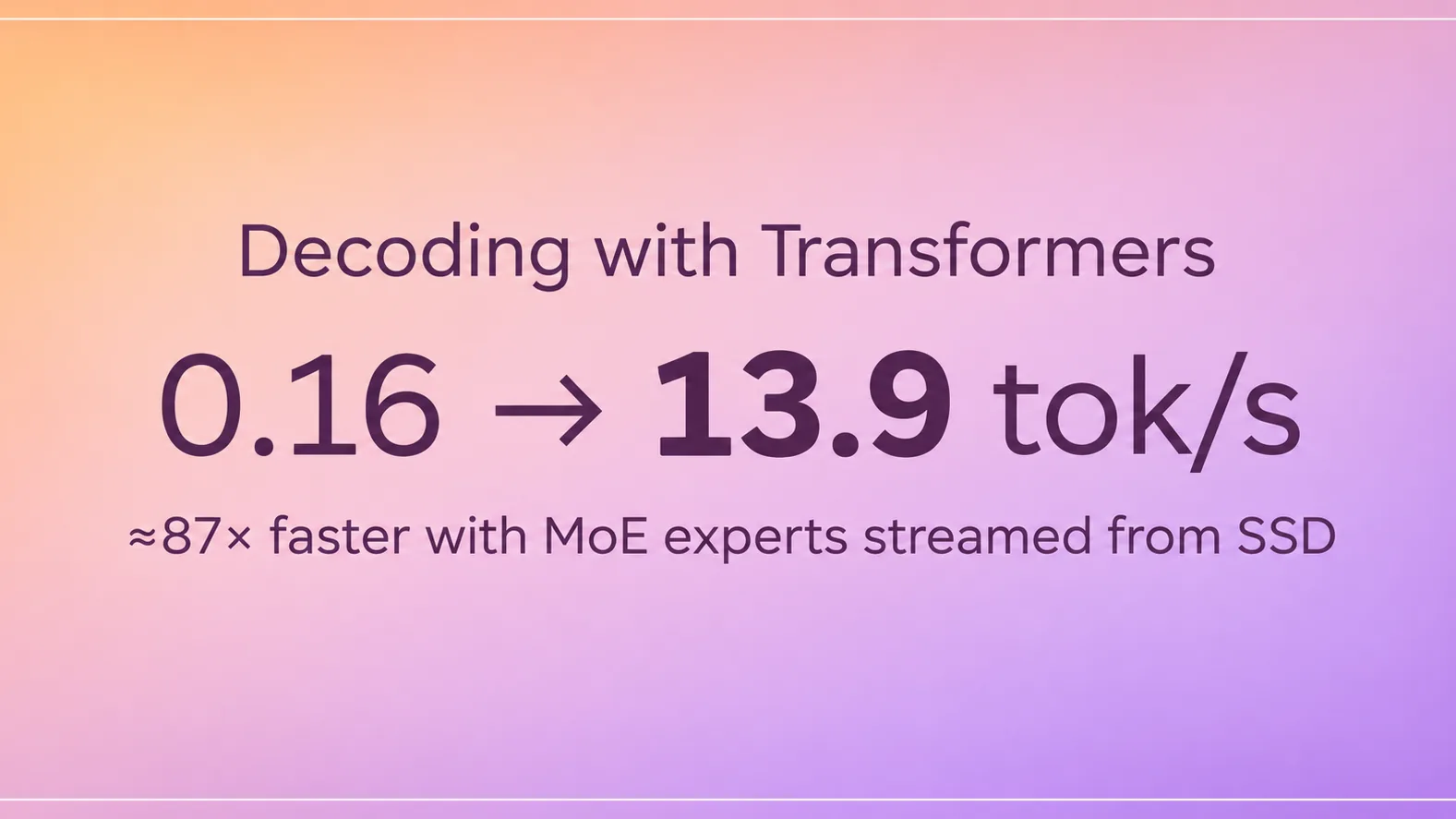
On 18 November 2026, a Hugging Face blog post by Tarek Ziadé described running Qwen3.8-Flash-Next, a 180-billion-parameter mixture-of-experts (MoE) model, on a MacBook M5 with 32 GB of unified memory. An MoE stores many specialist sub-networks, called experts, and turns on only a few of them for each token, a small piece of text. The post's subtitle says that streaming those experts from an SSD, a solid-state drive, "gets within 6% of Strata on token generation."
The number that is easiest to misread is a jump from 0.16 to 13.9 tokens per second, about 87 times, under the heading "Decoding with Transformers." That 0.16 figure is not a comparison with Strata. It is Transformers plus Accelerate, Hugging Face's ordinary offload path, from an earlier test on a different model and a different machine. On the Mac, after later optimizations, short decode is 13.9 against Strata's 14.8. Ziadé writes that this is still too slow for how he uses coding agents. The desktop he calls Orthrus, with two RTX 4090 graphics cards, "keeps doing the real work."
[1]Why stock offload was too slow
Strata is an inference engine for MoE models. It keeps only the "hot" experts, the ones in use, in GPU memory and can send the rest to system memory or to disk. Ziadé writes that experts are more than 90% of a MoE's weights, so a 180B model can run on a GPU that could not hold the whole file.
When a MoE does not fit, llama.cpp can compute experts on the CPU if they fit in RAM. vLLM can leave expert weights in pinned RAM, but the post says nothing is cached and there is no disk tier. Transformers, through Accelerate, copies a layer's whole expert bank, so every token copies every expert of an offloaded layer to use 8 or 10 of them. On a Mac, CPU and GPU share the same memory, so "offload to CPU" frees nothing.
He ran those engines on Qwen3.6-35B-A3B on one 24 GB A10G. Strata with Q8_0 quantization decoded at 82 to 88 tokens per second; llama.cpp with the same setting reached 63 to 64; vLLM, in the best flags he and Harry Mellor reported, reached 20.1; Transformers plus Accelerate decoded at 0.16. That 0.16 is the number on the graphic, not a Mac-versus-Strata result.
[1]A slot pool that grouped_mm can use
Ziadé wanted to fix offloading inside Transformers, "knowing it would probably stay too slow for how I work." All of the code, he writes, was built with AI; his part was choosing what to try and what to keep. Benchmarks are in the Space tarekziade/moe-expert-streaming.
On OLMoE-1B-7B, which fits in memory, a first version ran one expert at a time in Python from an LRU cache, which evicts the expert unused the longest. Even with every expert cached, that loop did 10.1 tokens per second, against about 32 for ordinary Transformers, which uses grouped_mm, one kernel that multiplies a layer's active experts together. The fix was a slot pool: one preallocated device tensor shared by all layers, plus a per-layer table from expert id to slot. Remap the router's ids to those slots, and grouped_mm runs as if the experts were already on the device. That reached 34.6 tokens per second, against 38.1 for the ordinary path.
The loader became an option of from_pretrained in Transformers pull request 50717. Misses are read by 8 I/O threads. The next two layers' routers run early to prefetch experts. The API is still being discussed with the maintainers. The post does not say it has been merged.
The Mac numbers, in order
Qwen3.8-Flash-Next has 48 layers of 512 experts, with 10 active, and occupies 121 GB in FP8. A 51 GB n-gram embedding table, a large lookup of word sequences, needed its own disk path. Experts were quantized to 3 bits, 49 GB on disk, with 12 GiB cached; dense layers sat in 8 bits, about 5.4 GB, at +0.2% perplexity versus BF16, a small rise in prediction error. After loading, the run uses about 18 GiB. A 6,000-token prompt peaks at 25.4 GiB. He had to close the browser, or macOS started swapping.
He compared against Strata 0.1.60 (IQ3_XXS experts) on the same M5, with the same prompts, greedy decoding, thinking, MTP and speculative drafts off, and 1,024-token prefill chunks. Prefill reads the prompt; decode writes new tokens. The first table showed Transformers at 10.0 tokens per second for 200 decoded tokens, against Strata's 14.8; prefill on a 4,000-token prompt was 68 against 220; decode after a 6,000-token document was 7.3 against 13.7.
After later changes, including Metal kernels and Strata's own GGUF weight files, short decode is 13.9 against 14.8, a 1.06 times gap, about 6% behind. Prefill is 228 against 220. Decode after a 6,000-token document is 12.4 against 13.7, a 1.1 times gap. "That's about 6% behind Strata on short decode, with slightly faster prefill, all through Transformers," he writes. Most of the remaining gap is host round trips, about 10 milliseconds per token, with the GPU running dry while Python queues the next layer. There is no C++ extension, only Python, plus Metal kernels compiled at runtime and prebuilt kernels from the Hub.
[1]The case for a systems result inside Transformers
This is a real systems result, even if the graphic is easy to over-read. Getting a 180B-class MoE to run on a 32 GB laptop, inside the library many people already use, and publishing the tables, the Space, and a Transformers pull request, is more useful than a claim to have beaten a specialized engine. The author does not make that claim. He thanks Niko Veit, who built Strata, for setting the bar. The slot-pool idea is the part that travels: once the cache presents a dense bank of expert slots, grouped_mm can run unchanged.
[1]What the tables do not settle
Every speed figure is the author's, measured on his machines, on the models he chose. The 13.9 versus 14.8 comparison is one model on one 32 GB MacBook M5, not a survey of MoE engines and not an independent audit of Strata. The 0.16 number comes from a smaller model, on an A10G, under Accelerate.
The 180B-on-32GB setup depends on 3-bit experts, an 8-bit dense trunk, a disk path for the 51 GB n-gram table, and closing the browser so the machine does not swap. The generic streaming code lives in a pull request whose API is still under discussion, so the work is a public experiment, not a feature in a stable release. Closing the last 6%, the author writes, would take deeper changes, starting with a per-layer sync that PyTorch does not give him on this stack.
[1]What to watch over six months
The next fact that would change this story is whether expert streaming, with a slot-pool cache that grouped_mm can use, becomes an ordinary option in Transformers, or stays a personal build that still needs 3-bit experts, a closed browser, and a two-GPU desktop. If it does not, the honest reading remains the post's own conclusion: about 14 tokens per second, close to Strata, and still too slow for how he uses coding agents.
[1]