
要点
- On 12 November 2026, IBM Granite released granite-4.1-3b-LLMON-preview and granite-4.1-8b-LLMON-preview, further trained from Granite 4.1 base models, plus a GitHub toolkit, and called them an experimental preview not for production.
- LLMON marks instructions and data with reserved special-token delimiters and unique IDs, then binds them in an execution block. It enriches chat templates rather than replacing them, and the GitHub repo includes a lossless json-to-llmon converter.
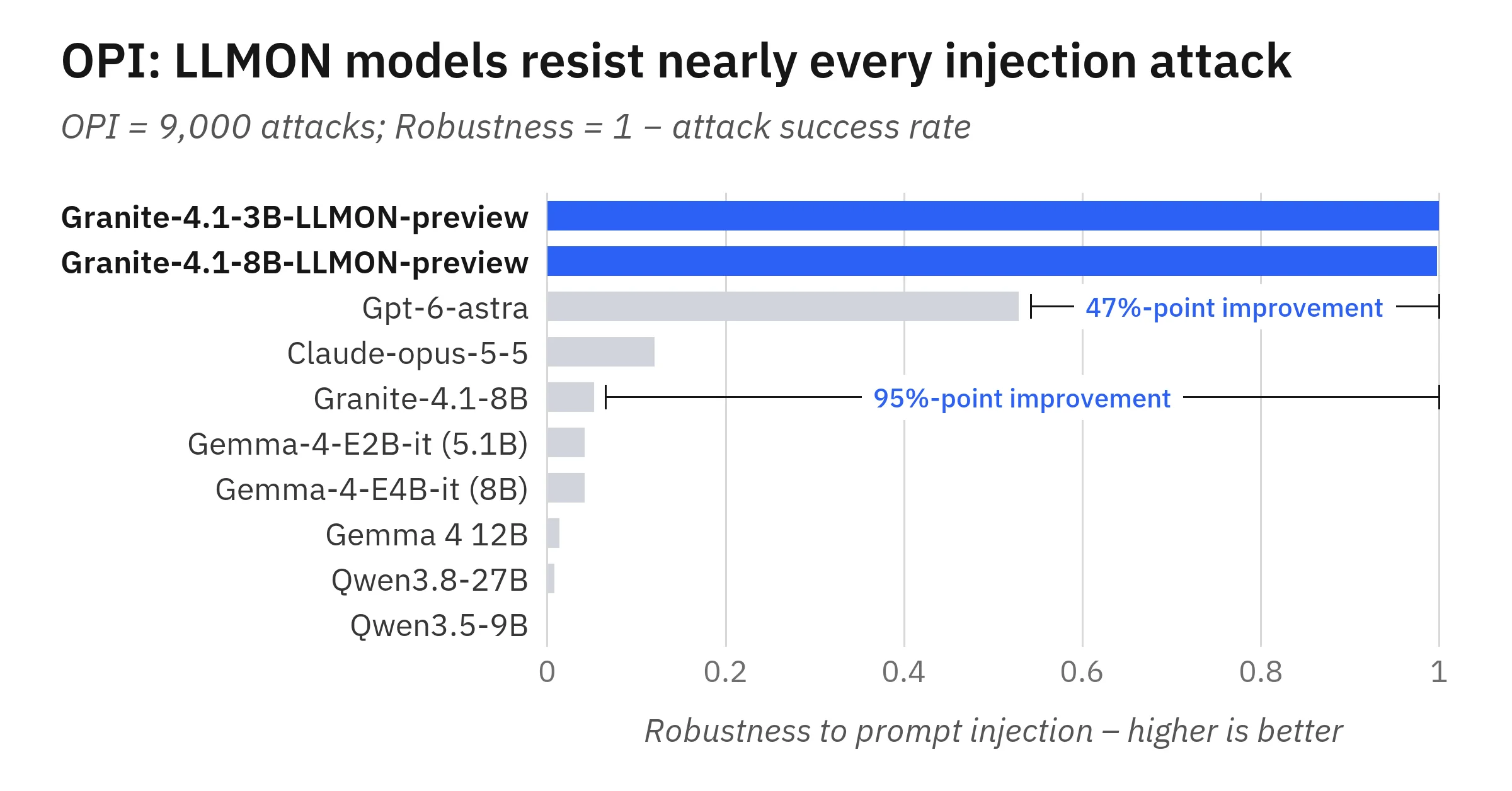
- On the authors' OPI evaluation, they say LLMON avoids 47% more attacks than the best frontier model they tested and 95% more than the best open-source model. Their chart labels 47%-point and 95%-point gains over Gpt-6-astra and Granite-4.1-8B and states that OPI comprises 9,000 attacks.
- The authors say the LLMON models perform on par with Granite 4.1 Instruct models. Their table shows seven-category averages of 69.44 versus 68.09 at 3B and 74.76 versus 74.90 at 8B, with higher safety scores and lower math, especially 79.63 versus 84.09 at 8B.
- The post states that the privilege rule is a learned behavior, not an enforced guarantee, that OPI, ASB, and StruQ test static indirect injections, and that the authors are working on adaptive attacks over many chat turns.
On 12 November 2026, IBM Granite published a technical blog on Hugging Face introducing LLMON, short for LLM Object Notation and pronounced "lemon". It is a markup language for language models, now trained into two experimental preview models built from Granite 4.1 base models: granite-4.1-3b-LLMON-preview and granite-4.1-8b-LLMON-preview. The authors, Abraham Daniels, Basel Shbita, Chad DeLuca, Dan Gutfreund, Michael Hind, and Shub A, also released a toolkit in a public GitHub repository. The claim is not that a larger model is harder to hijack. It is that if the context marks which span is an instruction and which span is data, and binds them with unique IDs, a model can be trained to ignore malicious commands hidden in retrieved documents, tool replies, or user-provided data.
[1][2]What shipped
The models start from Granite 4.1 base models, not from the released instruct models, so the new behavior is learned in later training. The repository README confirms the 3B and 8B previews are further trained from Granite-4.1-3B-Base and Granite-4.1-8B-Base. The blog calls this an experimental preview, ready for exploration and evaluation but not for production.
LLMON does not replace chat templates. A developer still calls apply_chat_template on a messages list. A turn can name its parts, such as instruction, data, and requirement, and mark each one exec True or False. Parts marked True are bound into an execution block that states which instruction to run on which data. Parts marked False remain in the context but are referenced by nothing. Two-character block IDs come from a fixed set encoded as single tokens, so addressing a block always costs two tokens.
JSON was designed for parsers. Its structural tokens can also appear in ordinary text, and language models are weak at counting nested brackets over long spans. LLMON uses six reserved special tokens as delimiters, so structure and content use separate parts of the vocabulary. Tags sit at the start of each span, and nesting is stated locally. The GitHub repository's json-to-llmon converter turns existing JSON into LLMON and back without loss. Mellea, a related library, has native LLMON support.
[1][2]What the numbers show
All robustness and capability figures come from the authors, with no independent leaderboard check.
Indirect prompt injection hides a malicious instruction in a retrieved document, a tool response, or user-provided data. On the OPI benchmark, which places that injection in the data of classic NLP tasks, the authors compared the LLMON previews with several open-source and closed-source models. They report robustness as one minus the attack success rate. The blog says LLMON practically eliminates the problem, avoiding 47% more attacks relative to the best frontier model they tested, and 95% more than the best open-source model.
The chart titled "OPI: LLMON models resist nearly every injection attack" states that OPI comprises 9,000 attacks. Both preview models have blue bars at or near 1.0 robustness. A callout marks a 47%-point improvement over Gpt-6-astra, near the midpoint, and a 95%-point improvement over Granite-4.1-8B, near zero. Shorter gray bars are shown for Claude-opus-5-5, Gemma-4-E2B-it at 5.1B, Gemma-4-E4B-it at 8B, Gemma 4 12B, Qwen3.8-27B, and Qwen3.5-9B. The chart labels the gains as percentage-point improvements. The prose says "47% more" and "95% more." The authors say they observe similar trends on ASB and StruQ, which also test static indirect injections, and they are working on adaptive attacks over many chat turns.
The blog says the LLMON models perform on par with the Granite 4.1 Instruct models across standard benchmark categories. The seven-category average is 69.44 against 68.09 at 3B, and 74.76 against 74.90 at 8B. Safety is higher for both LLMON previews, 89.64 against 80.89 at 3B and 90.36 against 84.19 at 8B, on a mix listed as Tulu3 Safety, AttaQ, and SALAD-Bench. Math is lower, especially at 8B, 79.63 against 84.09.
Training rewrites ordinary instruction data into LLMON and adds decoy blocks that are present but not tied to the task. Five sequential GRPO stages cover multi-domain reasoning, RLHF, knowledge calibration, and math, then a final DPO stage uses a thousand preference pairs built from the model's own responses to injection attempts. GRPO and DPO here are a staged reinforcement-learning pass and a preference-tuning pass. An instruction reached through an execution block is authoritative. Anything reached as input is material to read, not a command to follow. Unbound spans are ignored. This is a learned behavior, not an enforced guarantee.
[1][2]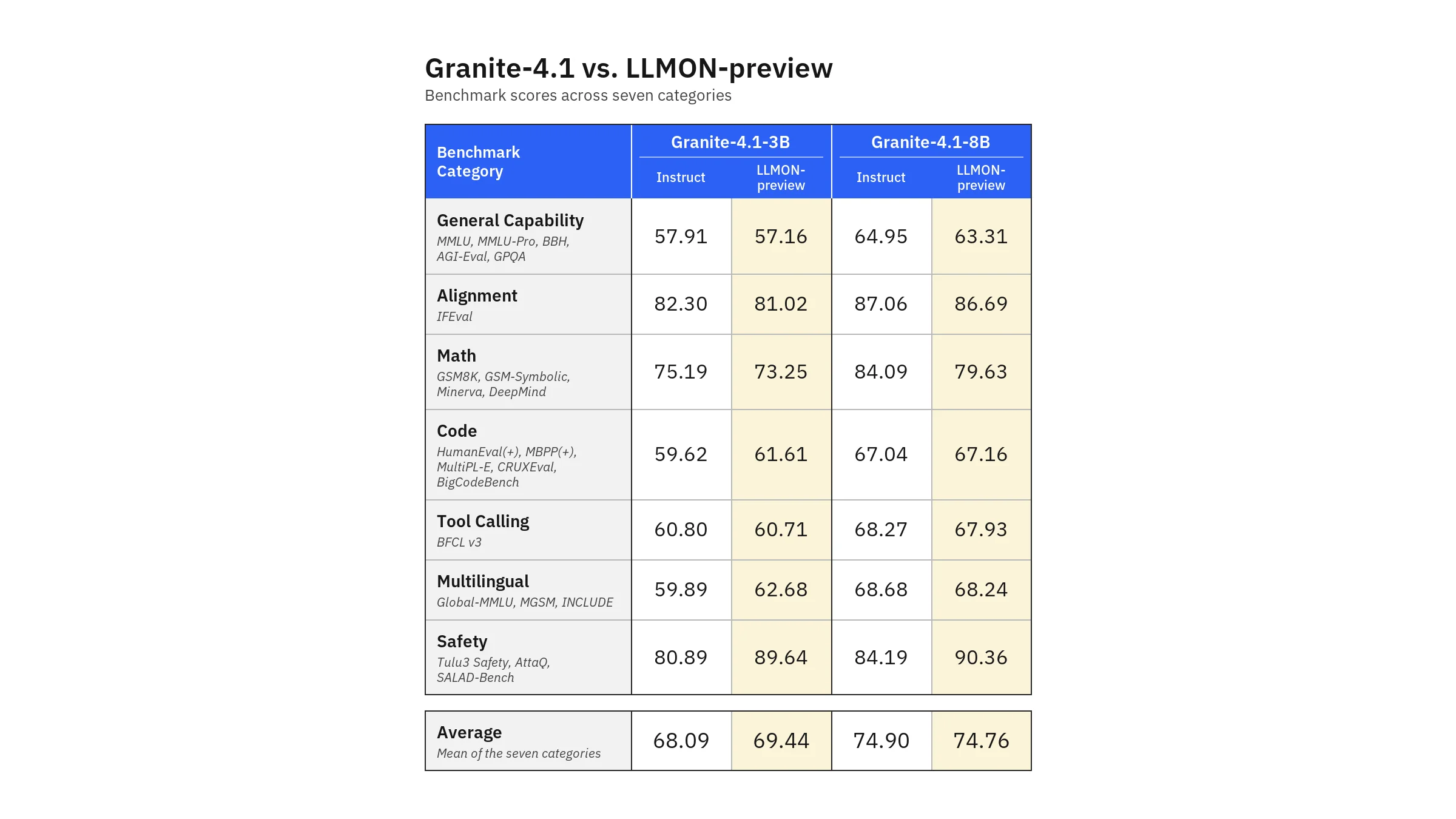
Where the claim stops
The closing section says the models are not for production. Static injection is exactly what these tags are built to handle. An attacker who can watch the model's replies and adjust the next payload is not scored in the OPI, ASB, or StruQ figures the post reports. Until those results exist, the honest claim is narrower than a general statement that prompt injection has been solved.
If a developer mis-tags a span, or if converted JSON still leaves a command where the model has been trained to treat text as input, there is no hard runtime check that catches the mistake. "Best frontier model tested" and "best open-source model" describe Gpt-6-astra and Granite-4.1-8B on this chart, not a complete market ranking. Other markup methods are not scored as rivals in the post. The two papers the blog links, arXiv 2603.22519 and 2610.38120, were not reviewed for this piece.
[1][2]The fair case
The fair reading is that prompt injection has not disappeared as models get larger. Several much larger models are shown with low robustness on OPI, while the two small LLMON previews sit near a perfect score on the same static benchmark. If that pattern holds in independent runs, IBM is right to treat this as a context-structure problem. Reserved tokens, bound execution blocks, and decoy unbound spans are a coherent way to teach a model that some text is a command and some text is only material. The same post still says the privilege rule is learned, and that adaptive multi-turn attacks remain open.
In a ScienceWorld demonstration, the authors defined their own tags, such as instr.task.goal and assistant.next_action, and trained a LoRA adapter, a small add-on, so it could play unseen test games in that vocabulary. That is a useful research preview. It is not a guarantee that a production agent will ignore a hostile document in a live, multi-turn tool loop.
[1][2]What to watch in the next six months
The first check is independent reproduction of OPI, ASB, and StruQ on the released preview weights. If the near-1.0 robustness and the large gap over Gpt-6-astra and Granite-4.1-8B hold, the structure bet is real on static injection. If those gaps shrink once someone else runs the suite, the headline percentages should be set aside.
The second is the adaptive, multi-turn setting the authors already flag, including cases where the injected instruction is revised after the model replies. A preview that only wins on static payloads will not be enough for production tool use.
The third is whether the learned privilege rule survives converted JSON, tool replies that contain imperative language, and mis-tagged spans, and whether a later supported release is no longer labeled "not for production." If the rule only holds in tidy chat-template examples, the markup is a research finding.
[1][2]