
On 27 November 2026, Kandinsky Lab published KVAE-3.0 on the Hugging Face blog, a set of image, video and audio tokenizers, with inference code at https://github.com/kandinskylab/kvae. A tokenizer here is the compressor that turns a picture, a clip or a sound into a smaller grid of numbers, which a generative model then works on. The authors say a training method they call latent alignment keeps those compressed numbers small and makes them easier for a later generative model to train on.
The tables that are easiest to re-run support a narrower claim. The new image tokenizer is much smaller than last year's, almost unchanged on a standard reconstruction test, and a few tenths of a point better on one generation metric against FLUX.2. Human raters barely preferred it. The experiment that would show alignment caused that gap is not in the post.
[1][2]KVAE-2D-3.0 is an 8x8 neural compressor with 32 channels in its compressed representation, matching KVAE-2D-2.1 on compression and channel count. The team cut the widest residual stage from 1,024 channels to 512, added self-attention in the encoder and decoder bottlenecks, and arrived at 85.6 million parameters, down from 218.4 million. Of that total, 34.8 million are in the encoder and 50.8 million in the decoder.
Alignment is added during training. A probe built from the first eight blocks of a SiT-XL/2 diffusion transformer is asked to predict patch features from a frozen DINOv2 ViT-B/14 vision model, given a noisy compressed representation and its noise level. When the tokenizer's encoder is updated, the probe stays fixed and an alignment loss of weight 1.5 sends a gradient back through those eight blocks. When the probe is updated, gradients into the compressor are blocked, a velocity-prediction loss is mixed with an alignment loss of weight 0.5, and the probe is discarded after training. The decoder is then fine-tuned with L1, LPIPS and an adversarial loss on 512x512 crops. The video tokenizer, KVAE-3D-3.0, uses the same idea with V-JEPA features. It compresses 4x in time and 32x in space with 128 channels, twice the compression of KVAE-3D-2.0. KVAE-Audio-Stereo is a 48 kHz stereo waveform model at a 50 Hz latent rate.
[1][2]Reconstruction was measured on all 5,000 images of COCO val2017, at native scale, with each side cropped to a multiple of 32, decoding the encoder's mean output in bfloat16. KVAE-2D-3.0 scored PSNR 32.18 dB, SSIM 0.9070 and LPIPS 0.0258. KVAE-2D-2.1 scored 32.15, 0.9057 and 0.0264. The two versions differ by less than 0.04 dB, as the authors note, while the new one is about 39 percent the size. FLUX.2-dev, which uses the same 32 latent channels, scored PSNR 31.37 and SSIM 0.8924, worse on those two metrics, but LPIPS 0.0167, better than both KVAE versions. The blog's opening summary says the new model "obtains higher PSNR and SSIM on reconstruction." That is true, and it does not mention LPIPS.
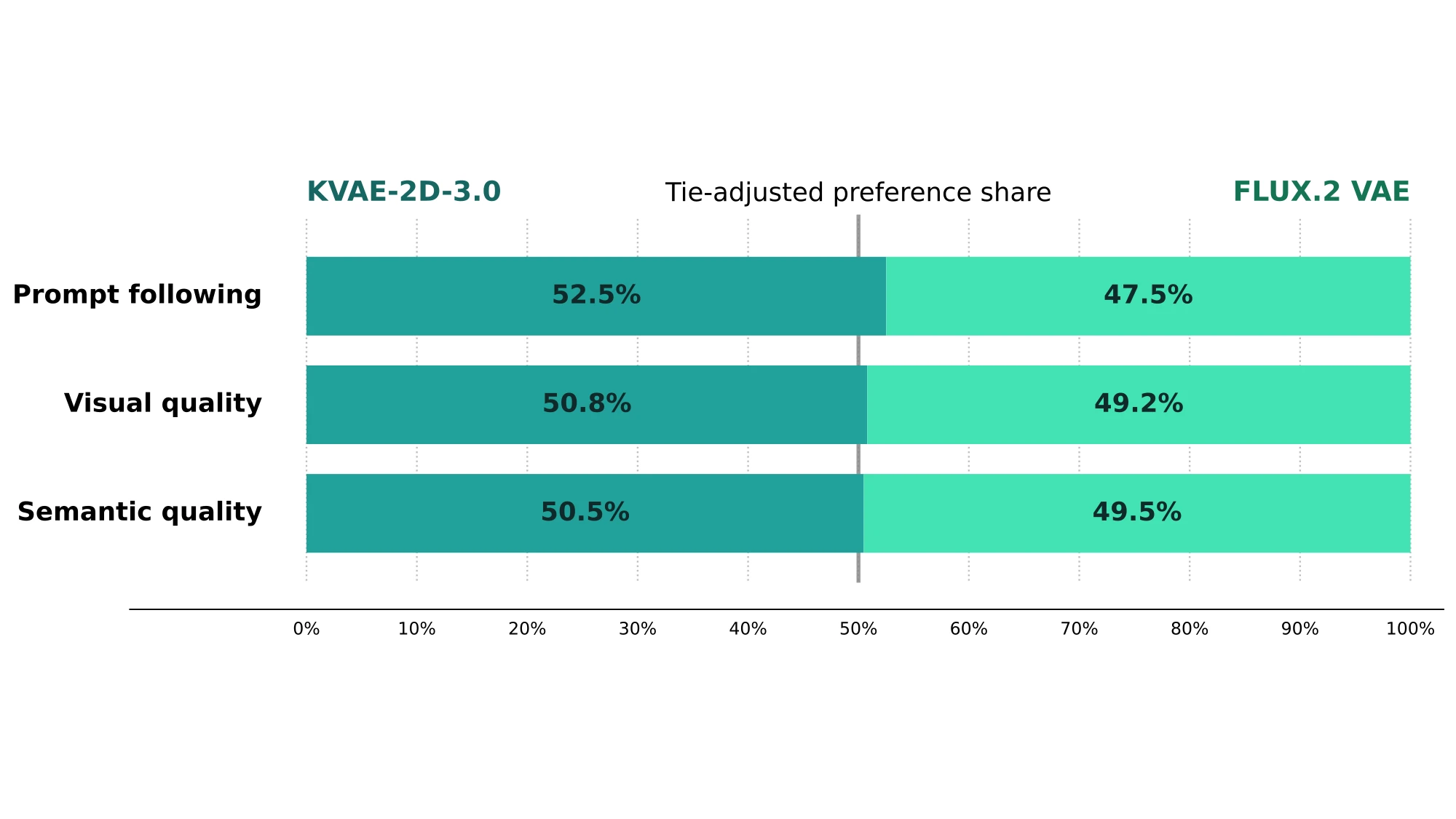
For generation, the team trained separate 2 billion parameter Kandinsky 5 text-to-image models on compressed representations from KVAE-2D-3.0, KVAE-2D-2.1 and FLUX.2, and measured FD-CLIP, a distance between generated and reference images in CLIP ViT-L/14 feature space. Lower is better. At 200,000 steps, KVAE-2D-3.0 was at 12.72, FLUX.2 at 13.05, and KVAE-2D-2.1 at 13.30. A side-by-side human test, using the same prompt and random seed for each pair, compared the KVAE-3.0 and FLUX.2 generators at that step count. After ties were split, the KVAE generator's share was 52.5 percent on prompt following, 50.8 percent on visual quality, and 50.5 percent on semantic quality. The post does not report how many raters took part, or a statistical test.
[1][2]If alignment is what made the smaller tokenizer easier to generate from, the clean test is to train the 3.0 architecture without that alignment loss, keep the 85.6 million parameter budget, and see whether FD-CLIP at 200,000 steps still beats 13.05. The post does not report that run. The comparison in the blog is useful, but it mixes architecture, size, and the new loss. Version 2.1 was purely convolutional and more than twice as large. Version 3.0 adds bottleneck attention, shrinks the deepest stage, and trains with the probe. Any of those changes could move FD-CLIP by three tenths of a point.
A fair reading in the authors' favor is that reconstruction was already close to a ceiling. If PSNR barely moved and generation still improved, something about the compressed representation, other than pixel fidelity, changed. That is the story this kind of alignment is meant to tell, and it is why the missing experiment matters. Without it, the generation gap is real as a comparison among three trained systems, and unproven as a claim about the alignment loss.
[1][2]On MCL-JCV 720p reconstruction, KVAE-3D-3.0 scored PSNR 32.26 dB, SSIM 0.878 and LPIPS 0.161. FLUX.3-Action, at the same 4x32x32 compression and 96 channels rather than 128, scored PSNR 32.79 and LPIPS 0.181. MiniMax-H3, at a milder 4x16x16 compression, scored PSNR 32.44 and LPIPS 0.176. KVAE therefore loses on PSNR and wins on LPIPS. The opening summary says it "outperforms MiniMax-H3 VAE over human preference test on generations by all criteria." The figure behind that sentence, after ties were split, gives 54.0 percent on prompt following, 56.6 percent on visual quality, and 52.5 percent on semantic quality. Those are clearer margins than in the image test, still modest, and again without a published rater count.
The audio model is the strongest part of the release on the published numbers. On Song Describer, LibriSpeech and AudioCaps, at 44.1 kHz and 48 kHz, the authors report the best reconstruction scores in their table against SAME-L, εar-VAE and LTX 2.5. For generation they trained a 0.6 billion parameter model from scratch for 60,000 steps on each tokenizer. Listening-test win rates against SAME-L, for sounds, speech and music, were 55, 68 and 64 percent on prompt following, and 71, 98 and 93 percent on audio quality. Against LTX-2.5 they were 74, 60 and 67 percent, and 82, 78 and 94 percent. The blog's opening line, that the model exceeds a 70 percent win rate against "Stable Audio 3 and LTX-2.5" on generation quality, is a rounded summary. Several prompt-following cells sit below 70 percent, the figure names SAME-L rather than Stable Audio 3, and on Song Describer the CLAP and VGG-backbone FAD scores still favor SAME-L and LTX 2.5. Speech word error rate is much lower for their generator, 25.93 percent against 58.97 for SAME-L and 29.62 for LTX 2.5.
[1][2]A reader who wants the authors to be right has a solid case on engineering grounds. Shipping public code, and reconstruction numbers on public sets, is the right way to make a tokenizer claim checkable. The audio reconstruction tables are consistent across three datasets and two sample rates. The stereo work is candid about a failure. Simply widening a mono 64-channel model to stereo made MEL and SI-SDR worse, and stretching the compressed representation to 128 channels helped reconstruction but hurt generation, which is why they changed the alignment target and added mid-side and phase losses. That is a real design report, not a brochure. The image model's parameter cut, at nearly unchanged PSNR, is also a practical result even if alignment is not the cause.
[1][2]The blog says the weights are on Hugging Face as well as GitHub. The clean six-month test is whether another team retrains a 2 billion parameter image generator on KVAE-2D-3.0 compressed representations, matches an FD-CLIP near 12.72 at 200,000 steps, and then trains the same 3.0 architecture without the alignment loss. If the gap remains, the blog's mechanism is wrong and the architecture is still useful. If the gap disappears, latent alignment is doing the work the reconstruction table cannot show. Until one of those runs exists, KVAE-3.0 is a smaller tokenizer with a slight generation edge and a human preference that, for images, is close to a coin flip.
[1][2]