
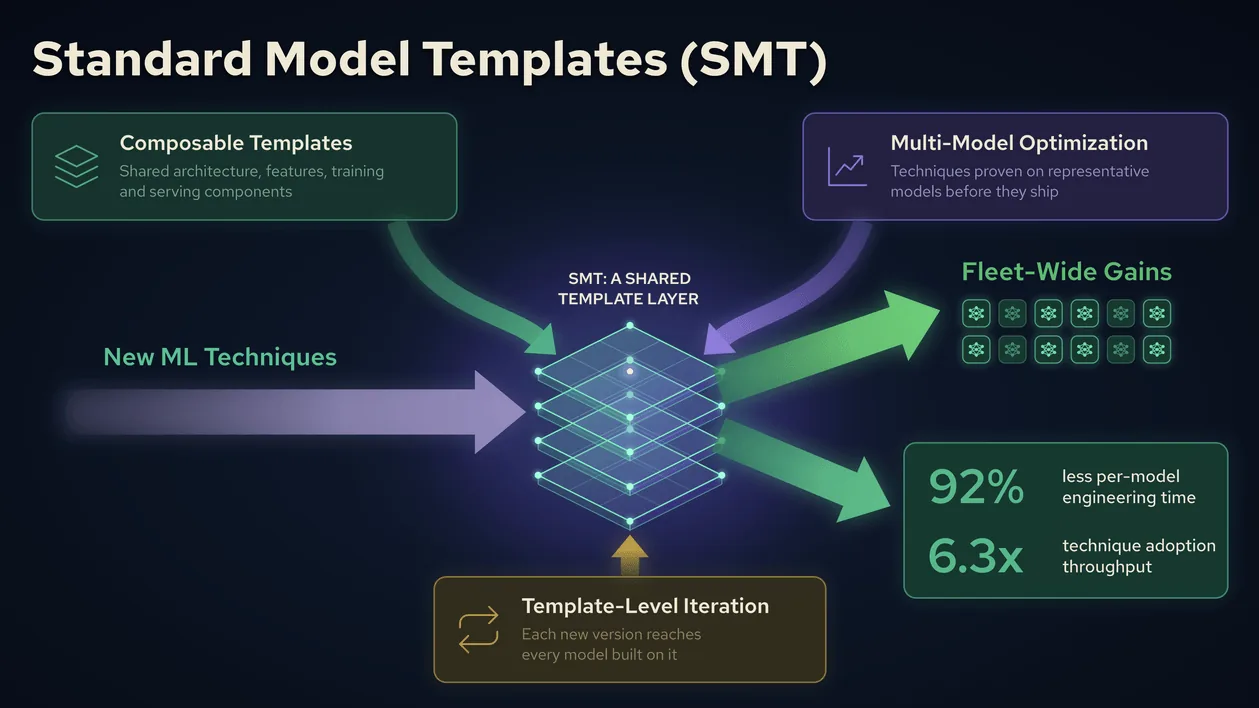
On 18 November 2026, Meta Engineering published "Design Once, Deploy at Scale: Building a Template-Driven ML Ecosystem." The subject is ads ranking at Meta, the models that decide which advertisements to show, across many products and objectives, and a large number of production models. The post's argument is that as that fleet grew, "the main challenge in improving user relevance and advertiser value has shifted from inventing new techniques to propagating them."
The two-year results it reports are specific. Standard Model Templates (SMT), a small set of reusable, composable templates, reduced per-model engineering time by 92%, shipped more than 5,000 technique-model combinations, improved offline quality by 0.63% on average at neutral serving capacity, and delivered 0.86% cumulative online lift, covering 70% of models by count. Offline quality is a lab measurement. Neutral serving capacity means the comparison was made at the same serving budget. Online lift is the measured gain once a model is serving real users. Those numbers are all Meta's own.
[1][2]When each model is a special case
Meta says its ads ranking systems process billions of daily requests, served by a large number of production models with different surfaces and objectives. Fragmentation, in this account, compounds quickly. A new architecture lands on one model, but bringing it to every corner of the ecosystem may take years. A platform migration works for one family and breaks on a long tail of specialized configurations.
The post argues that if each idea must be evaluated and adapted per model, the work grows linearly with the number of models. It also weakens automation. Optimization systems work best in a structured space, but when every model has a different shape, "the highest-potential techniques reach only a subset of models." Meta's answer, it says, was not to add another layer of automation on top of that complexity. It was to reduce the complexity, by standardizing model design into a curated set of reusable templates.
[1][2]How a template changes the work
A template, as the post defines it, is "an opinionated, minimal model setup built from shared components such as architecture choices, feature logic, training settings, and serving configs." Similar models are grouped around a smaller number of standard templates. Model-specific logic still exists where necessary, but the common parts are explicitly shared. In practice, Meta says it uses a small set of templates that cover major ranking and retrieval patterns across different model sizes.
The operating change is the point. Instead of evaluating a new idea on every model, teams can evaluate it on a smaller set of representative templates, then propagate it to the model groups that use them. The post calls this a shift from per-model iteration to template-level iteration. It claims lower cost, because one implementation can serve many models; better reliability, because fewer unique setups make validation more transferable; and better predictability, because performance on representative models is a stronger signal for the rest of the group.
Multi-model optimization is how that iteration is made rigorous, in this account. Candidate techniques are evaluated across representative models. Consistency matters as much as peak gain, because a technique with frequent regressions is hard to ship across a large fleet. Candidates are then validated on held-out models, kept aside for a check, and, if they pass, integrated into the next template version. Over the last two years, Meta says, it shipped 80 new ML techniques through this workflow.
[1][2]The numbers, as Meta states them
The headline figures appear in the opening of the post and again in the body. Over two years, SMT reduced per-model engineering time by 92% and shipped more than 5,000 technique-model combinations, "while improving offline model quality by 0.63% on average at neutral serving capacity, and delivered 0.86% cumulative online lift." The opening bullets add that this online lift covered 70% of models by count. A diagram on the page also states "6.3x technique adoption throughput." That 6.3 times figure appears on the graphic, not in the post's prose. It does appear in the linked paper's abstract.
The post links to an arXiv paper whose preprint title is "Template-Driven Machine Learning Standardization for Large Model Fleets." The Engineering page labels that link with a different title. The result figures in this article are taken from the Engineering post.
Agents appear as a layer that sits on top of templates, not as a substitute for them. SMT, the post says, gives agents a structured starting point, a limited space in which to search, and a minimum quality level. The post points to a companion article on how Meta uses agents across ads ranking models. This piece stays on the SMT post and does not import the companion's results.
[1][2]Why a two-year production report is stronger than a demo
A two-year report from a live ads ranking fleet, with an online lift number and a linked paper, is a stronger kind of evidence than a one-off research demo. If the work of adapting each idea grows with the number of models, then reducing fragmentation is a rational way to make both human engineering and later automation scale. The post says standardization only works if it is opinionated enough to remove unnecessary diversity, while still preserving the limited flexibility that matters. A template system that tries to accommodate every historical edge case will, it warns, recreate the fragmentation it was meant to solve. It also challenges a common assumption, stated in the post, that diverse optimization goals require highly diversified model designs. In many cases, Meta says, a well-designed shared template can generalize further than expected.
[1][2]What Meta has not shown
All of the percentages are vendor-reported. The 0.86% cumulative online lift is not independently audited here, and the post does not publish the raw experiment list. Coverage is "70% of models by count," not 70% of revenue, traffic, or advertiser spend. The post gives no split in those units. A small average lift on lower-value models would mean something different from the same lift on the models that matter most.
The 92% cut in per-model engineering time is Meta's own accounting, without a spelled-out baseline. The 0.63% average offline improvement, though measured at neutral serving capacity, is still an in-house lab figure. The linked arXiv paper, dated 15 November 2026, reports different abstract figures: a 0.77% average cross-entropy improvement at neutral serving capacity, and a 1.52% cumulative online metric lift. This article keeps the Engineering post's figures and leaves the mismatch unresolved.
[1][2]What to watch over six months
In the next six months, the claim that will matter is not another template slogan. It is whether Meta, or any large ranking fleet that follows this path, reports online lift in the units that finance teams actually use, and whether an independent check, or a fuller breakdown by traffic or revenue, sits beside the 0.86% and the 70% by count. If those figures still hold under a clearer denominator, Standard Model Templates will look like a genuine change in how a large model fleet absorbs new techniques. If coverage looks narrower once it is stated in value rather than in model count, the map of which models were lifted will need to be more precise.
[1][2]