
On 19 November 2026, NVIDIA published a technical blog on using its Dynamo serving layer to generate rollouts for reinforcement learning, the step in which workers produce sequences of model outputs, actions, and environment interactions that a training framework then scores. As that work scales, the authors wrote, redundant computation, slow rollouts, weight updates, and worker failures can waste GPU time. Dynamo, they argue, sits between the RL framework and the inference workers. The framework still owns optimization, rewards, environments, and which samples are accepted. Dynamo routes requests, manages workers, and, with a component called ModelExpress, distributes updated weights.
That division of labor is the point of the post, and it is easy to miss. A reader who stops at the title can come away thinking NVIDIA has a new way to train models. The diagrams and the table say something narrower: the training loop is waiting on inference.
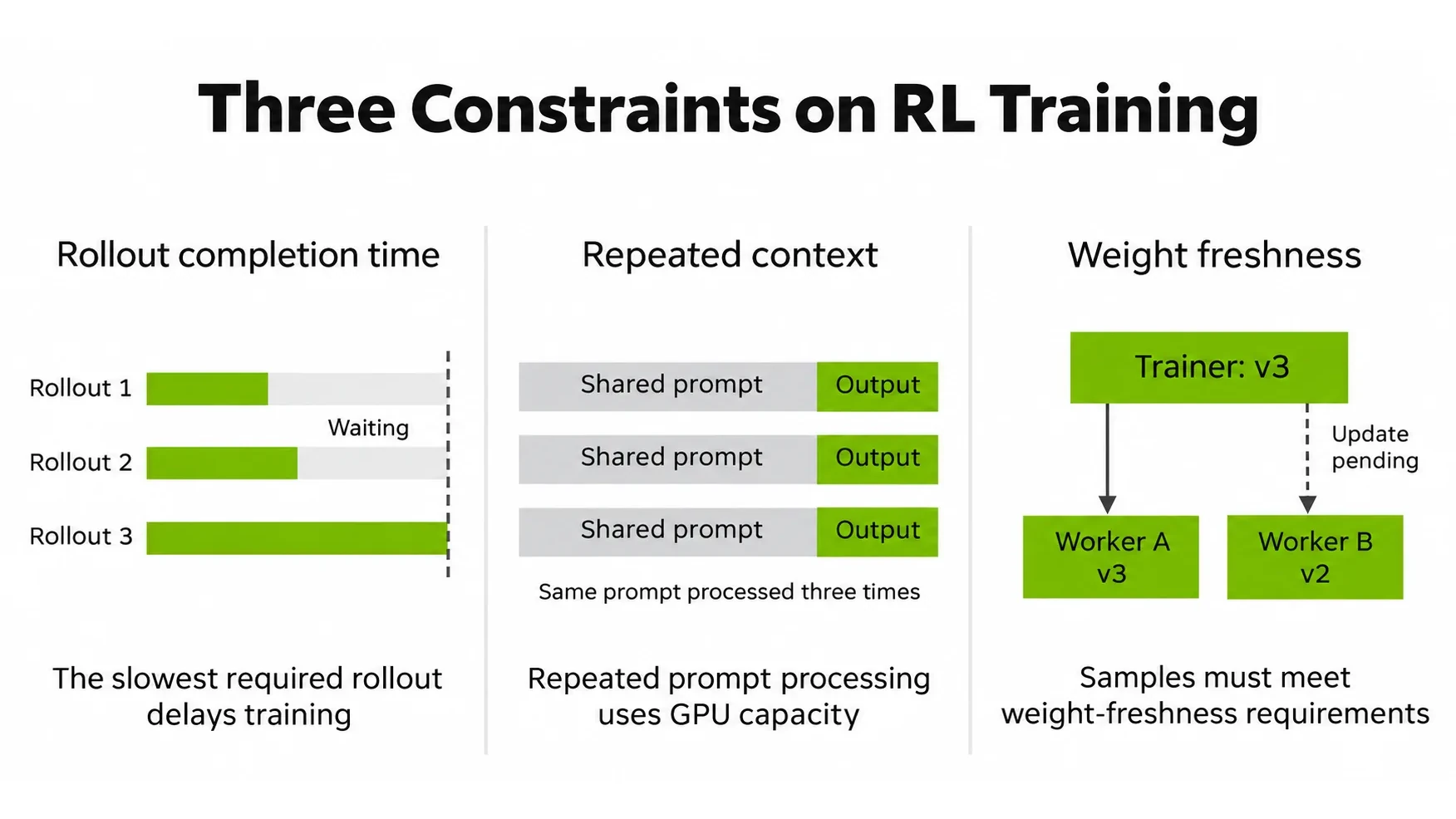
[1]The authors isolate three limits. Rollout completion time: when training needs a group of samples, the slowest required rollout can stall the next step, and spreading request counts evenly across GPUs does not necessarily spread work evenly. Repeated context: many attempts start with the same instructions or repository context, and recomputing those prefixes burns GPU time before new output is produced. Weight freshness: training keeps producing new weights, and workers have to receive them in line with the algorithm's rules for how stale a sample may be.
Dynamo, they say, uses routing that is aware of cached key-value context, to balance cache reuse against worker load, transfers compressed delta updates so workers can reuse weights already in GPU memory, and can detect worker failures, reroute work, and let a replacement catch up from a checkpoint and a delta. They list open-source ties to existing RL stacks, including verl, NeMo RL, Slime, and prime-rl.
[1]The numerical claims are customer "up to" figures, not a single public benchmark with a full method. NVIDIA says CoreWeave uses Dynamo and ModelExpress to accelerate model weight updates by up to 15 times. It says H Company used them to reduce average training-step time by up to 20 percent and GPU-hours by up to 5 percent. Cognition, it says, used Dynamo to manage inference workers and route rollouts during post-training of SWE-1.7. Those are named customers, which is better than an anonymous case, and they remain vendor-reported maxima. The post does not publish the baselines, cluster sizes, or variance behind "up to."
[1]The fair case for NVIDIA is that RL post-training really is often stalled by inference rather than by the optimizer, especially for coding-agent rollouts that wander through a repository, run tests, and take different amounts of time. A serving layer that reuses prefixes and shortens weight updates could be the right place to spend engineering time. The post is also explicit that Dynamo does not take over the learning process, which is the correct scope if the claim is infrastructure.
The risk is translation. "Up to 15 times" on weight updates and "up to 20 percent" on step time can be repeated as a training-speed result. They are not, as written, a result about sample quality or about a new algorithm.
[1]The next useful evidence would be a customer or a research group publishing a measured training-step breakdown with and without Dynamo, including the tail of rollout times, not only a best-case weight-update factor. Until then, treat the post as a serving-layer argument with named customer claims that are stated as maxima.
[1]