
要点
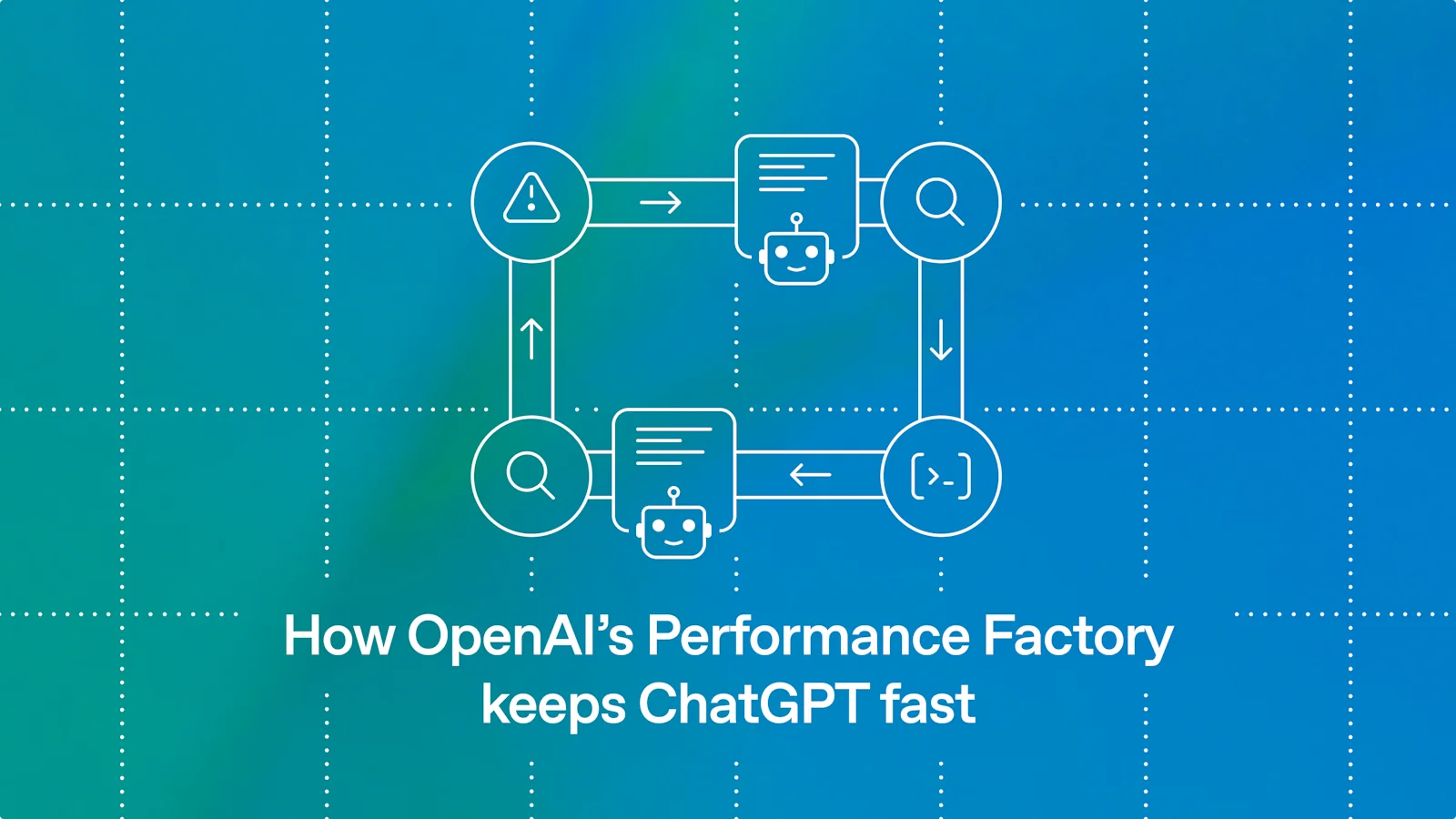
- The Regression Workflow opens a task when a configured performance alert fires. An agent investigates, records its findings, and proposes a fix for an engineer to review before deployment. After a fix is deployed, another agent checks whether performance has returned to its earlier baseline.
- The company reports that in just over three months the workflow tracked more than 1,700 investigations and root-caused over 600 cases, which it describes as about 17 automated investigations a day. Those figures come from OpenAI's own count. The post does not provide an independent audit.
- In a manual review of 100 root-cause suggestions, the team graded 70% as accurate and 30% as needing further refinement or not fully establishing causality. The post says agents sometimes stopped at the first plausible explanation, so the company added a separate adversarial review.
- The post says getting fixes right has been harder than finding the cause. Agent-proposed changes have sometimes been more complicated than necessary, or have introduced new issues. An engineer still decides whether to merge. The company says today's bottleneck may be waiting for review and merge, and that it is exploring whether agents could later ship low-risk changes themselves.
On 19 November 2026, OpenAI technical staff members Okay Zed and Cyrus Forbes published an engineering post describing the Performance Factory, a cloud system that uses Codex agents to investigate why services such as ChatGPT have slowed down after a performance alert, to propose a fix, and to check after deployment whether performance has returned to baseline. The company reports more than 1,700 investigations and over 600 root causes in just over three months, which it describes as about 17 automated investigations a day. What can be checked is the throughput of that workflow, and a manual grade on 100 root-cause suggestions, not the title's promise that this is what keeps ChatGPT fast. The post itself says today's bottleneck may be waiting for an engineer to review and merge the fix.
[1]What the system actually does
The authors describe a lengthening chain of automation. Before Codex, engineers inspected metrics and logs, compared traces, debugged machines, and read code. For repeated problems, such as a rise in the time from a ChatGPT request to the first token, they accumulated more than 30 performance tools. Once Codex was available, an engineer could ask why something had gotten slower and let the model search code, metrics, and traces even in an unfamiliar system, while still choosing the tools and steering the investigation.
They then captured the investigation steps in a shared skill named perf-forensics, which tells Codex which tools exist, when to use them, and how to determine when a slowdown began, which requests were affected, and whether a deployment or configuration change could explain it. The skill was tested against past regressions. For a time, engineers mostly pasted alerts into Codex and pasted the findings back into Slack. Later, an alert could start a Codex session in the cloud and post the findings to Slack, but the automation stopped there. An engineer still had to write the fix and check after deployment whether it had worked. As Slack threads piled up, even deciding which regressions needed attention became a burden. The Performance Factory is meant to connect investigation, a proposed fix, a wait for deployment, and a later check into one workflow that keeps its state.
The system has four parts. A task service uses configuration files and Markdown prompts to set the states a task may pass through, and which steps require an engineer. A dispatch loop periodically finds tasks ready for the next step and starts a Codex turn with instructions for the current state. Codex runs inside the company's network, with access to code repositories and to metrics, logs, traces, CPU profiles, and memory snapshots. Agents run under a service identity so their permissions can be limited and their actions distinguished. When a task must wait for events such as review comments or failed automated test runs, it can subscribe for a notification rather than keep a session running.
The Regression Workflow is the first workflow they have running. A task moves through needs investigation, root caused, fix proposed, and resolved. Engineers can follow the work in Slack or in a workflow interface, add context, and review proposed changes. If a deployed fix only partly restores performance, the agent marks the original regression resolved and opens a new task for the remaining slowdown. If there is no improvement, the task goes back to investigation.
[1]Which figures and examples can be checked, and which cannot
The figures of more than 1,700 investigations, over 600 root causes, and about 17 a day are OpenAI's own operating counts. The post does not break them down by service, and it offers no independent check. They tell you how many tasks the workflow followed and how many were marked as root-caused. They do not, by themselves, show that ChatGPT became faster for users, or how many fixes were ultimately merged into production.
On the quality of diagnoses, the post gives a more specific, and more limited, number. In a manual review of 100 root-cause suggestions, the team graded 70% as accurate and 30% as needing further refinement or not fully establishing causality. Those 100 items are a manual sample, not an audit of all 600-plus cases marked as root-caused. The post also does not say how the 100 were chosen.
The company is direct about early mistakes. Agents sometimes stopped at the first plausible explanation, and some of those diagnoses later proved wrong. The team therefore added an adversarial review: a separate Codex session that tries to disprove the proposed diagnosis and tests counterfactuals. If a rollout caused the slowdown, did similar requests that were not exposed to it stay healthy? If the suspected change was rolled back, did the affected metric recover? In the example the post gives, an agent traced failing ChatGPT conversations to errors in image downloads and marked the cause as found. The reviewing session noticed that the internal service responsible for locating files had already recovered, while image requests were still failing. The diagnosis did not explain the continuing failures, so the reviewer reopened the investigation and recorded what still had to be established.
The post describes getting the fix right as harder than finding the cause. After a diagnosis passes review, the workflow asks Codex to implement a fix and open a pull request, and an engineer decides whether to merge it. Each task report automatically summarizes the regression, its impact, the root cause, and the proposed fix, and includes metrics time series, CPU flame graphs, which show where a program spends processor time, and traces so engineers can inspect the evidence. Engineers can edit the request or write their own fix from the diagnosis. Comments on the request wake an agent. The authors say agent-proposed changes have sometimes been more complicated than necessary, or have introduced new issues, so they added an adversarial review of each proposed fix as well. Some changes also involve design tradeoffs. Adding a cache, for example, may improve performance and may also introduce stale data, which calls for an engineer who knows the service.
The post does not say how many of the 600-plus root-caused cases reached a proposed fix, how many an engineer merged as written, or how many were rewritten or dropped. Without those rates, it is not possible to tell whether the factory is already repairing production failures, or mainly speeding up investigation while leaving the merge decision to a person. The company says it is comparing the fixes agents propose with the changes engineers ultimately merge, in order to build evaluations and improve the workflow, and that it is working on synthetic performance tests so agents can measure a proposed fix before asking for review. Those are described as work in progress, not as published results.
[1]The company's strongest fair reading
A fair reading is that OpenAI is not claiming the Performance Factory already repairs ChatGPT without a person. The post traces a path from manual investigation, to pairing with Codex, to a shared skill, to automatic Slack replies, and only then to a stateful factory. It records that early diagnoses could stop at the first explanation that sounded right, and that this is why an adversarial review was added. It reports a 70% accuracy grade on 100 root-cause suggestions, with 30% still insufficient, rather than claiming that diagnosis is already reliable enough to leave alone. By calling today's bottleneck the wait for an engineer to review and merge, it admits that throughput is still capped on the human side.
Reading the title as a claim that Codex already keeps ChatGPT fast goes beyond the evidence in the body. What the body supports is a stateful agent workflow that already investigates and proposes fixes at production scale, while leaving the merge decision with engineers.
[1]What to watch in the next six months
The first test is whether the company lets agents merge low-risk changes without a human review, how it defines low-risk, and how it rolls back a bad merge. The second is whether diagnosis accuracy is published again on a larger sample. A manual review of 100 suggestions at 70% accurate cannot be stretched to all 600-plus tasks marked as root-caused. The third is whether OpenAI publishes a merge rate for proposed fixes, including how many agent pull requests ship as written and how many engineers rewrite. The fourth is whether the planned proactive monitoring arrives, so that agents can compare batches of CPU and memory profiles, heap dumps, and request traces across releases, catch slowdowns that no alert fired on, and feed them into the same Regression Workflow.
If, six months from now, the public record still has throughput counts but no merge rates, no larger accuracy sample, and no clear rules for unattended merges, then this post will still have shown that investigation has been factory-organized, not that repair has been automated.
【No.2】
[1]