
On 19 November 2026, OpenAI staff members Okay Zed and Cyrus Forbes described a cloud system they call the Performance Factory, built to find and fix performance problems in ChatGPT with the company's Codex agents. In a little more than three months, they wrote, the first workflow in that system, the Regression Workflow, tracked more than 1,700 investigations and root-caused over 600 cases, or about 17 automated investigations a day.
The post is easy to read as a claim that ChatGPT now heals itself. The authors are more precise than that. After an agent investigates a slowdown and proposes a fix, an engineer still reviews and deploys it. After deployment, another agent checks whether performance has returned to baseline. "Today, the bottleneck may be waiting for an engineer to review and merge the fix," they wrote. They are already exploring whether agents can do that step themselves.
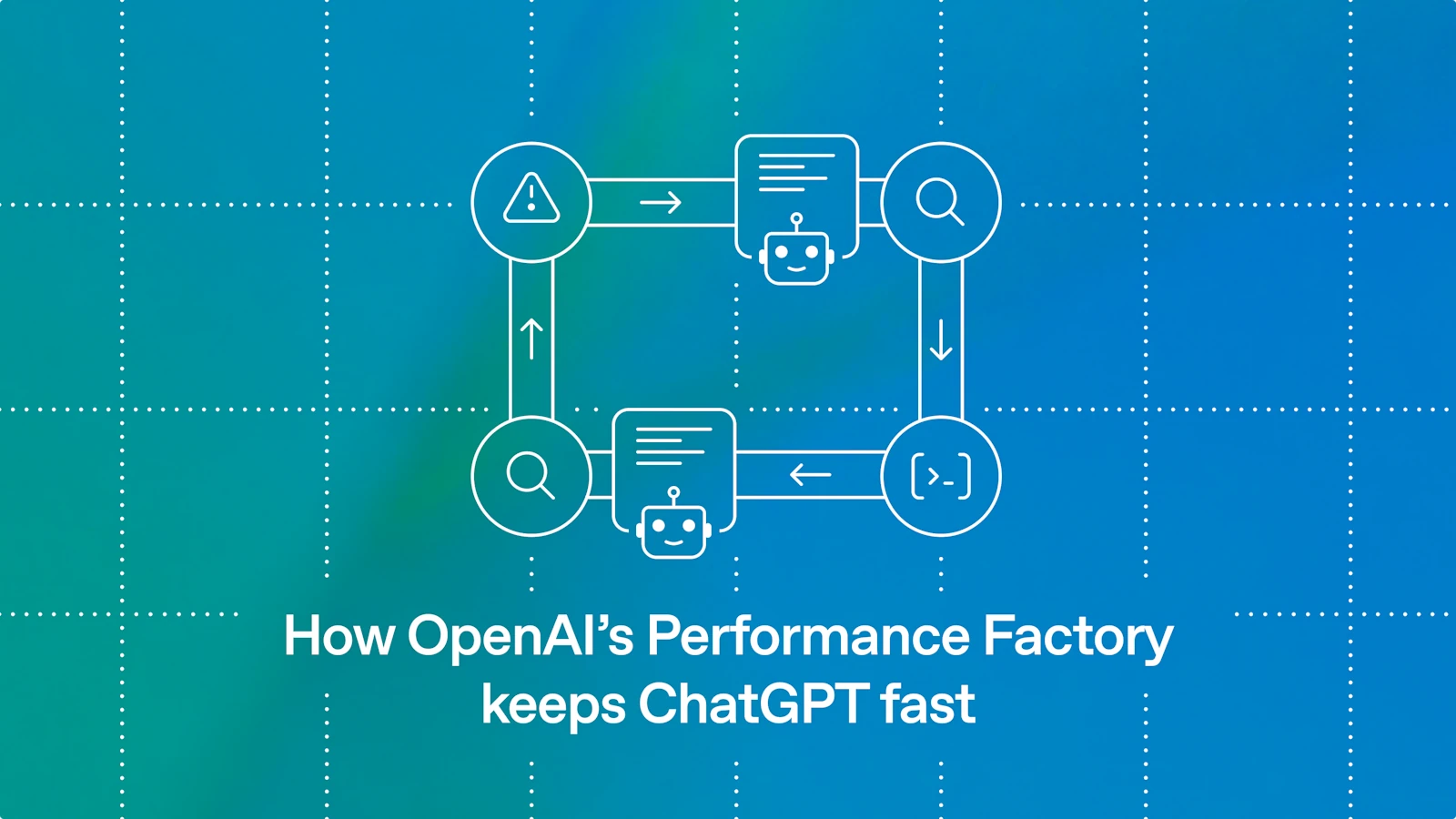
[1]The Regression Workflow opens a task when a performance alert fires. An agent investigates, records findings on the task, and proposes a fix. The factory, as they describe it, has four parts: a task service with configurable workflows, a dispatch loop that assigns ready work to agents, an API that runs Codex in the cloud, and subscriptions that wake agents when something changes, such as a GitHub review comment or a completed deployment.
The authors describe a path that started with manual investigation, then Codex as a partner, then a shared skill called perf-forensics, then engineers who felt they were mostly copying alerts into Codex and pasting answers back into Slack, then investigations that posted to Slack on their own, and only then a factory that keeps state across investigation, review, and verification. They say the team had accumulated more than 30 performance tools before this.
[1]The headline counts (1,700 investigations, 600 root causes) are OpenAI's own operational tallies. They are specific, and they are not independently audited in the post. The more useful figure is smaller. In a manual review of 100 root-cause suggestions, the authors graded 70 percent as accurate, and 30 percent as needing further refinement or as not fully establishing causality. They also say they test two things separately: how well the agent investigates, and how useful its summaries are to engineers.
That 70 percent figure is a credit to the post, because it is the sort of number a company blog often omits. It also limits the claim. A system that opens 17 investigations a day will still hand engineers a mix of solid diagnoses and cases that do not fully prove cause. The factory automates the gathering of evidence. It does not, on OpenAI's own review, guarantee that the cause is right.
[1]A fair reading in OpenAI's favor is that 70 percent accurate root-cause suggestions, at this volume, already changes how a large consumer service is kept fast. The alternative they describe is a small group of specialists digging through metrics, traces, and those 30-plus tools by hand. Even if a third of the suggestions need more work, the workflow still moves the scarce time of reviewers onto a shorter list. The post does not claim the factory has removed humans from production changes, and it should not be faulted for a claim it does not make.
The remaining risk is the one they flag themselves. If the next step is to let agents merge fixes, the 30 percent of suggestions that do not fully establish causality becomes an operations problem, not only a research footnote.
[1]The next evidence that would matter is not another headline count of investigations. It would be a later account of how often proposed fixes actually land, how often they restore the baseline, and whether any merge happens without an engineer. Until those figures exist, the honest title is the one the authors already point toward: Codex is investigating ChatGPT's slowdowns at a high rate, and a person is still in the path before the fix goes out.
[1]