
要点
- Brain automatically writes and revises personal skills from memory and session history, and updates built-in skills from aggregate patterns across users. The post states that personalization changes context and instructions, not model weights.
- The improvement loop has four stages: evidence, reflection, verification, and activation. Creating a personal skill requires two independent occurrences of the same reusable behavior; an update to an existing skill can rest on a single grounded occurrence. Each run may change a given skill only once. The system keeps at most 10 automatically created skills per user.
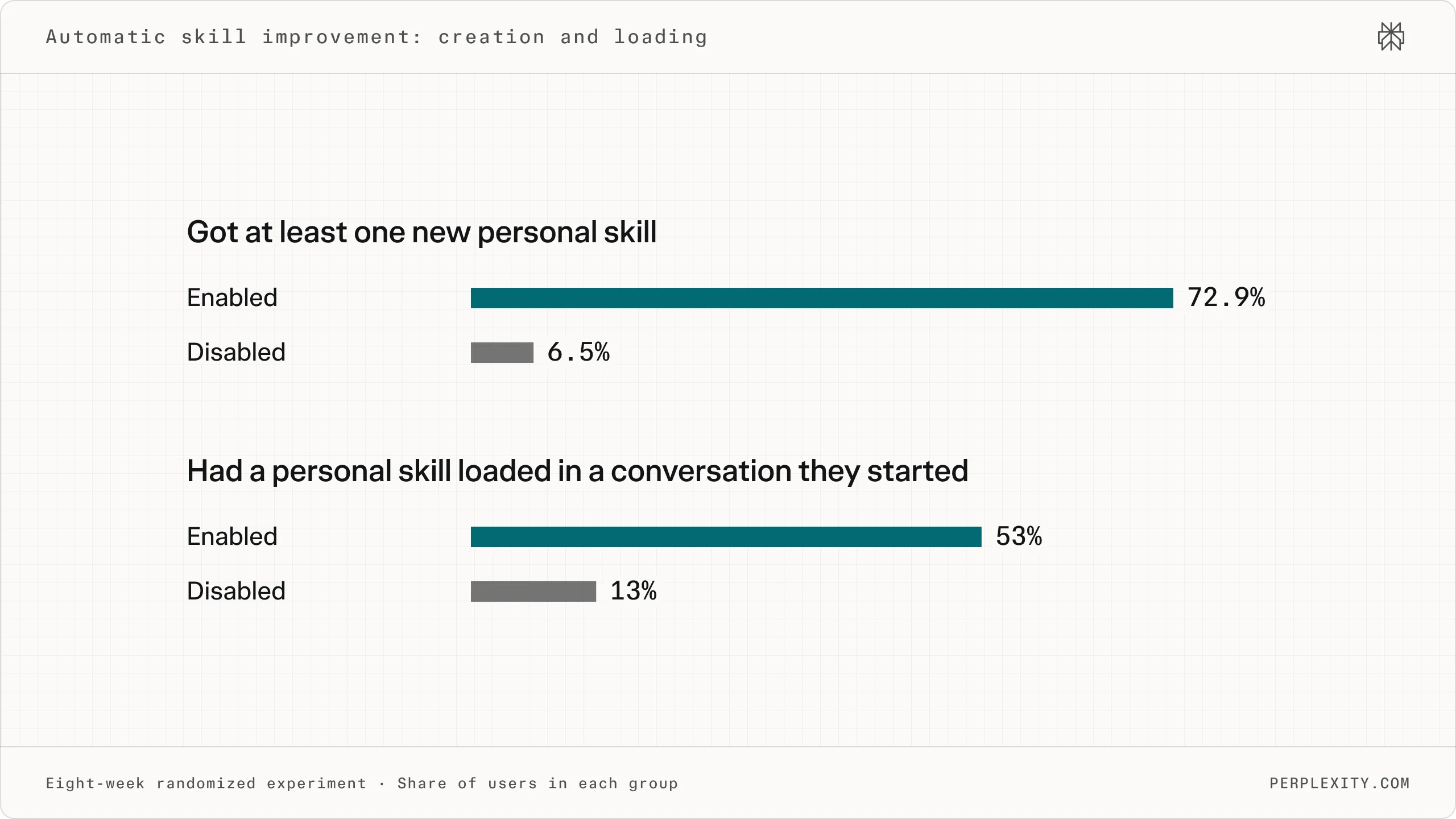
- In an eight-week randomized production test, 72.9% of users with automatic improvement enabled received at least one new personal skill, compared with 6.5% of the control group. A personal skill was loaded in a conversation the user started for 53% of the enabled group and 13% of controls. The tool-call failure rate fell 11% across all Computer activity, and about 7% after excluding the system's own background runs. User dissatisfaction fell 7.6%. Cost and response time did not change in a measurable way. The post does not report the number of users in the test.
- Personal skill improvement is now available to all US Max subscribers, on by default, and can be turned off. Changes to built-in skills must pass paired replay and internal human review, and take effect only if an engineer approves the pull request.
Perplexity published a blog post titled Self-improving skills, describing how Computer's Brain system now writes and updates reusable skill instructions from a user's past sessions and memory. The company account announced the post on X at 16:12 UTC on 19 November 2026. The retrieved page has no visible byline or separate publication time. The body presents this as a change to context and instructions, not to model weights. What can be checked is an eight-week randomized production test on skill use, tool-call failures, and user dissatisfaction, plus a cap of 10 auto-created skills per user and a default rollout limited to US Max subscribers, not a claim that Computer is already continually learning in the weight-updating sense.
[1]What the system actually does
The post describes skills as reusable instructions that guide an agent through a particular task, and that can include scripts for steps better expressed as code. The harness makes available skills discoverable and loads their instructions into context when the agent asks for them. Users can also name a skill in the prompt. Brain already maintains a structured knowledge wiki, which background agents update as new information arrives. This post extends the same idea to skills: writing personal skills for one user, and updating built-in skills available to every Perplexity user from patterns seen across sessions.
The shared improvement loop has four stages. The system finds past sessions in which a skill was used, especially sessions in which it fell short. An improvement agent proposes a change. Checks assess whether the proposal is well formed and likely to help. A verified change is then activated, so later sessions can use the new version and supply evidence for the next round. Personal skill improvement runs daily. The improvement agent works in a sandbox, with a batch of recent sessions and skill-usage data preloaded, with the rest of the user's history available on request, and with a catalog of existing skills. It does not have access to the internet or other connectors. It draws a concrete lesson from each full trajectory, then decides whether to update a skill, create one, or make no change. Creating a skill requires two independent occurrences of the same reusable behavior; an update can rest on a single grounded occurrence. The agent does not edit the skill directly. It writes a proposal that records the intended change, the reasoning, and the evidence. Each run may change a given skill only once. Deterministic checks verify that a proposal can be applied. A separate large-language-model judge audits a sample of proposals to see whether the evidence supports the change.
Once activated, a skill enters the user's library. Because each session starts by loading an index of all available skills, a large library can crowd the context window and make relevant skills harder to find. The system therefore keeps only the skills it judges most useful, and enforces a cap of 10 automatically created skills per user. At that cap, the agent can still update or remove skills, but to add a new one it must retire an existing skill and explain why the new skill is more useful.
Built-in skills can be used by anyone, so the bar for changes is higher. The improvement agent edits only candidate versions. Evidence comes from sanitized sessions eligible for use in training. A pipeline strips credentials, secrets, and attached files and media. A scenario-generation agent turns failures into self-contained tests that can run without connected apps or a sign-in. A weekly revision job looks only for failures that recur across multiple sessions, so a single bad session does not drive an edit. Candidate revisions go through paired replay: every test scenario must pass with the revised skill, and at least one must fail with the original. Scenarios built from control sessions are replayed as well, to check that previously working behavior has not broken. The package then becomes a pull request, and the change takes effect only if an engineer approves it.
[1]Which figures can be checked, and which cannot
The post reports two scale counts. Between 1 August and 14 November, Brain wrote more than 80,000 personal skills for more than 20,000 users. Between 4 September and 14 November, it applied more than 100,000 automatic updates to more than 30,000 existing personal skills. Among 64,230 personal skills automatically created from 1 August to 4 November, software engineering accounted for 11.0%, research and briefings for 10.1%, and sales and operations and finance and investing for 9.9% each. The ten domains shown account for 80.3% of that sample. These are the company's own counts. A large creation count can coexist with a cap of 10 skills per user, because old skills can be retired when the cap is reached, so creations need not equal the skills still in use. The post does not say how many skills each user currently keeps.
On outcomes, the main evidence is an eight-week randomized test on production traffic, comparing users with automatic personal-skill improvement enabled against a control group with it disabled. In the enabled group, 72.9% of people received at least one new personal skill, compared with 6.5% of the control group who added one by hand. A personal skill was loaded in a conversation the user started for 53% of the enabled group and 13% of the control group, and turns in the enabled group loaded a personal skill about 3.6 times as often. Among customers who received a Brain-written skill, 63% used one again in a later conversation within four weeks. The same experiment reports that the tool-call failure rate fell 11% across all Computer activity, and about 7% after excluding the system's own background runs. User dissatisfaction, measured as medium or high dissatisfaction threads per user, fell 7.6%. Cost and response time showed no measurable change. These are the most directly comparative public figures in the post. The post does not report how many users were in each group, and it does not give the absolute baselines for failure or dissatisfaction, so it is not possible to tell whether an 11% or 7.6% drop is a large improvement or a small move from an already low level.
The post also cites narrower offline tests. In an experiment called SkillLearnBench, Computer used prior task trajectories to create one personal skill for each of nine task families. Across 16 paired evaluation instances, task success rose from 43.8% without skills to 62.5% with the generated skills. That sample is small. It can show that skills derived from past work sometimes help on repeated tasks; it cannot be stretched to all production work. The post also mentions one built-in case study in which edits to an ecommerce skill produced a 6% quality increase and a 32% cost reduction, with quality scored by an automated judge. That is a single case, and the quality standard was defined by the automated judge, not by a blinded human review.
A figure in the post also shows an unmerged built-in revision. A change meant to preserve fixed features of a room passed the targeted test, but one of three previously successful checks scored lower, and the average fell from 1.00 to 0.83. The review marked it as not merged. The example suggests that the human gate on the built-in path is not only a formality.
[1]The company's strongest fair reading
A fair reading is that Perplexity is not presenting self-improving skills as continual training of the model. The post draws a clear line: personalization changes context and instructions, not weights. It requires two independent occurrences before a new skill is created, allows only one change per skill per run, and uses a cap of 10 auto-created skills to limit crowding of the context window. Built-in skills must pass paired replay and an engineer's approval, and the unmerged example in the post shows that passing a single targeted test is not enough. The company also published a production test with a control group, and it reported the null result that cost and response time did not change in a measurable way.
Reading the post as a claim that Computer already continually learns by updating weights, or that the feature is already live for every user, goes beyond the text. What the body supports is a capped, optional skill-writing and revision process, now on by default for US Max subscribers, that has raised skill use and has reported modest drops in tool failures and user dissatisfaction.
[1]What to watch in the next six months
The first test is whether personal skill improvement expands beyond US Max subscribers, and whether the drops in tool-call failures and dissatisfaction still hold after a wider rollout. The second is whether the promised next step appears, extending improvement to user-authored skills, skills shared inside projects, and organization-level skills. The third is whether merges of built-in skills become more common, and whether unmerged cases are still discussed in public. The fourth is whether the company publishes the number of users in the randomized test, the absolute baselines for failure and dissatisfaction, and a larger SkillLearnBench-style evaluation that includes human scoring.
If, six months from now, the public record still has relative percentages and US Max usage figures, but no headcount, no baselines, and no wider rollout, then this post will still have shown that a bounded skill-memory system is in production, not that general continual learning has been demonstrated.
【No.2】
[1]