
PostgreSQL 19 was released on 19 November 2026, more than a month after the mid-September to mid-October window that Jonathan Katz and Robert Haas say had held for about a decade. In a Databricks blog post published the same day, the two PostgreSQL contributors argue that the delay came from a surge of bugs and security issues found with AI, not from a decision to hold new features that were not ready. The part of that claim you can check is the volume. On 12 November the PostgreSQL Global Development Group issued an update that fixed 52 security vulnerabilities and more than 140 bugs reported over the previous several months. It also published a second release candidate, a nearly final build, so version 19 could ship with those fixes. That announcement had already set 19 November as the planned release date.
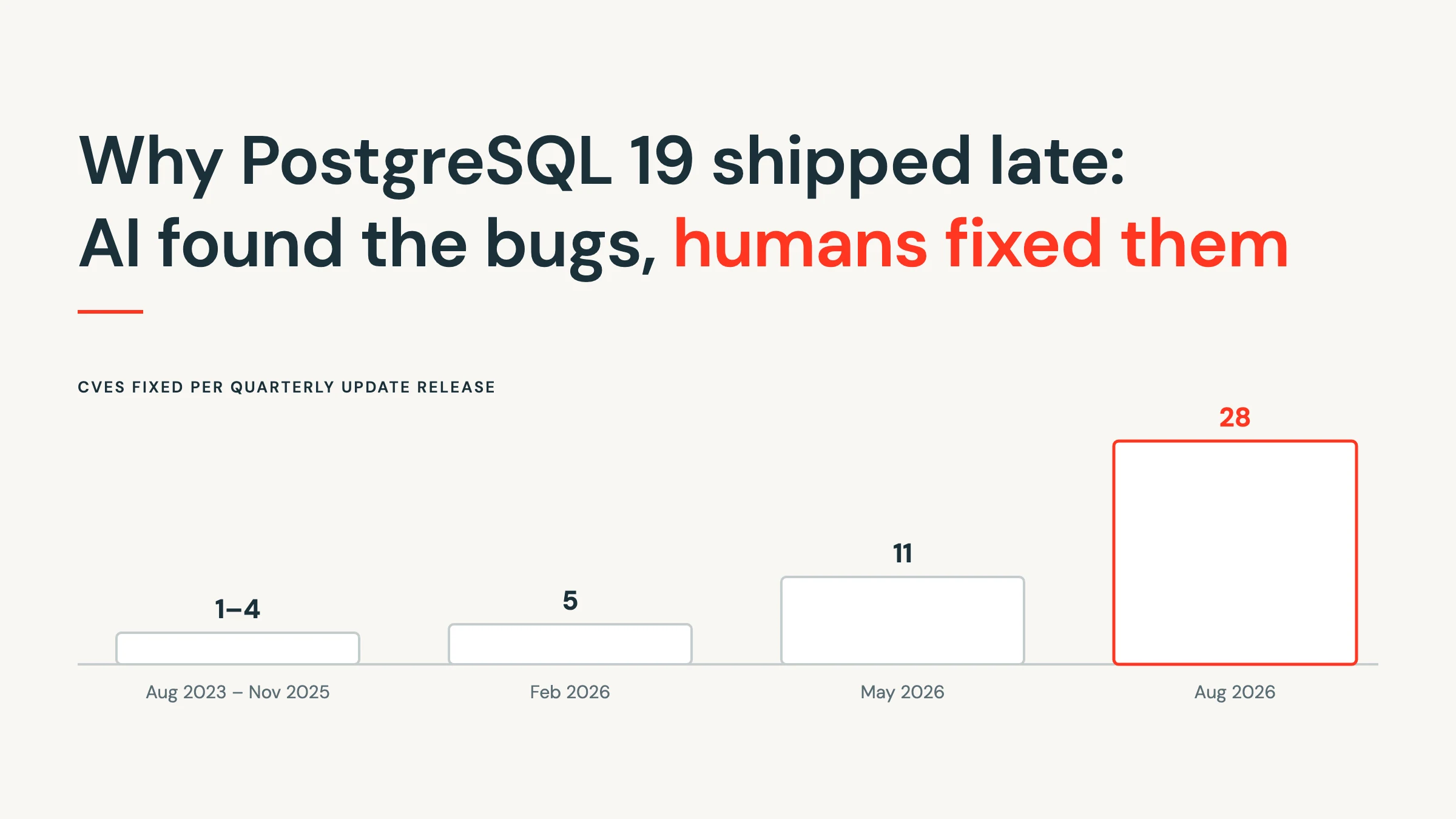
[1][2]Katz and Haas give a time series for quarterly updates, the regular security and bug-fix releases that come out several times a year. From August 2023 through November 2025, they say each of those updates fixed between one and four CVEs, meaning numbered security vulnerabilities. In 2026 the count rose to 5 in February, 11 in May, and 28 in August. Bug fixes per update, they write, moved from roughly 50 to 75 up to about 140 in August 2026. Those August figures are theirs. They sit in the same range as the official 12 November count of more than 140 bugs, though that later update is a different release and lists 52 vulnerabilities, higher than their August CVE figure.
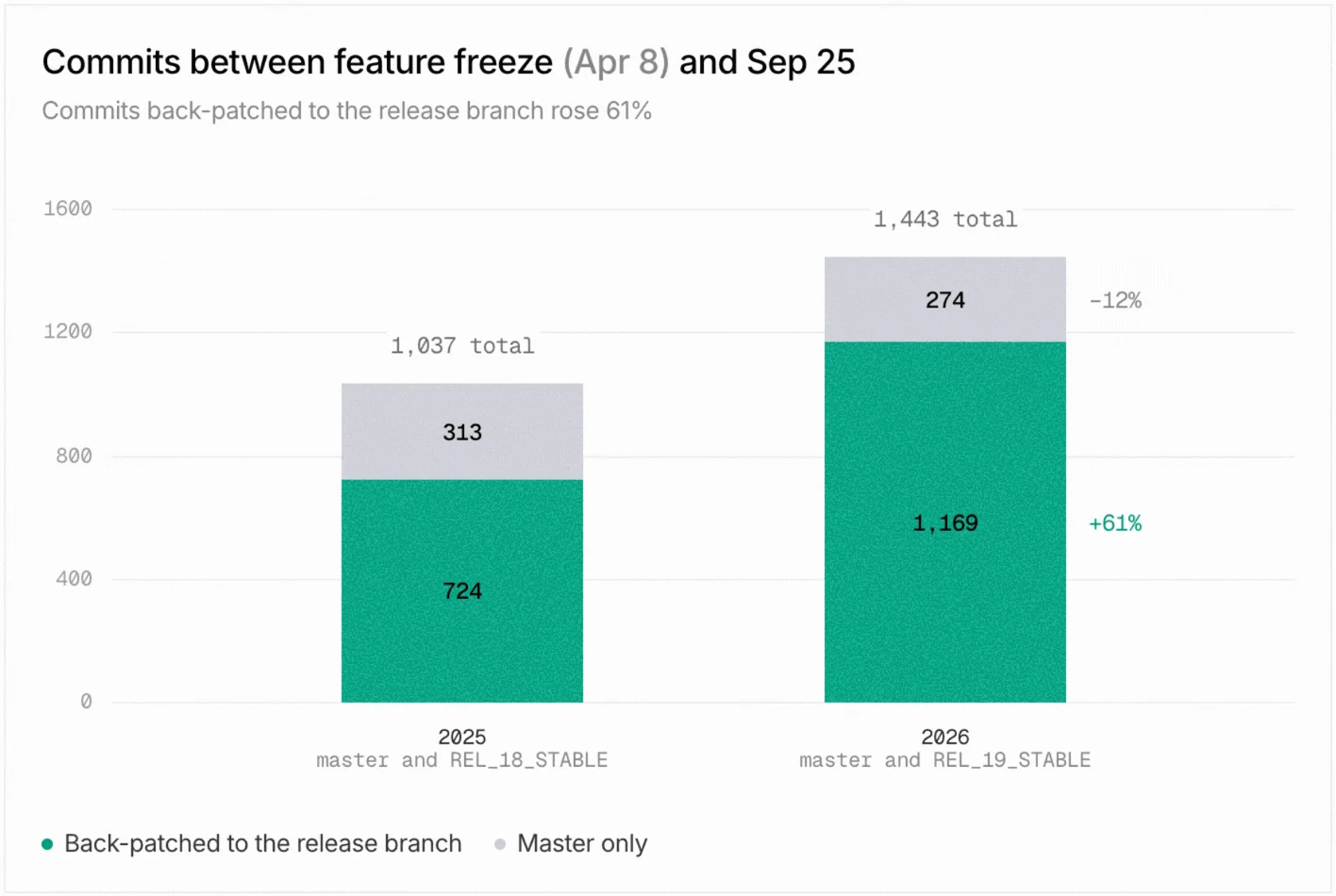
They also count commits, the recorded code changes, between 8 April and 25 September, the stretch from feature freeze, when new features stop being added, to late September. In 2025 there were 1,037 commits to master, the main development line, and 724 to REL_18_STABLE, the branch for the version then being prepared. In 2026 there were 1,443 commits to master and 1,169 to REL_19_STABLE. Commits copied back to the release branch, known as back-patches, rose 61 percent. Commits copied back to the previous release branch rose from 248 on REL_17_STABLE in 2025 to 433 on REL_18_STABLE in 2026, more than 74 percent. They note that commits which went only to master between feature freeze and 25 September actually declined slightly. That detail undercuts a simple story of a busier year overall. Their reading is that committers were about as careful as usual, and that current models were simply finding more of the mistakes.
[1][2]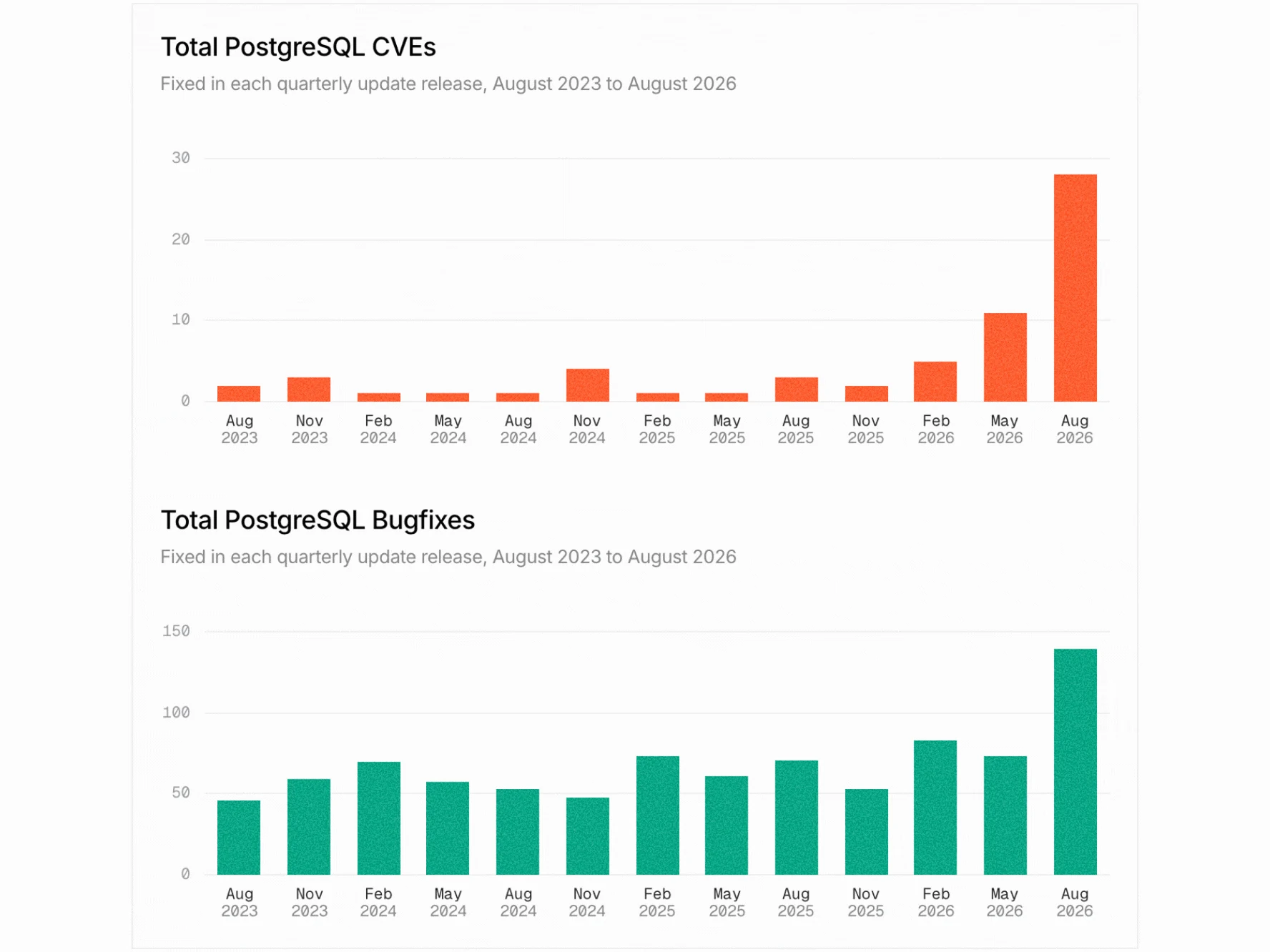
They date the change to around February 2026. That is when, they say, developers noticed that the latest models were good enough to write real code, and also good enough to find bugs and research security issues with much less specialized effort. "A huge number of people on the Internet are now reporting bugs in PostgreSQL that they found using LLMs," they write, meaning large language models. Time that would have gone into reviewing features for version 19 went into fixing those reports instead. A few features still in progress were deferred, which they describe as the project's usual practice when work cannot be stabilized in time. The calendar still slipped because the fixes kept arriving. They say the 12 November update included so many fixes that the release team issued that second release candidate so version 19 could include them. The second candidate is a matter of public record.
[1][2]The 12 November update states the planned date and the size of the fix list. It does not attribute the delay to AI. Katz and Haas published their account on a Databricks blog, not on postgresql.org. This commentary has not independently recounted the git or CVE totals they report. A CVE count also does not tell you how severe each issue was. The authors themselves say many of the bug fixes are long-tail issues, meaning less common edge cases, and that not every CVE is equally serious. The 52 vulnerabilities in the 12 November update are a different snapshot from the August series they chart. In their account, the CVE count rose in the same period when AI made bugs easier to find. A tighter causal proof would need a breakdown of which reports were produced with AI, which this desk does not have.
[1][2]A fair counter is that the project could have shipped on time by deferring even more work, or that committers in 2026 simply introduced more bugs. Katz and Haas consider the second idea and call it unlikely. They point to the jump in back-patches to already released branches, which would be an odd place for a sudden drop in care to show up first. Another counter is that a vendor blog has a reason to present AI as a tool that finds problems and thereby improves software. Their numbers are still the kind you can check in public git history and in the project's own security announcements. The delay itself is not in dispute. Version 19 arrived on 19 November, and the usual window they describe is mid-September to mid-October.
[1][2]If the authors are right, the next two quarterly updates and the PostgreSQL 20 calendar will show whether the project can absorb this faster discovery without slipping the release again. The figures to watch are the CVE and bug counts in the February and May 2027 updates, and whether PostgreSQL 20 stays inside the September to October window. Finding bugs got cheaper. Closing them, and reviewing the fixes, is still a human queue.
[1][2]