
On 26 November 2026, NVIDIA published "Building on Nemotron 3.5 Parse: Open Data, Fine-Tuning, and Faster Inference" on the Hugging Face blog. The post follows the recent release of Nemotron 3.5 Parse, a document model that turns a page image into structured text, tables, charts, and bounding boxes for retrieval and agent pipelines.
The new material is a set of practical releases, not a new flagship architecture. NVIDIA is opening three synthetic training sets, a supervised-plus-reinforcement fine-tuning recipe, and DFlash2, a small draft model that speeds up decoding. The training comparison is the sharper claim. Supervised fine-tuning still teaches the parser what a page contains. Reinforcement learning mainly makes that output finish cleanly.
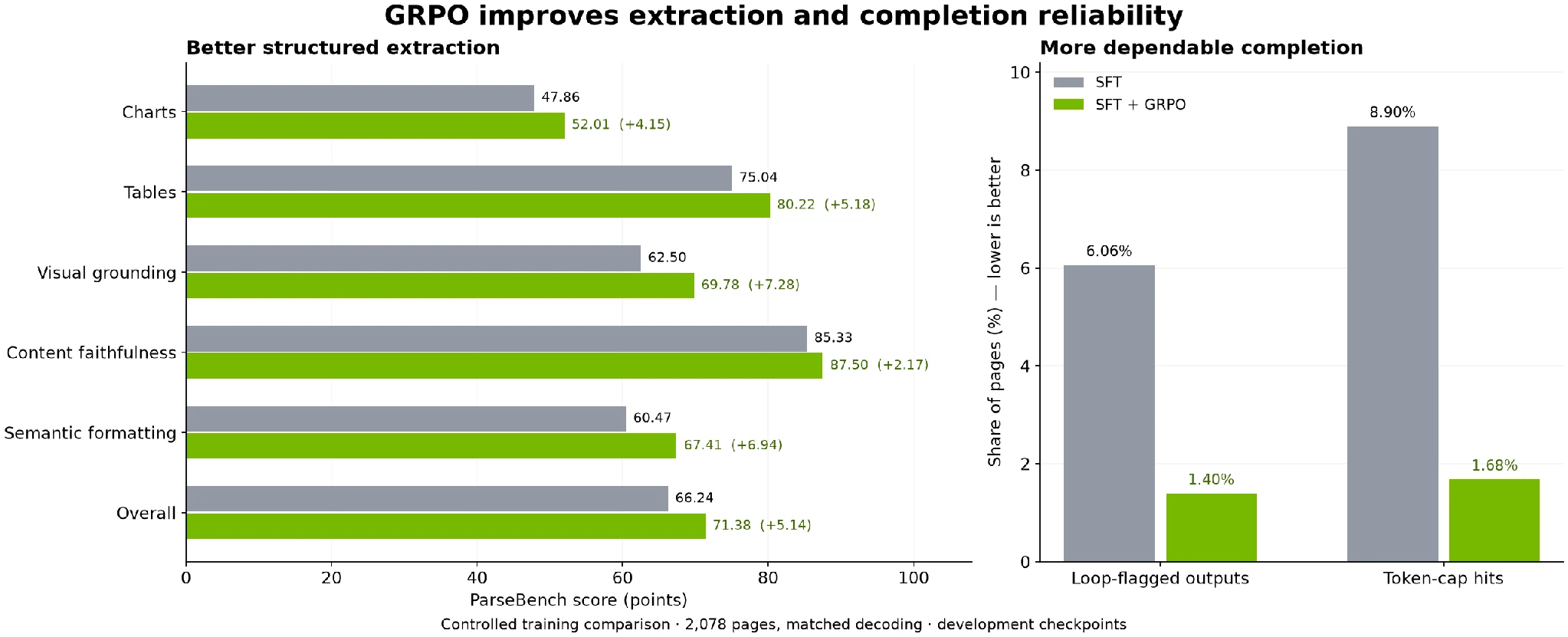
[1]The three datasets are large and specific. Synthetic Charts V1 has 9.98 million examples of rendered charts with structured labels for categories, series, and values. Synthetic Tables V1 has 1 million rendered HTML tables whose targets keep rows, columns, headers, and cell relationships. OCR Synthetic Multilingual v2 has 7.9 million synthetic pages in the Parse training format, across varied fonts and layouts. The post then reports a matched comparison of development checkpoints, which it says are separate from the final released model. After supervised fine-tuning, 126 pages were flagged for looping and 185 runs hit a 9,000-token limit. After reinforcement learning with verifiable rewards, using Group Relative Policy Optimization, those figures fell to 29 and 35. That is about 77% fewer loop-flagged pages. The overall score rose from 66.24 to 71.38, including a 5.18-point gain on tables and a 4.15-point gain on charts.
A second, narrower test shows the same split more clearly. NVIDIA shares a recipe that adapts Parse to a synthetic dental form with an odontogram, a tooth chart that marks planned procedures and tooth surfaces. Before adaptation, the model reads printed tooth numbers but misses the procedure table. After supervised fine-tuning, first-attempt success, reported as sampled pass@1, rose from 0.00% to 95.85% on 256 held-out forms from the same generator, with eight samples per page. Reinforcement learning then moved the number only to 96.58%. Success required a natural completion, exact chart content, and error-free normalized page text.
[1]Training comes in two stages. Supervised fine-tuning teaches the model to predict structured targets from text, layout, tables, charts, and multilingual pages. A document page often has more than one valid structured form, so a token-for-token target is a poor fit. The reinforcement stage, which the post calls RLVR, scores sampled extractions with checks. Those checks ask whether a chart recovers the right series and values, whether the structure is usable, and whether the model finishes without repeating itself. The model can reach a correct answer without copying one exact token sequence, but it is penalized for loops and unfinished output.
The inference work targets a different bottleneck. A parser has to emit a lot of text and structure for every page. Parse 3.5 replaces a fixed 2048 × 1664 canvas with NaViT dynamic rectangular inputs, feeds compressed visual tokens to the decoder as a prefix instead of encoder-decoder cross-attention, and uses grouped-query attention with 16 query heads and 8 key/value heads. A built-in multi-token prediction head supplies one-token lookahead. DFlash2 goes further. A small draft model proposes up to 32 tokens, and Parse checks them together. In the measured 32-token setup, it accepted about 14 draft tokens on average, or roughly 15 output tokens of progress per verification step, counting the target token.
On a native single-pass benchmark on one H200 in BF16, using the same 2,078 pages, DFlash2 raised throughput 7.62 times at concurrency 1, one request at a time, and 1.52 times at concurrency 512, with 512 requests in flight, compared with Parse 3.5 with speculative decoding turned off. At concurrency 512, Parse 3.5 reached 13.48 pages per second without speculation and 20.44 pages per second with DFlash2, against 2.98 pages per second for Parse 2.0. Those are 4.53 times and 6.86 times the Parse 2.0 throughput.
Cheaper decoding also makes a second look affordable. A single pass reads the whole page once. A double pass crops the tables and charts the first pass found and re-reads them at higher detail. A triple pass adds a detection pass to check that boxes were not missed, then re-extracts found charts and tables. In the published reference evaluation, double and triple pass added 2.18 and 2.46 ParseBench points over a single pass. The extra accuracy costs throughput, and the post presents that as a choice applications can make.
[1]All of these figures come from NVIDIA, on the lab's own development checkpoints, ParseBench protocol, and a synthetic dental generator. The post thanks Denis Ovchinnikov for independent performance validation of the vLLM integration, but it does not present a third-party re-run of the 126-to-29 loop comparison or of the dental pass@1 numbers. This article did not re-run those tests.
The dental result is also a narrow one. The held-out forms come from the same synthetic generator as the training data. A 0.00% to 95.85% jump after supervised fine-tuning shows that the recipe can teach a form the base model does not already know. It does not show how far that jump will travel on messy scanned hospital paperwork, or on layouts the generator never rendered.
The open datasets are large, but they are synthetic. They are designed so the model can reverse a rendering process whose ground truth is already known. That is a good way to teach charts that have no labeled numeric values, and tables whose row and column structure actually matters. It is not the same as a public audit of accuracy on real, messy PDFs.
[1]A fair reading is that NVIDIA is being unusually clear about what reinforcement learning is for in a parser. The lab does not claim that RLVR invented the ability to read a page. It claims that verifiable rewards cut loops and unfinished outputs, and that a modest score gain came with that cleanup. Opening the datasets and the NeMo Automodel plus NeMo RL recipe, with vLLM used to sample candidate answers, gives other teams a way to test that claim on their own documents, if they can supply image-label pairs and a verifier.
The product case is also straightforward. Document parsing is a generation-heavy job. If DFlash2 really delivers 7.62 times the throughput at concurrency 1 on one H200, then re-reading hard regions is no longer expensive. The double- and triple-pass gains of a little more than two ParseBench points only make sense if the first pass is already cheap. The inference stack is what makes those accuracy knobs usable.
[1]In the next six months, watch whether groups outside NVIDIA publish loop rates, token-limit hits, and ParseBench or equivalent scores with and without the RLVR stage, on documents they did not generate themselves. The sharper test of the dental recipe is not another 96% on held-out synthetic forms. It is whether a team with its own labels can move first-attempt success on a real form family by a similar margin after supervised fine-tuning alone, and whether reinforcement learning then adds anything material beyond cleaner completions.
[1]