
要点
- On 10 November 2026, the Yang-Mills group, chaired by David Gross, published Assessment 1 of OpenAI's 28 October 2026 Lean submission. In the group's words, the submission proves that a relativistic quantum field theory satisfying the Wightman axioms can be constructed as a scaling limit of four-dimensional Wilson lattice gauge theory for any simple compact gauge group.
- The same assessment says the submission does not prove that the infinite-volume limit is unique, or that there is a mass gap. Those two points are why the Clay Mathematics Institute's Yang-Mills existence and mass gap problem, one of seven Millennium Prize Problems, is not settled.
- David Louapre, writing on Hugging Face on 13 November, walks through the physics and lists further caveats from the group's first statement: the box-to-infinity limit is shown only along a subsequence, there is no proof of universality, and the construction gives no evidence for or against the mass gap.
- Louapre also reports that the reviewers wrote they do not fully understand the proof yet, that the first assessment is based on the Lean code only, not on OpenAI's 1,147-page manuscript, and that OpenAI's claimed existence proof for QCD, meaning Yang-Mills plus quarks, has not been released. The group's repository lists an OpenAI package dated 4 November 2026 as work in progress.
- Louapre notes that particle-physics predictions will not change. Physicists will keep using perturbative expansions and lattice simulations. What a complete proof would change is confidence that the theory behind the strong force is a consistent mathematical object, not only a successful recipe.
On 10 November 2026, a group chaired by the Nobel physicist David Gross published its first assessment of an OpenAI submission dated 28 October. In the group's own words, posted in its public results repository, the submission proves that a relativistic quantum field theory satisfying the Wightman axioms can be constructed as a scaling limit of four-dimensional Wilson lattice gauge theory, for any simple compact gauge group. It does not prove that the infinite-volume limit is unique, or that there is a mass gap.
The limits in those last two sentences are what matter. The Wightman axioms are the standard mathematical checklist for a quantum field theory to be well defined: a unique vacuum, energies that are never negative, compatibility with special relativity, and the rule that measurements too far apart to exchange a light signal do not influence each other. A scaling limit means you start from a well-defined theory on a discrete grid, then shrink the grid spacing toward zero in a controlled way. If that works in four dimensions for interacting Yang-Mills fields, it is a major existence result. It is still only half of the Clay Mathematics Institute's Yang-Mills problem, which also asks for a mass gap: a minimum mass for the particles the theory produces, which is why the strong nuclear force is short-range.
David Louapre, a physicist writing on Hugging Face on 13 November, is useful here because he translates the assessment into that distinction, and because he reports limits the repository's one-paragraph verdict does not spell out at the same length.
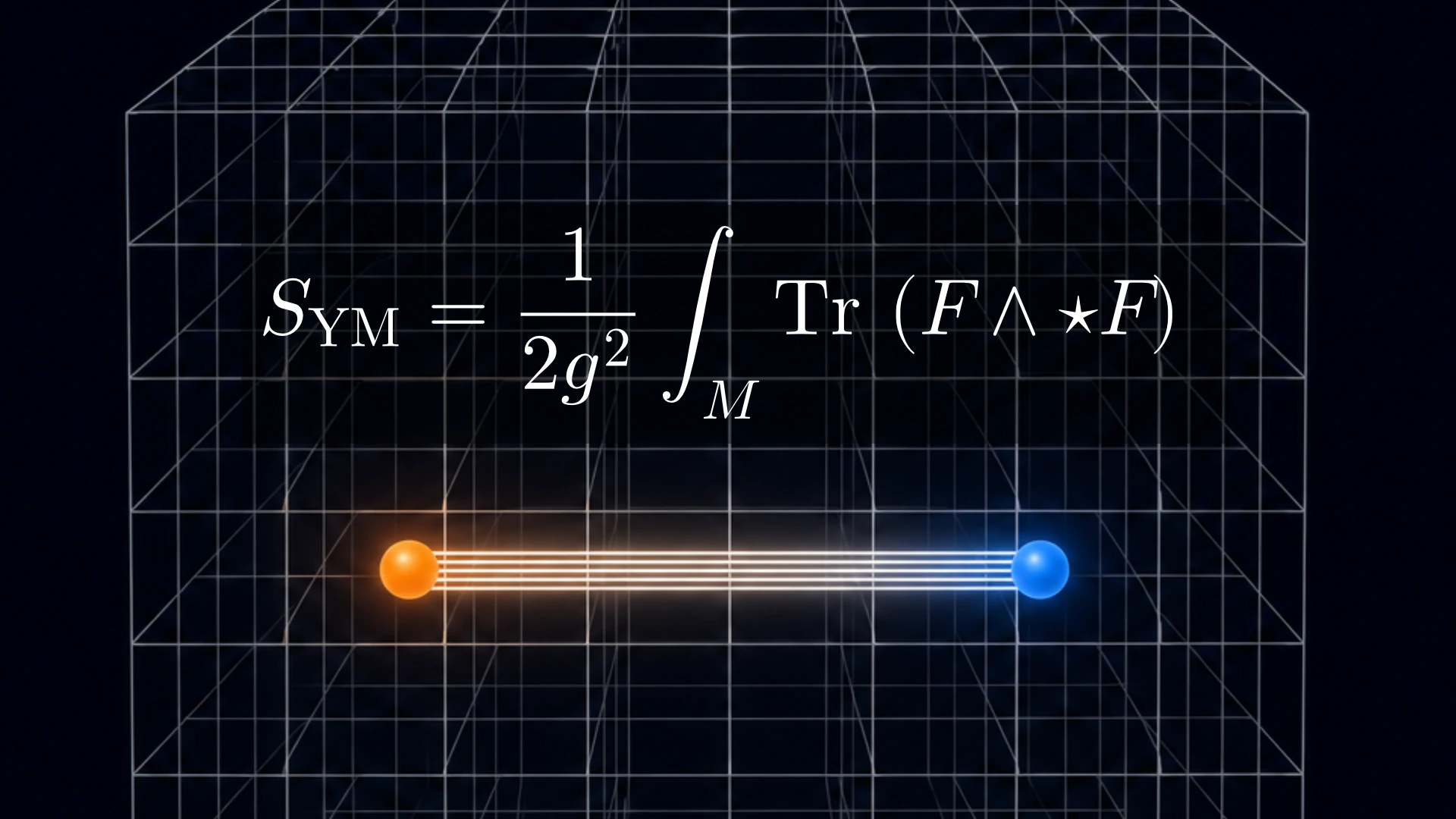
[1][2]The Clay problem is about pure Yang-Mills theory, the mathematical skeleton of the strong force, without quarks. In 1954, Chen Ning Yang and Robert Mills wrote a family of theories that includes electromagnetism as a special case and, with the group SU(3), the theory of gluons. Gluons are massless in the equations, just as photons are. A massless messenger usually means a long-range force, like electromagnetism. The strong force is not long-range. It acts over about the size of a proton.
Lattice simulations, following Kenneth Wilson's 1974 idea of putting the theory on a grid inside a finite box, have long suggested a way out. At long distances gluons interact so strongly that they cannot appear alone. In the pure theory they bind into glueballs, and those glueballs have a lowest mass, about 1.5 to 1.7 GeV in the numbers Louapre cites, roughly one and a half times the mass of a proton. That minimum mass is the mass gap. It is a quantum effect, and it disappears in the classical limit.
The existence half of the prize is to show that the continuum theory, after the grid spacing goes to zero and the box becomes infinitely large, is a real mathematical object and not a free theory with no interactions. The mass-gap half is to prove that this lowest mass is strictly greater than zero. Louapre reminds readers that interacting theories satisfying the Wightman axioms have been constructed in two and three spacetime dimensions, but that no interacting theory in four dimensions, the world we live in, had previously been shown to satisfy them.
[1][2]What, then, did the group accept? Louapre lists the points from the first statement. The grid-spacing-to-zero limit exists, for any compact simple group, and the coupling behaves as asymptotic freedom predicts, meaning the interaction gets weaker at shorter distances. That property earned David Gross, Frank Wilczek, and David Politzer the 2004 Nobel Prize, and it is one reason Gross is a natural chair for this review. The resulting theory satisfies the Wightman axioms, with a caveat that the limit might at first be a mixture of several phases, each of which is shown to be a proper quantum field theory. The theory is not a free theory in disguise. Louapre notes that classical Yang-Mills has no built-in scale, but in the quantum theory the running of the coupling breaks that scale symmetry and leaves a fingerprint in correlation functions that no free theory can copy.
The infinite-box limit is the weaker step. Louapre writes that it is shown only along a subsequence. His example is the sequence 1, -1, 1, -1. The whole sequence does not settle on a single value, but every other term does. Different subsequences can settle on different values. The proof, he says, cannot rule out something similar here, even though nobody expects it. There is also no proof of universality, meaning a different grid shape or a different way of writing the theory on the grid has not been shown to give the same continuum theory, and no proof that every way of letting the box grow leads to the same result.
The group's public summary is shorter and consistent with that account: a Wightman-axiom theory can be built as a scaling limit of four-dimensional Wilson lattice gauge theory for any simple compact group, and uniqueness of the infinite-volume limit and a mass gap are not proved.
[1][2]The assessment is also narrower than a casual reading of "OpenAI solved Yang-Mills" would suggest in two other ways.
First, the reviewers are not claiming to have digested the argument as a human would a journal paper. Louapre reports that they wrote they do not fully understand the proof yet, and that the first assessment is based on the Lean code only, not on the 1,147-page manuscript OpenAI produced. Lean is a language in which a computer checks every logical step. That is a genuine advantage over a pile of informal pages. It does not, by itself, guarantee that the definitions in the code are the objects mathematicians and physicists meant. Louapre's whole point is that this second check is still running. I have not independently read the manuscript, and I am relying on Louapre for its length and for the claim that it was not the basis of Assessment 1.
Second, the package that has been assessed is pure Yang-Mills. Louapre writes that OpenAI also claims an existence proof for QCD itself, Yang-Mills plus quarks, and that this has not been released. The group's repository lists a second OpenAI item dated 4 November 2026 as work in progress, and it tells proposers that results about QCD should be directed to a corresponding results repository. Until that package is public and assessed, it should not be folded into the 10 November verdict.
Louapre is also clear about what this does not change in the laboratory. Physicists will keep using perturbative expansions at short distances and lattice simulations at the scale of a proton. Their numerical predictions will not shift because a formal existence result landed. What a complete proof would change is confidence that the theory behind the strong force is a consistent mathematical object, and not only a very successful recipe.
[1][2]The fair counter is that "not the Millennium Prize" can be used to shrink a result that would have been the news of the decade even ten years ago. If the group's opinion holds up, this is the first construction of an interacting four-dimensional quantum field theory that meets the Wightman axioms, for every simple compact gauge group, with the short-distance coupling under control in the way asymptotic freedom requires, and with a proof that the limit is not a free theory. Lattice QCD practitioners have believed the continuum limit exists for a long time. Believing it and proving it in a machine-checked chain are different things.
It is also fair to say that OpenAI asked a serious group, not a marketing panel, to look at the formalization, and then put the Lean sources, the group's checks, and reproduction instructions in a public repository. That is a better process than dropping an unread formal dump and declaring a prize problem closed. The remaining gaps, uniqueness, universality, the mass gap, and the unreleased QCD claim, are now stated in official language rather than left for social media to invent.
[1][2]Over the next six months, the test is whether the group, or independent formalizers, close the subsequence and uniqueness issues, and whether anyone produces evidence on the mass gap from this construction, or shows why the construction cannot reach it. Watch also whether the 4 November QCD package is released and assessed in the same public way, and whether mathematicians who were not on the committee can reconstruct the argument from the Lean development and the 1,147-page manuscript, if and when they have both. If those steps stall, the honest headline stays the one the group already wrote: an existence result for a scaling limit, not a solution of the Millennium problem.
[1][2]