Wet labs: closed loops work; physical intuition still fails
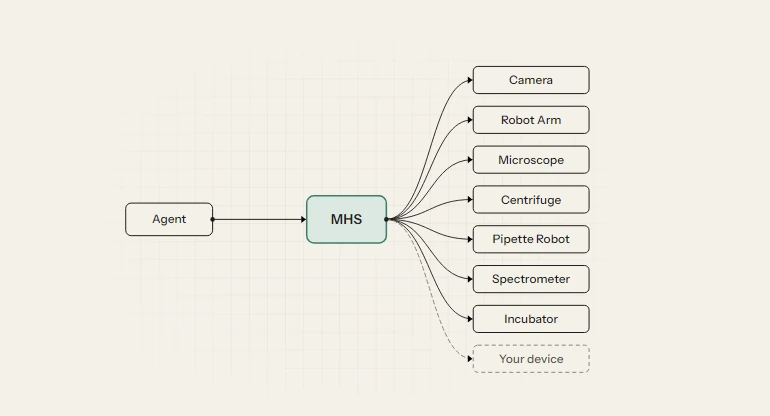
Genentech used MHS to orchestrate a BCA protein assay across a liquid handler, an arm, and a plate reader. Claude’s first pass used one flow rate for water and viscous BSA, which foamed. After trial transfers against an expert ground-truth well and RMSE scoring, it reported ~140 µL/s for water (RMSE 0.016) and ~10 µL/s for BSA (RMSE 0.181)—parameters experts called reasonable. It recovered from tip-pickup and fluid-detection errors on its own. When mixing created bubbles, its default was to retry the same well, which made more foam. Scientists had to explain that the fault was physical, requiring a clean well and gentler mixing. Their write-up is blunt: general reasoning is strong; intuition for physical, chemical, and biological constraints is not.
University of Washington Baker/Pinglay labs. PhD student Zihao Song put the cost gap on the page: designing a de novo protein can cost about $0.01, while testing one candidate is about $100 and a week of labor, at 1,000 candidates per round. He connected six instruments in under a week, drivers included: a remote dashboard; agent-watched qPCR that stops before the plateau and holds at 4°C; and a collision-free plate handoff between a LeRobot arm and a liquid handler (about 10 seconds after dispense). He also listed the bill still unpaid: harder protocols, and compute cost for long watches.
Carnegie Mellon reported serial-dilution dose–response about 3× faster. The stack is named: CyBio FeliX, Varioskan LUX, Spinnaker arm, cameras, orchestrated by Claude Opus 4.8. Drivers from scratch took about eight hours. Three computers meant a drop-folder scheduler, COM scripting, and a plate reader with no API at all—MHS drove the GUI. Six induced faults (missing plate, rotated plate, busy reader, dead camera, unreachable device, e-stop) were all blocked before motion. A 200 µg/mL top concentration saturated (R² < 0.9); the agent reran at 100 µg/mL (R² > 0.98) with no human in the loop. The analyte was a dye, not a drug candidate.
Tetsuwan wired MHS into ResearchOS for qPCR source-tracking of fecal contamination in San Pedro Creek, California. Early curves detected only human-associated markers (BacH/HF183). When a camera saw bubbles in master mix, Claude suggested via Slack moving the tube to a centrifuge. A compiler-tuning loop ran 9,143 dispenses and 300 transfer types; on held-out runs, multi-dispense precision predictions beat the vendor spec by about 12% (31 of 45, p≈0.001).