
DEEP Robotics sent a release through GlobeNewswire, and Markets Insider carried the full text. The visible clock on that page reads Oct. 24, 2026, 08:20 AM. The same page's structured publication time is 2026-10-24T14:20:39Z. No time zone is printed beside 08:20 AM. The release announces five research pieces in support of an embodied architecture it names DEEPRobotics-Brain, for robots that have to work where the surroundings change. The five are the DR-WM-1.0 world model, the DR-VLA-2.0 embodied foundation model, the DR-APO policy optimization framework, the DR-Agent embodied agent, and the DR-Benchmark data and evaluation platform. The named collaborators are the Massachusetts Institute of Technology, the University of California San Diego, the University of Illinois Urbana-Champaign, Tsinghua University, Zhejiang University, the Hong Kong University of Science and Technology, and the Beijing Institute of Technology. That list is the release's own. It is not a replication published by another laboratory.
[1]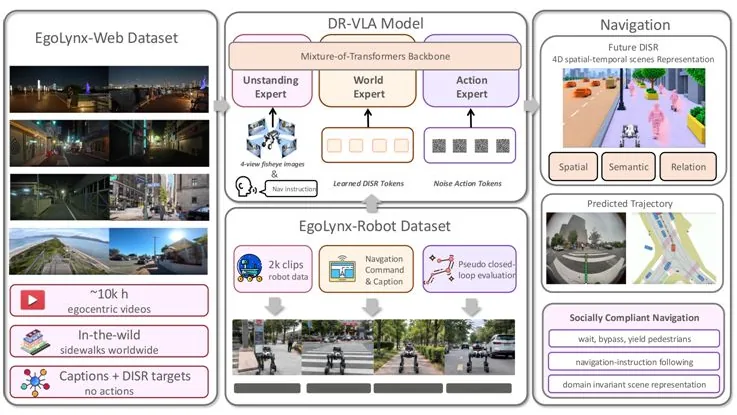
The clearest real-robot number is in the DR-APO section, which the release says was developed by DEEP Robotics and Zhejiang University. In embodied visual-navigation post-training, DR-APO raises the simulated success rate of pretrained NavDP from 70.33 percent to 89.55 percent, an increase of 19.22 percentage points. On the company's LYNX M20 wheel-legged robot, real-world navigation success rises from 25 percent to 65 percent, a gain of 40 percentage points. The same section says that across five MuJoCo-v5 continuous-control tasks, DR-APO records the best result in nine of ten diffusion-policy comparisons and in all ten flow-policy comparisons reported in the study. Those rankings are comparisons inside the study. The release says they do not depend on a critic picking among several candidate actions at inference time. For Gaussian policies, it says the result stays competitive with Soft Actor-Critic. The page does not say how many trials produced the 65 percent figure, and it does not describe the ground.
[1]The DR-VLA comparison is also the release's own. On the held-out EgoLynx-Robot test split, DR-VLA improves the Quadruped Navigation Score, called QNS, by approximately 5 percent and reduces open-loop final heading error by 14.6 percent. Each change is relative to the best competing result for that metric. The release says QNS combines safety, instruction compliance, comfort, and progress. On the data, the release says EgoLynx comprises 10,000 hours of curated egocentric web video and 2,000 teleoperated robot navigation clips. The hours and the clip count are the company's description of the set. The picture here is Figure 2 from the release. It marks about ten thousand hours of egocentric video and two thousand robot clips.
[1]The remaining measurements stay inside the same release. DR-WM-1.0 draws on 2.58 million image-mask pairs and more than 100,000 real-robot clips. Inspection of a substation after rain or snow is only an illustration, not a published inspection score. For manipulation, the release reports opposite-atom separation of 92.5 percent on single-atom prompts and 83.1 percent on two-atom prompts. On real bimanual tasks with unseen layouts, normalized task progress reaches 87.8 percent. With force feedback added, the drawer-and-plug task reaches 78.5 percent and vase wiping reaches 75.2 percent. The release says these evaluations improve on the tested baselines, including a fine-tuned π0.5. LynxScenes, collected with the LYNX M20, spans 833.6 hours and 3,294.7 kilometers. EvoWorld-Bench has 54 simulated scenes, 803,680 task instances, and about 239,000 dynamic state changes. The release says navigation success and search efficiency improved against the baselines, and it does not give the size of that gain.
[1]The preprints are placed in the research section of the DEEP Robotics Developer Center, and the address is printed on the page. The release does not say those preprints have finished independent peer review, and it does not say another laboratory reproduced the real-world move from 25 percent to 65 percent. The carrying page says the content is provided by DEEP Robotics and states that it does not verify whether the information is accurate. The five pieces sit under one architecture name. The page does not say they already run as one deliverable product at a customer's site.
[1]