
On 24 October 2026, Moonshot released Kimi K3.1 Pro, the first model in the K3.1 series. The stamp on the IT Home page is 2026/10/24 7:08:43, and the article says the release happened in the early hours of that day. That page calls it the most capable 3-trillion-parameter model so far, with a context of 1 million tokens. The official blog is dated 2026-10-24 and gives no clock. It calls the model the most capable 3T-class open-weight model to date, with a context of 1 million tokens. Kimi K3.1 Pro Highspeed came out at the same time. IT Home says the high-speed model has the same intelligence and about two to three times the output speed. The official blog only says the speed is two to three times that of K3.1 Pro, and does not repeat the claim of equal intelligence. The entrances listed by IT Home are kimi.com, the Kimi app, Kimi Work, Kimi Code, and the Kimi API. The official page lists Kimi.ai, Kimi Work, Kimi Code, and the Kimi API. Full weights are to be released before 4 November. The English line says by Nov 4. The file cannot be downloaded yet. The official page says enterprise administrators can turn it on, and that access is off by default at launch.
[1][2]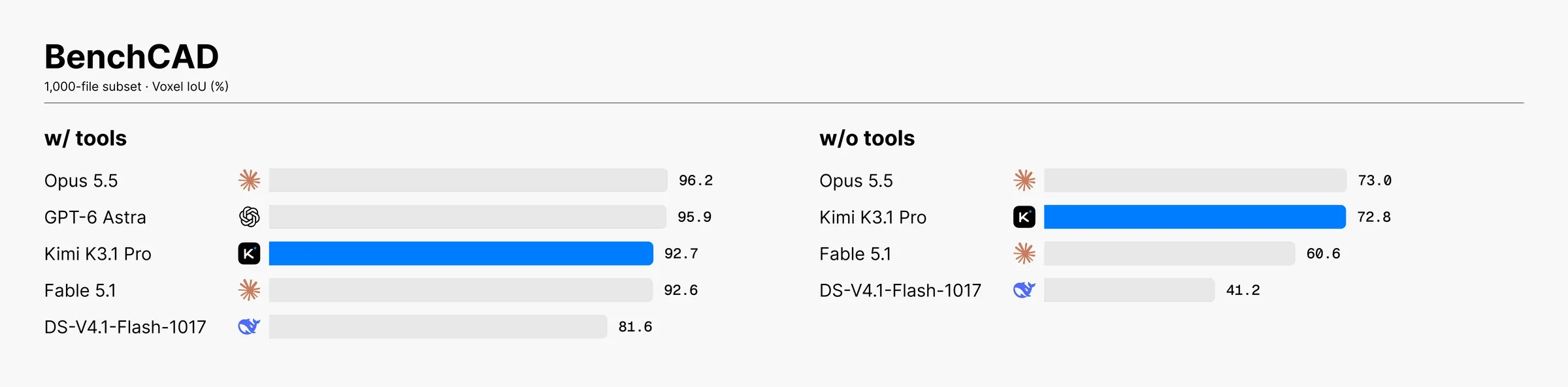
Several printed scores match across the two pages. Terminal-Bench 4.0 tests coding agents on realistic, resource-constrained terminal tasks. K3.1 Pro scores 65.7 percent, ahead of GPT-6 Astra at 58.2 percent and narrowly behind Claude Opus 5.5 at 66.4 percent. The official footnote says this result uses the Claude-Code harness, and that the remaining scores are the higher figure in each company's blog or on the official leaderboard. Unless the page says otherwise, the reported results use a reasoning effort of max, a temperature of 1.0, and a top-p of 0.95. The internal benchmark Kimi Code Bench 3.0 Long-horizon tests multi-step execution and end-to-end problem solving. K3.1 Pro scores 61.2 percent, against 55.95 percent for K3.
[1][2]BenchCAD reconstructs a 3D model from multi-view renderings by generating CAD code. With tools, K3.1 Pro scores 92.7 percent. The official page says that approaches Claude Opus 5.5 at 96.2 percent and GPT-6 Astra at 95.9 percent. Open models were scored on a 1,000-case subset drawn at random from the 17,900-case Vision2Code set. Results with tools use the Claude Code harness. Results without tools are single-shot generations that follow the official prompts. The chart above is the one on the official blog, and it places the two settings side by side.
[2]OfficeQA Pro v2 is 64.4. The benchmark tests complex analysis of real financial documents, including retrieval, checks across documents, and multi-step numerical reasoning. The official page calls the result the best current one. Kimi Hallu Bench Hard is an internal stress test of factual accuracy. The rate of errors in individual factual claims fell from 23.4 percent for K3 to 8.3 percent. The share of answers with at least one factual error was about 42.4 percent of the predecessor's rate. The page says the sample is aimed at cases where models slip, and that the reported rates are not an everyday error rate.
[1][2]The three finance comparisons do not collapse into one number. The official blog says financial modeling is 7.2 points above K3, financial research is 11.6 points above K3, and business operation is about 4.2 times K3. IT Home prints a 14 percent rise for modeling, a 20 percent rise for research, and about 4.2 times K3 for operations. The 4.2 times figure is the same on both pages. Fourteen percent is not 7.2 points, and 20 percent is not 11.6 points. The two pages are not using the same units, and the percentages are not a translation of the official points.
[1][2]The API price is the yuan figure printed by IT Home. The model kimi-k3.1-pro costs 1.3 yuan per million tokens on a cache hit, 13 yuan on a miss, and 68 yuan for output. The high-speed version is about two to three times as fast on output, at twice the price. The official page has no clock, so the time used here is the 7:08:43 stamp. The weights have a date on the page, and the file is not public yet. The pages do not attach the raw records.
[1]